
10 Best Product Design Books
The best product design books, ranked by expert source recommendations, with notes on who each suits, from usability basics to teamwork and communicating decisions.
Our take
Product design connects how something works with how people understand and experience it. These books focus mainly on digital products, while drawing on principles that also apply to physical objects. They help beginners learn usability, give working designers language for their decisions, and offer teams ways to test ideas before committing to a solution. Different books address different parts of that process.
The Design of Everyday Things provides a foundation in human-centered design, and Don't Make Me Think applies a concise usability perspective to websites. Emotional Design asks why people respond to products beyond their practical function. For team practice, Sprint offers a time-bounded workshop, while Lean UX connects ongoing design work with experiments and feedback. Articulating Design Decisions concentrates on explaining that work to other people. Start with Norman or Krug if the principles are unfamiliar, then choose the process or communication book that addresses your current project.
10 books · 7 sources · Last updated
As an Amazon Associate, we earn from qualifying purchases (at no extra cost to you).
How to choose from this list
Skip to the full rankingIf you're new to usability: The Design of Everyday Things → Don't Make Me Think
If you want a reference for design principles: Universal Principles of Design
If you want to understand emotional responses: Emotional Design
If your team needs to test an idea quickly: Sprint
If you're integrating design with Agile work: Lean UX
If you need to explain your decisions: Articulating Design Decisions
The 10 books, ranked
Ranked by how many expert sources name each book. Ties go to the book more people recommend.

The Design of Everyday Things
For beginners who want to understand why products confuse their users. Norman's everyday examples make human-centered principles tangible across physical and digital design, though the conceptual foundation does not teach a complete interface-design workflow.
What it's about
Don Norman examines why everyday objects can be difficult to use, locating many failures in design rather than their users. He connects human psychology with product design to explain how objects can better support understandable interaction.
Also recommended by
4 people Scott Adams recommended this book
Scott Adams
One of the books on Scott Adams' "Persuasion Reading List."
Scott Adams's recommendation of this book  Jeff Atwood recommended this book
Jeff Atwood
"Will give you a new appreciation of the 'devil in the details.'" - Jeff Atwood
Jeff Atwood's recommendation of this book  Tobi Lütke recommended this book
Tobi Lütke
Tobi Lütke mentioned this book on the "Invest Like the Best" podcast.
Tobi Lütke's recommendation of this book  Marissa Mayer recommended this book
Marissa Mayer
"Makes you think about design in new ways." - Marissa Mayer
Marissa Mayer's recommendation of this book

For designers examining why people return to a product repeatedly. Its compact behavioral model makes engagement patterns easy to discuss, though building habits needs ethical judgment and does not establish that a product provides lasting value.
What it's about
Nir Eyal explains a four-stage model for designing products that encourage repeated use. Examples and practical guidance help founders, designers, marketers, and product managers examine how technology influences behavior and how customer habits develop.
Also recommended by
1 person Marc Goodman recommended this book
Marc Goodman
One of Marc Goodman's answers to "sources you've learned from in the last year?"
Marc Goodman's recommendation of this book

100 Things Every Designer Needs to Know About People
For designers who want short explanations linking human behavior with design choices. Its modular format supports quick consultation more easily than a continuous argument, though individual findings need context before becoming rules for every user or interface.
What it's about
Susan Weinschenk connects cognitive, perceptual, and social psychology with everyday design decisions. Practical examples explain how people see, remember, process information, and respond to motivation, helping designers shape typography, interfaces, and interactions around human behavior.
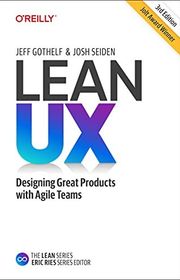
Lean UX
For designers working with development teams who need to learn through small experiments. Its collaborative approach connects design with delivery more directly than a principles book, though it requires organizational support and offers little detailed visual instruction.
What it's about
Jeff Gothelf and Josh Seiden describe a collaborative approach to user experience work in Agile teams. The book connects assumptions, hypotheses, prototypes, and feedback with shared outcomes, emphasizing experiments and learning instead of treating design documents as the main deliverable.
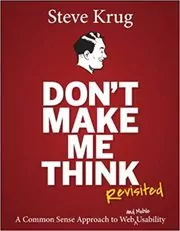
For designers who want to make websites easier to understand and navigate. Krug's concise examples translate usability principles into visible decisions, though the emphasis on web interactions offers less depth on discovery or broader product strategy.
What it's about
Steve Krug explains how to design websites people can navigate and understand with little effort. Using practical examples, he examines information design, scanning, usability testing, and mobile experiences, emphasizing clarity in everyday interactions.
Also recommended by
5 people Ev Williams recommended this book
Ev Williams
On the "books read" section of Ev Williams' GoodReads profile.
Ev Williams's recommendation of this book  Brian Armstrong recommended this book
Brian Armstrong
"A framework to simulate how customers experience your product, especially the moments of confusion." - Brian Armstrong
Brian Armstrong's recommendation of this book - Jeff Atwood recommended this book
Jeff Atwood
"The single best book on usability I've ever read." - Jeff Atwood
Jeff Atwood's recommendation of this book  Nick Ganju recommended this book
Nick Ganju
"About usability and making software and user interfaces that are friendly to people." - Nick Ganju
Nick Ganju's recommendation of this book  Garry Tan recommended this book
Garry Tan
"The simplest book I recommend everyone to read when they want to do design." - Garry Tan
Garry Tan's recommendation of this book

For teams that need a shared process for narrowing and testing an idea. Its daily structure makes a workshop more concrete than a general design-thinking discussion, though the format needs committed participants and adaptation to the problem.
What it's about
Knapp, Zeratsky, and Kowitz describe a five-day process for tackling difficult problems and testing ideas. Their design sprint guides teams from identifying a challenge through selecting a solution, building a prototype, and learning from customer responses before committing further resources.
Also recommended by
1 person Marty Cagan recommended this book
Marty Cagan
Marty Cagan mentioned this book on twitter.
Marty Cagan's recommendation of this book

The Laws of Simplicity
For readers who want to question what a product truly needs. Maeda's brief principles encourage reflection across design and technology, though their abstraction offers less direct instruction than a usability guide or a detailed project method.
What it's about
John Maeda presents ten principles for balancing simplicity and complexity in design, technology, business, and daily life. He explores reduction, organization, and meaningful additions while acknowledging that some problems resist simplification.
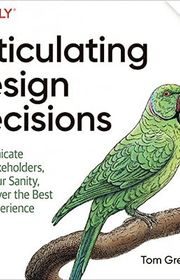
Articulating Design Decisions
For designers whose work needs clearer discussion with stakeholders. Greever gives meetings, feedback, and explaining decisions more attention than the craft-focused books, though the communication methods still depend on sound design reasoning and understanding the audience.
What it's about
Tom Greever examines how designers explain their work and discuss decisions with stakeholders. The book covers preparation, listening, feedback, meetings, and follow-through, connecting communication habits with the practical task of gaining shared understanding around a design.
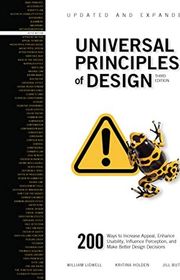
Universal Principles of Design
For designers who want a broad reference of concepts to revisit during projects. The illustrated entries make unfamiliar principles easy to locate, though the breadth and brevity mean each concept needs checking against the specific design context.
What it's about
William Lidwell, Kritina Holden, and Jill Butler organize design principles into illustrated reference entries. Examples connect ideas from perception, psychology, engineering, and usability with decisions about how products, environments, and information are shaped and understood.
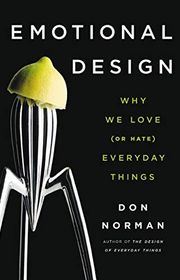
Emotional Design
For designers who want to understand why usefulness alone does not explain people's attachment to products. Norman expands the discussion into emotion and identity, though the framework is more conceptual than a practical guide to testing specific interfaces.
What it's about
Don Norman explores how emotion shapes the way people perceive, use, and remember products. He distinguishes visceral, behavioral, and reflective responses, using examples to examine the relationships among appearance, function, pleasure, identity, and personal meaning.
Sources
- 1
The 10 Best Product Design Books
shopify.com
- 2
UX, product design and critical design books
theuxologist.com
- 3
Product design books
lyssna.com
- 4
17 Best Product Design Books To Make You A Finer Designer
cpoclub.com
- 5
Product Design Books
goodreads.com
- 6
100 Best Product Design Books of All Time (Updated for 2026)
shortform.com
- 7
Books recommendation
reddit.com




Edited by
Software engineer whose passion for tracking book recommendations from podcasts inspired the creation of MRB.
Lead investor at 3one4 Capital whose startup expertise and love for books helped shape MRB and its growth.
Comments
Did we miss something? Have feedback?
Help us improve this page by sharing your thoughts