
12 Best Economics Books
The best economics books, ranked by how many expert sources recommend each one, with notes on reader fit, different perspectives, and where to begin.
Our take
Economics studies how people and institutions use limited resources, and what follows from the choices they make. The books here range from approachable explanations of prices and incentives to arguments about capitalism, inequality, and national prosperity. Some introduce a way of thinking through everyday examples. Others ask readers to follow a historical or political argument across a much longer stretch of time.
Naked Economics offers a broad introduction without making equations the main attraction, while The Undercover Economist starts with familiar markets and everyday prices. Freakonomics explores surprising questions through incentives and data, and Thinking, Fast and Slow turns toward the psychology of judgment. For a different route, The Worldly Philosophers introduces major thinkers before you tackle The Wealth of Nations or Das Kapital. Poor Economics concentrates on poverty and evidence from particular interventions, while Why Nations Fail makes a broader argument about institutions. Start with Naked Economics, then follow the question that interests you most.
12 books · 10 sources · Last updated
As an Amazon Associate, we earn from qualifying purchases (at no extra cost to you).
How to choose from this list
Skip to the full rankingIf you're new to economics: Naked Economics → The Undercover Economist
If you like everyday puzzles: Freakonomics → The Armchair Economist
If you want the history of ideas: The Worldly Philosophers → The Wealth of Nations → Das Kapital
If you want to understand poverty: Poor Economics → Why Nations Fail
If you want to examine decisions: Thinking, Fast and Slow
If you want financial history: Manias, Panics, and Crashes
The 12 books, ranked
Ranked by how many expert sources name each book. Ties go to the book more people recommend.

For newcomers who enjoy unexpected questions, Levitt and Dubner make incentives and data analysis feel approachable. Its short investigations encourage economic curiosity, though the selective case studies do not build a systematic introduction to the subject.
What it's about
Steven D. Levitt and Stephen J. Dubner use economic reasoning to investigate unexpected questions about everyday life. Their accounts of cheating, crime, parenting, and real estate explore incentives and challenge familiar explanations of how people behave.
Also recommended by
3 people Daymond John recommended this book
Daymond John
"I love newer books like [this book]." - Daymond John
Daymond John's recommendation of this book  James Altucher recommended this book
James Altucher
James Altucher mentioned this book on "The Tim Ferriss Show" podcast.
James Altucher's recommendation of this book  Ev Williams recommended this book
Ev Williams
On the "books read" section of Ev Williams' GoodReads profile.
Ev Williams's recommendation of this book

Thinking, Fast and Slow
For readers interested in the assumptions behind economic choices, Kahneman explores judgment and bias in more depth than the everyday economics books. The psychological focus is useful, though it will not teach markets or macroeconomic policy.
What it's about
Kahneman explores two modes of thought: quick, intuitive responses and slower, deliberate reasoning. Drawing on psychological research, he examines how biases and impressions shape decisions, and when intuition helps or misleads in personal and professional life.
Also recommended by
19 people Bill Gates recommended this book
Bill Gates
List of books Bill Gates read in 2012.
Bill Gates's recommendation of this book  Ray Dalio recommended this book
Ray Dalio
Ray Dalio mentioned this book in his book, "Principles."
Ray Dalio's recommendation of this book  Scott Adams recommended this book
Scott Adams
One of the books on Scott Adams' "Persuasion Reading List."
Scott Adams's recommendation of this book  Naval Ravikant recommended this book
Naval Ravikant
"Fine book but it didn’t need to be an entire book. A blog post would have gotten the point across." - Naval Ravikant
Naval Ravikant's recommendation of this book - Ev Williams recommended this book
Ev Williams
"I love surprising scientific findings, as well as information about how our brains work. [This book] is a treasure trove of both." - Ev Williams
Ev Williams's recommendation of this book  Marc Andreessen recommended this book
Marc Andreessen
"Captivating dive into human decision making, marred by inclusion of several/many? psychology studies that fail to replicate. Will stand as a cautionary tale?" - Marc Andreessen
Marc Andreessen's recommendation of this book +13
More recommendations
- Stewart Brand
Stewart Brand recommended this book on his "Selected Books for the Manual for Civilization" blog post.
- Bryan Johnson
"I started reading [this book] and I became increasingly convinced of my own fickleness and inability to actually act rationally in life." - Bryan Johnson
- Derek Sivers
"If you liked 'Predictably Irrational' or 'Stumbling on Happiness' or any of those pop-psychology books, well, this is the Godfather of all of their work." - Derek Sivers
- Sam Altman
One of Sam Altman's answers to "What are some of the best books you recommend for a young startup founder?"
- Ron Conway
"Covers all three phases of [the author's] career: his early days working oncognitive bias, his work on prospect theory, and his later work on happiness." - Ron Conway
- Jason Fried
"I enjoyed [this book]. Fascinating." - Jason Fried
- Nassim Taleb
"A landmark book in social thought, in the same league as The Wealth of Nations by Adam Smith and The Interpretation of Dreams by Sigmund Freud." - Nassim Taleb
- Sahil Lavingia
Sahil Lavingia recommended this book on Notion.
- Mark Manson
Mark Manson recommended this book on his website.
- Jay Shetty
"[One] of my favourite books." - Jay Shetty
- Michiko Kakutani
"Has become essential reading in many baseball front offices and among coaching staffs." - Michiko Kakutani
- Preston Pysh
"An incredible book!" - Preston Pysh
- Ben Greenfield
Most Recommended Books reached out to Ben Greenfield directly.
- Stewart Brand

The Undercover Economist
Exposing Why the Rich Are Rich, the Poor Are Poor - and Why You Can Never Buy a Decent Used Car!
For beginners who want to understand prices and markets through recognizable situations, Harford builds intuition from everyday observations. Its conversational explanations make abstract ideas easier to grasp, though it offers less of a structured course than a textbook.
What it's about
Tim Harford uses everyday questions about coffee prices, traffic and health care to introduce economic ideas. He explains how money, incentives and markets shape who gets what, while considering the differences between economic efficiency and a fair society.
Also recommended by
1 person- Naval Ravikant recommended this book
Naval Ravikant
Naval Ravikant mentioned this book on "The Knowledge Project with Shane Parrish" podcast.
Naval Ravikant's recommendation of this book

The Wealth of Nations
For readers interested in where classical economics began, Smith offers a broad inquiry into production, trade, and institutions. Its historical importance rewards close reading, though the eighteenth century prose makes it a demanding first introduction.
What it's about
Adam Smith examines how economic prosperity arises through labor, exchange, competition, and capital. First published in 1776, his study considers wages, trade, taxation, and the role of government within a broader account of national wealth.
Also recommended by
8 people Elon Musk recommended this book
Elon Musk
"Adam Smith FTW obv." - Elon Musk
Elon Musk's recommendation of this book - Naval Ravikant recommended this book
Naval Ravikant
Naval Ravikant's answer to "any good book about economy for a beginner?"
Naval Ravikant's recommendation of this book  Neil deGrasse Tyson recommended this book
Neil deGrasse Tyson
"To learn that capitalism is an economy of greed, a force of nature unto itself." - Neil deGrasse Tyson
Neil deGrasse Tyson's recommendation of this book  Nick Szabo recommended this book
Nick Szabo
"[One] of the most important books I’ve read." - Nick Szabo
Nick Szabo's recommendation of this book  Noam Chomsky recommended this book
Noam Chomsky
On the "Top 100 Books Referenced by Noam Chomsky" list.
Noam Chomsky's recommendation of this book  Brandon Stanton recommended this book
Brandon Stanton
Brandon Stanton mentioned this book on "The Tim Ferriss Show" podcast.
Brandon Stanton's recommendation of this book +2
More recommendations
- Bill Gurley
"[The author]'s magnum opus." - Bill Gurley
- Patrick Bet-David
Patrick Bet-David recommended this book on his website.
- Bill Gurley

For readers seeking a broad first introduction without heavy mathematics, Wheelan connects core concepts with practical policy questions. Its accessible sweep helps build a foundation, though formal models and quantitative practice require a more technical follow up.
What it's about
Charles Wheelan explains economic ideas through familiar situations rather than equations. His account connects incentives, markets, trade, and public policy with contemporary debates over inequality, automation, financial crises, and the choices people and governments make.
Also recommended by
1 person Mr. Money Mustache recommended this book
Mr. Money Mustache
"This book’s claim to fame is that it uses absolutely no graphs or numbers when explaining economics. It’s also moderately funny at times." - MMM
Mr. Money Mustache's recommendation of this book
The Worldly Philosophers
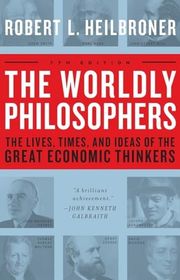
For readers who find economic theories easier to understand through people and historical circumstances, Heilbroner supplies a readable route into major thinkers. The biographical approach provides context, though it cannot replace studying their arguments in full.
What it's about
Heilbroner introduces influential economic thinkers through their lives, historical settings, and central arguments. The changing effort to understand capitalist society links contrasting ideas about markets, social conflict, growth, and the organization of economic life.

For readers studying critiques of capitalism, Marx offers a sustained theoretical argument about production, labor, and accumulation. Its influence makes it valuable historical reading, though the dense conceptual framework requires patience and benefits from a companion introduction.
What it's about
Karl Marx examines capitalist production and the economic relations that structure bourgeois society. His critique investigates how capitalism operates, developing an analysis of labor, exchange, and the organization of economic power.
Also recommended by
2 people- Elon Musk recommended this book
Elon Musk
"Read [this book] when I was 14." - Elon Musk
Elon Musk's recommendation of this book - Noam Chomsky recommended this book
Noam Chomsky
On the "Top 100 Books Referenced by Noam Chomsky" list.
Noam Chomsky's recommendation of this book

For readers asking why prosperity differs between countries, this presents an institution centered argument through historical comparisons. The broad framework connects politics with economics, though its emphasis on one explanation invites comparison with competing accounts of development.
What it's about
Daron Acemoglu and James Robinson examine why countries follow different paths toward prosperity or poverty. Historical comparisons support their argument that political and economic institutions, rather than geography or culture alone, shape national development and opportunity.
Also recommended by
2 people Mark Zuckerberg recommended this book
Mark Zuckerberg
"Explores the different kinds of social institutions and incentives that nations have applied to encourage prosperity, economic development and elimination of poverty." - Mark Zuckerberg
Mark Zuckerberg's recommendation of this book - Bill Gates recommended this book
Bill Gates
"A major disappointment. I found the authors’ analysis vague and simplistic." - Bill Gates
Bill Gates's recommendation of this book

For readers who want development debates grounded in specific evidence, Banerjee and Duflo examine decisions facing people living in poverty. The close attention to interventions is valuable, though local findings do not automatically establish universal policy answers.
What it's about
Abhijit Banerjee and Esther Duflo examine poverty through evidence about the lives and choices of poor people. They discuss how randomized trials and close attention to actual outcomes can challenge assumptions behind development policy and charitable aid.
Also recommended by
1 person- Bill Gates recommended this book
Bill Gates
"Does a great job of bringing alive the complexities of poor people’s lives." - Bill Gates
Bill Gates's recommendation of this book

For readers who enjoy testing everyday assumptions, Landsburg develops incentive based arguments through puzzles and provocative examples. Its logical approach complements more empirical books, though the conclusions depend on assumptions that readers should examine rather than accept automatically.
What it's about
Steven Landsburg uses economic reasoning to explore everyday decisions and public debates. Through examples involving incentives, advertising, and policy, he shows how apparently puzzling behavior can become clearer when viewed in terms of costs and benefits.

For readers who want recurring financial crises placed in historical context, this connects speculative enthusiasm with credit and institutional responses. The comparative approach reveals patterns across episodes, though it assumes more financial vocabulary than an introductory economics book.
What it's about
Robert Aliber and Charles Kindleberger examine the recurring patterns behind speculative booms, financial panics, and market crashes. Historical cases reveal how credit, investor behavior, and international connections contribute to crises, with this edition extending the account to more recent upheavals.
Also recommended by
1 person Raoul Pal recommended this book
Raoul Pal
Raoul Pal recommended this book on Twitter.
Raoul Pal's recommendation of this book

The Affluent Society
For readers questioning the balance between private consumption and public provision, Galbraith offers a clear, argumentative perspective on prosperity. Its social criticism remains useful for comparison, though the examples and economic setting reflect midcentury America.
What it's about
John Kenneth Galbraith questions an economy organized around ever greater production and private consumption. He argues that advertising manufactures wants while public services remain neglected, examining the tensions between material abundance, inequality, and collective social needs.
Sources
- 1
10 Business & Economics Books Every Student Should Read
oxfordscholastica.com
- 2
Must-Read Economics Books
american.edu
- 3
Top 10 Best Economics Books
inomics.com
- 4
7 books to read if you’re an economics student
topuniversities.com
- 5
Recommended reading for economic students
economicshelp.org
- 6
Economics Books
goodreads.com
- 7
Suggested Readings in Economics
some.ox.ac.uk
- 8
Book recommendations related to economics
reddit.com
- 9
The 12 Best Books on Economics
markmanson.net
- 10
What are the best Economics Textbooks for a Beginner?
reddit.com






Edited by
Software engineer whose passion for tracking book recommendations from podcasts inspired the creation of MRB.
Lead investor at 3one4 Capital whose startup expertise and love for books helped shape MRB and its growth.
Comments
Did we miss something? Have feedback?
Help us improve this page by sharing your thoughts