
11 Best Microeconomics Books
The best microeconomics books, ranked by how many expert sources recommend each one, with notes for beginners, intermediate students, and graduate theory study.
Our take
Microeconomics studies how people and firms make choices, how markets coordinate them, and what changes when information, competition, or incentives are imperfect. The books here range from readable examples of economic reasoning to textbooks that develop models step by step. Their biggest difference is the background they expect. An introductory course may rely mainly on words, graphs, and algebra; advanced theory requires much more mathematical preparation.
Mankiw's Principles of Microeconomics offers a conventional starting point, while Freakonomics explores selected questions through stories rather than a full curriculum. Intermediate Microeconomics builds a more analytical foundation. Pindyck and Rubinfeld's Microeconomics connects models with applications, and Perloff's calculus-based text makes the mathematical route explicit. For graduate study, Advanced Microeconomic Theory and Mas-Colell, Whinston, and Green's Microeconomic Theory require sustained formal work. Start with the level your background supports, and if you are taking a course, match its textbook and edition before choosing an additional perspective.
11 books · 9 sources · Last updated
As an Amazon Associate, we earn from qualifying purchases (at no extra cost to you).
How to choose from this list
Skip to the full rankingIf you're studying the basics: Principles of Microeconomics
If you want economic questions without a textbook: Freakonomics
If you're ready for intermediate models: Intermediate Microeconomics
If you want applied intermediate study: Microeconomics (Robert S. Pindyck and Daniel L. Rubinfeld)
If you want a calculus-based course: Microeconomics (Jeffrey M. Perloff)
If you're preparing for graduate theory: Advanced Microeconomic Theory → Microeconomic Theory (Andreu Mas-Colell, Michael Whinston, and Jerry Green)
The 11 books, ranked
Ranked by how many expert sources name each book. Ties go to the book more people recommend.

Principles of Microeconomics
For first-time students who want an orderly introduction to economic reasoning. Clear explanations and familiar examples make the basic models approachable, though readers seeking deeper mathematics or a wider debate about economic methods will need other books alongside it.
What it's about
N. Gregory Mankiw introduces core microeconomic principles through clear explanations and meaningful examples. The textbook helps beginning students connect economic ideas with everyday situations, emphasizing the essential concepts needed to understand decisions made by individuals and businesses.

Microeconomic Theory
For graduate students who need a broad, rigorous reference in microeconomic theory. Its formal treatment brings many areas into one framework, though the density and mathematical prerequisites make it a poor starting point for readers still building basic intuition.
What it's about
Andreu Mas-Colell, Michael Whinston, and Jerry Green develop a mathematical treatment of microeconomic theory. Individual choice and game theory lead into market failure, general equilibrium, welfare economics, and incentives, with a mathematical appendix supporting the formal analysis.
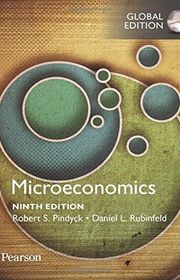
Microeconomics
For intermediate students who want theory tied closely to business and policy applications. The examples help connect models with recognizable decisions, though the broad textbook coverage still calls for sustained problem-solving rather than the lighter approach of popular economics.
What it's about
Robert Pindyck and Daniel Rubinfeld explain consumer and firm behavior, market structures, pricing, uncertainty, and public policy. The textbook connects microeconomic models with business and economic examples, showing how analytical tools can be applied to practical questions.
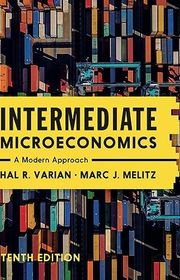
Intermediate Microeconomics
For students moving beyond introductory supply and demand into a more analytical course. Its focus on economic reasoning develops intuition alongside models, though readers need to work carefully through the diagrams and problems rather than treat it as a quick overview.
What it's about
This textbook develops intermediate microeconomics through consumer and producer choices, markets, strategic behavior, and information. Models and examples explain how economic decisions fit together, with mathematical material supporting a more systematic study of incentives and resource allocation.

For intermediate students who want calculus applied directly to economic questions. Worked problems link formal tools with applications, though this version requires calculus and should not be confused with Perloff's separate text for readers taking a less mathematical course.
What it's about
Jeffrey M. Perloff teaches intermediate microeconomics through calculus, algebra, and graphs, connecting formal theory with applications. Worked problems and analysis of real situations show how mathematical tools can be used to examine markets and economic decisions.

For curious readers who want to see how incentives can illuminate unexpected questions. Its stories make economic inquiry engaging without textbook prerequisites, though the selective cases and provocative arguments do not provide a systematic foundation in microeconomic theory.
What it's about
Steven D. Levitt and Stephen J. Dubner use economic reasoning to investigate unexpected questions about everyday life. Their accounts of cheating, crime, parenting, and real estate explore incentives and challenge familiar explanations of how people behave.
Also recommended by
3 people Daymond John recommended this book
Daymond John
"I love newer books like [this book]." - Daymond John
Daymond John's recommendation of this book  James Altucher recommended this book
James Altucher
James Altucher mentioned this book on "The Tim Ferriss Show" podcast.
James Altucher's recommendation of this book  Ev Williams recommended this book
Ev Williams
On the "books read" section of Ev Williams' GoodReads profile.
Ev Williams's recommendation of this book

For advanced readers who want the assumptions behind choice and competitive markets examined closely. Kreps combines formal arguments with attention to their meaning, though the mathematical demands are substantial and this first volume covers only part of microeconomics.
What it's about
David M. Kreps develops the foundations of individual choice, prices, and competitive markets with detailed mathematical arguments. Explanations examine the interpretation and motivation of the theories, while appendices review the mathematics used, including dynamic programming.

For students who want calculus-based theory developed through both mathematical and graphical reasoning. The extensions and graded problems support deeper study than an introductory text, though working through the analysis takes more time and mathematical preparation.
What it's about
Walter Nicholson and Christopher Snyder develop microeconomic models through a calculus-based approach for advanced students. Graphical explanations connect mathematical and geometric treatments, while applications and exercises progress from numerical problems toward more analytical, theoretical, and behavioral questions.

Microeconomics
For beginners who learn well through models connected with contemporary examples. The coauthored introduction builds intuition about markets and policy, though its broad course coverage requires exercises and sustained study rather than casual reading alone.
What it's about
Paul Krugman and Robin Wells explain how individuals, firms, and markets allocate resources. This introductory textbook uses economic models and examples to examine supply and demand, incentives, market power, externalities, and the choices behind economic activity.

Advanced Microeconomic Theory
For advanced students who want a focused bridge into formal microeconomic theory. Its structured development offers a more contained route than the largest graduate reference, though the arguments and exercises require mathematical maturity and prior exposure to microeconomics.
What it's about
Geoffrey Jehle and Philip Reny develop advanced microeconomic theory through consumer and producer behavior, equilibrium, welfare, game theory, and information. Mathematical explanations and exercises build the formal tools needed to analyze decisions and interactions across these areas.

For intermediate readers who want to approach markets through firms' pricing decisions. Beginning with monopoly creates a different route into competition and strategic behavior, though the unconventional sequence may not align with a course built around a standard textbook.
What it's about
Rakesh V. Vohra begins intermediate microeconomics with monopoly and the trade-off between profit margins and sales volume. He then develops imperfect competition and Nash equilibrium before addressing perfect competition, externalities, and the problems involved in providing public goods.
Sources
- 1
The Best Microeconomic Books | INOMICS
inomics.com
- 2
Microeconomics Books - 10 Best Textbooks [Updated 2026]
wallstreetmojo.com
- 3
The 10 Best Microeconomics Books - Value of Stocks
valueofstocks.com
- 4
Top 10 Microeconomics Textbooks | Video Review
wiki.ezvid.com
- 5
Microeconomics Books
goodreads.com
- 6
Adapting Microeconomics Courses – Economy Studies
economystudies.com
- 7
List of Fundamentals Graduate textbooks.
reddit.com
- 8
Economics Reading List: University Textbooks & Study Guides
unireadinglist.com
- 9
MICROECONOMICS TUTORIALS: YEAR 1
seh.ox.ac.uk







Edited by
Software engineer whose passion for tracking book recommendations from podcasts inspired the creation of MRB.
Lead investor at 3one4 Capital whose startup expertise and love for books helped shape MRB and its growth.
Comments
Spotted a missing book, a wrong order or a mistake? Tell us and we'll fix this page.
We're a reading guide, not the author or publisher, so we can't send books or pass on messages.