
21 Best Behavioral Psychology Books
The best behavioral psychology books, ranked by how many expert sources recommend each one, with notes for readers exploring decisions, habits, and change.
Our take
Books about behavior work at different levels. Some explain learning and the influence of the environment; others examine judgment, biology, motivation, or the organization of choices. Practical guides turn selected ideas into approaches for personal habits, workplaces, and products. These books are most useful when you distinguish an author’s explanatory framework from a technique that still needs testing in a particular setting.
For the behaviorist tradition, Science and Human Behavior and About Behaviorism offer historical foundations. Thinking, Fast and Slow explores judgment, while Behave takes a much longer biological view. The Power of Habit explains ideas through reported stories, and Atomic Habits organizes practical suggestions around repeated actions. How to Change matches strategies with different obstacles. For organizations, Switch and Upstream shift attention toward circumstances and systems; Designing for Behavior Change focuses on products. Start with the question you want to answer, then choose a second perspective that challenges or extends the first rather than expecting one book to explain every kind of behavior.
21 books · 10 sources · Last updated
As an Amazon Associate, we earn from qualifying purchases (at no extra cost to you).
How to choose from this list
Skip to the full rankingIf you want behaviorist foundations: Science and Human Behavior → About Behaviorism
If you want to examine habits and personal change: The Power of Habit → Atomic Habits → How to Change
If you want judgment and choice: Thinking, Fast and Slow → Nudge
If you want a biological explanation of behavior: Behave
If you want organizational change: Switch → Upstream
If you want to apply the ideas to products: Designing for Behavior Change
The 21 books, ranked
Ranked by how many expert sources name each book. Ties go to the book more people recommend.

Thinking, Fast and Slow
For readers who want a substantial account of judgment, intuition, and recurring errors. The linked examples make abstract ideas memorable, but the long argument and earlier research context call for more careful reading than a quick practical checklist.
What it's about
Kahneman explores two modes of thought: quick, intuitive responses and slower, deliberate reasoning. Drawing on psychological research, he examines how biases and impressions shape decisions, and when intuition helps or misleads in personal and professional life.
Also recommended by
19 people Bill Gates recommended this book
Bill Gates
List of books Bill Gates read in 2012.
Bill Gates's recommendation of this book  Ray Dalio recommended this book
Ray Dalio
Ray Dalio mentioned this book in his book, "Principles."
Ray Dalio's recommendation of this book  Scott Adams recommended this book
Scott Adams
One of the books on Scott Adams' "Persuasion Reading List."
Scott Adams's recommendation of this book  Naval Ravikant recommended this book
Naval Ravikant
"Fine book but it didn’t need to be an entire book. A blog post would have gotten the point across." - Naval Ravikant
Naval Ravikant's recommendation of this book  Ev Williams recommended this book
Ev Williams
"I love surprising scientific findings, as well as information about how our brains work. [This book] is a treasure trove of both." - Ev Williams
Ev Williams's recommendation of this book  Marc Andreessen recommended this book
Marc Andreessen
"Captivating dive into human decision making, marred by inclusion of several/many? psychology studies that fail to replicate. Will stand as a cautionary tale?" - Marc Andreessen
Marc Andreessen's recommendation of this book +13
More recommendations
- Stewart Brand
Stewart Brand recommended this book on his "Selected Books for the Manual for Civilization" blog post.
- Bryan Johnson
"I started reading [this book] and I became increasingly convinced of my own fickleness and inability to actually act rationally in life." - Bryan Johnson
- Derek Sivers
"If you liked 'Predictably Irrational' or 'Stumbling on Happiness' or any of those pop-psychology books, well, this is the Godfather of all of their work." - Derek Sivers
- Sam Altman
One of Sam Altman's answers to "What are some of the best books you recommend for a young startup founder?"
- Ron Conway
"Covers all three phases of [the author's] career: his early days working oncognitive bias, his work on prospect theory, and his later work on happiness." - Ron Conway
- Jason Fried
"I enjoyed [this book]. Fascinating." - Jason Fried
- Nassim Taleb
"A landmark book in social thought, in the same league as The Wealth of Nations by Adam Smith and The Interpretation of Dreams by Sigmund Freud." - Nassim Taleb
- Sahil Lavingia
Sahil Lavingia recommended this book on Notion.
- Mark Manson
Mark Manson recommended this book on his website.
- Jay Shetty
"[One] of my favourite books." - Jay Shetty
- Michiko Kakutani
"Has become essential reading in many baseball front offices and among coaching staffs." - Michiko Kakutani
- Preston Pysh
"An incredible book!" - Preston Pysh
- Ben Greenfield
Most Recommended Books reached out to Ben Greenfield directly.
- Stewart Brand

For readers who want a biological account extending from immediate brain activity to development and evolution. The many timescales discourage simple explanations, but the length and technical detail make this a substantial project rather than a practical change guide.
What it's about
Robert M. Sapolsky explores the forces behind human behavior, moving backward from an action's immediate causes toward development and evolutionary history. He brings together research across disciplines to examine cooperation, conflict, prejudice, and the origins of good and harmful conduct.
Also recommended by
6 people Sam Harris recommended this book
Sam Harris
"I highly recommend. It really is the most accessible discussion of brain science you will find." - Sam Harris
Sam Harris's recommendation of this book - Marc Andreessen recommended this book
Marc Andreessen
"Robert Sapolsky's magnum opus on human behavior." - Marc Andreessen
Marc Andreessen's recommendation of this book  Vinod Khosla recommended this book
Vinod Khosla
"Among the best insights into our brain and behavior." - Vinod Khosla
Vinod Khosla's recommendation of this book  Bryan Johnson recommended this book
Bryan Johnson
Bryan Johnson recommended this book on Twitter.
Bryan Johnson's recommendation of this book  Keith Rabois recommended this book
Keith Rabois
"A bit of a long commitment but worth it. Provocative." - Keith Rabois
Keith Rabois's recommendation of this book  Michael Mauboussin recommended this book
Michael Mauboussin
"The best book I have ever read on human behavior." - Michael Mauboussin
Michael Mauboussin's recommendation of this book
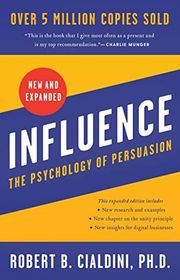
Influence: The Psychology of Persuasion
For readers interested in recurring patterns of persuasion and compliance. The revised examples connect research with familiar encounters, but the named principles are tools for interpreting situations, not a reliable formula for controlling how other people respond.
What it's about
Robert Cialdini examines the psychological principles that make people agree to requests. Research and everyday examples explain how cues such as reciprocity, social proof, authority, and scarcity shape decisions, alongside ways to recognize unwanted persuasion.
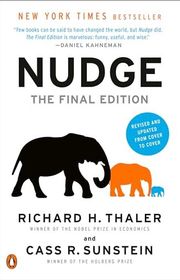
Nudge
For readers who want to connect behavioral findings with the organization of everyday choices. Defaults and presentation make the ideas concrete, but useful applications depend on context, evaluation, and judgments about what outcomes should be encouraged.
What it's about
Thaler and Sunstein explain choice architecture, the design of settings in which people make decisions. Using behavioral insights, they consider defaults, framing, and related tools across public and private institutions, with discussion of policy applications and ethical questions.

For readers who prefer research ideas explained through reported stories about people and organizations. The habit-loop framework gives those cases continuity, but its simplicity and selective examples offer less detail than a comprehensive account of learning and behavior.
What it's about
Charles Duhigg examines how habits form and change through scientific research and stories about individuals, companies, and social movements. He explains how recurring patterns influence behavior and how identifying them can help people reshape routines and organizations improve their practices.
Also recommended by
9 people- Ray Dalio recommended this book
Ray Dalio
"Fantastic. I got [this book] and I gave it to everyone in my company." - Ray Dalio
Ray Dalio's recommendation of this book - Scott Adams recommended this book
Scott Adams
One of the books on Scott Adams' "Persuasion Reading List."
Scott Adams's recommendation of this book  Tim Ferriss recommended this book
Tim Ferriss
"A very good book." - Tim Ferriss
Tim Ferriss's recommendation of this book - Naval Ravikant recommended this book
Naval Ravikant
"Interesting, not because of its content necessarily, but because it’s good for me to always keep on top of mind how powerful my habits are." - Naval Ravikant
Naval Ravikant's recommendation of this book  Kelly Starrett recommended this book
Kelly Starrett
Kelly Starrett recommended this book in the "Tools of Titans" book.
Kelly Starrett's recommendation of this book  Mr. Money Mustache recommended this book
Mr. Money Mustache
Mr. Money Mustache recommended this book on his blog.
Mr. Money Mustache's recommendation of this book +3
More recommendations
- Max Levchin
"Compiles a bunch of great academic neuroscience and applied psychology research on habit formation." - Max Levchin
- Danny Miranda
"Great writing, interesting stories, and incredible insights on how to control your habits." - Danny Miranda
- Patrick Bet-David
Patrick Bet-David recommended this book on his website.
- Max Levchin

For readers interested in motivation at work and the limits of simple rewards. The autonomy, mastery, and purpose framework is easy to discuss, but the organizational examples and selective synthesis need adapting to the task and setting.
What it's about
Daniel Pink examines motivation beyond rewards and punishments. Drawing on research, he argues that autonomy, mastery, and purpose can support lasting engagement, and considers how organizations can create conditions that encourage those internal drives.
Also recommended by
4 people Tobi Lütke recommended this book
Tobi Lütke
One of Tobi Lütke's favorite books according to "The Globe and Mail."
Tobi Lütke's recommendation of this book  David Heinemeier Hansson recommended this book
David Heinemeier Hansson
"Takes some of those same ideas about motivations and rewards and extrapolates them in a little bit." - DHH
David Heinemeier Hansson's recommendation of this book  Danny Miranda recommended this book
Danny Miranda
"A highly practical guide to mastering your own psychology." - Danny Miranda
Danny Miranda's recommendation of this book  Michael Hyatt recommended this book
Michael Hyatt
Michael Hyatt recommended this book on his website.
Michael Hyatt's recommendation of this book

For readers interested in moral disagreement and the connection between intuition and group identity. The framework helps organize competing priorities, but its political emphasis and selected research should be read as a perspective rather than a complete explanation of belief.
What it's about
Jonathan Haidt investigates the intuitive foundations of moral judgment and the sources of political and religious disagreement. Drawing on moral psychology, he explores how differing values can bind communities together while creating persistent divisions between them.
Also recommended by
4 people A.J. Jacobs recommended this book
A.J. Jacobs
"All about trying to figure out the gap between the red and blue states – Republican and Democrat – and it’s really interesting." - A.J. Jacobs
A.J. Jacobs's recommendation of this book  Ann Miura-Ko recommended this book
Ann Miura-Ko
"I love this book because it clarified for me a lot of things that I’ve been feeling for so long around." - Ann Miura-Ko
Ann Miura-Ko's recommendation of this book  Derren Brown recommended this book
Derren Brown
"Tremendous & was part of forming Sacrifice (on Netflix)." - Derren Brown
Derren Brown's recommendation of this book  Russell Moore recommended this book
Russell Moore
"The most important book in years." - Russell Moore
Russell Moore's recommendation of this book

For readers who want to examine the costs of abundant options and constant comparison. The familiar examples make the argument accessible, but the effect of choice depends on the situation, so fewer options should not be treated as universally better.
What it's about
Barry Schwartz examines how an abundance of options can produce anxiety, regret, and dissatisfaction. Across consumer decisions and major life choices, he argues for managing expectations and adopting habits that make choosing less burdensome.
Also recommended by
2 people Pavel Tsatsouline recommended this book
Pavel Tsatsouline
"A very good book." - Pavel Tsatsouline
Pavel Tsatsouline's recommendation of this book  Noah Kagan recommended this book
Noah Kagan
"At restaurants, close the menu after you find the 1 dish that you like." - Noah Kagan
Noah Kagan's recommendation of this book
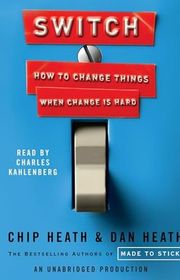
Switch
For readers working on change within teams or organizations. The memorable framework joins direction, motivation, and circumstances, but the illustrative stories and simplifying metaphors need translating into the actual constraints and power relationships of a setting.
What it's about
The Heath brothers explore change through the interaction of reasoning, emotion, and the surrounding environment. Stories from organizations and everyday life support a framework for clarifying direction, encouraging participation, and making different behavior easier to carry out.

For readers interested in resistance to change rather than stronger persuasive pressure. The obstacle-removal framework organizes varied cases clearly, but the examples do not make changing another person’s mind predictable, despite the subtitle’s broad promise.
What it's about
Jonah Berger examines why people resist change and how that resistance can be reduced. Research and case studies introduce an approach centered on removing obstacles, helping readers reconsider persuasion in personal conversations, organizations, and efforts to shift behavior.

For readers who want an organized set of ideas for changing repeated daily actions. The clear framework supports practical experimentation, but its compressed rules and success stories are a popular synthesis rather than a complete scientific account of habit formation.
What it's about
James Clear explores why habits persist and how everyday systems influence behavior. He draws on behavioral research and illustrative stories to offer practical methods for establishing constructive routines, reducing unwanted habits, and making gradual improvements more sustainable.
Also recommended by
8 people Tim Urban recommended this book
Tim Urban
"I'd attribute about 60% of my good habits to [the author's] blog and this book is rapidly filling in the other 40%." - Tim Urban
Tim Urban's recommendation of this book - Vinod Khosla recommended this book
Vinod Khosla
"A decent book on self-help tools, not a category I am generally a fan of." - Vinod Khosla
Vinod Khosla's recommendation of this book  Biz Stone recommended this book
Biz Stone
"Great book." - Biz Stone
Biz Stone's recommendation of this book  Anthony Pompliano recommended this book
Anthony Pompliano
"Highly recommend." - Anthony Pompliano
Anthony Pompliano's recommendation of this book  Jodie Cook recommended this book
Jodie Cook
"I love the simplicity of this book." - Jodie Cook
Jodie Cook's recommendation of this book  Blake Randall recommended this book
Blake Randall
"" - Blake Randall
Blake Randall's recommendation of this book +2
More recommendations
- Ali Abdaal
"Helped me understand how habits are formed and what we can do." - Ali Abdaal
- Ben Greenfield
Most Recommended Books reached out to Ben Greenfield directly.
- Ali Abdaal

For readers who want the history of behavioral economics through one participant’s experience. The anecdotes make intellectual disagreements vivid, but the personal perspective and field-building narrative provide less systematic theory than a textbook.
What it's about
Richard Thaler recounts the development of behavioral economics and his challenges to models of perfectly rational decision-making. Through research, everyday examples, and academic disputes, he explores how human habits and predictable mistakes complicate traditional economic assumptions.
Also recommended by
1 person Peter Mallouk recommended this book
Peter Mallouk
Peter Mallouk mentioned this book on Twitter.
Peter Mallouk's recommendation of this book
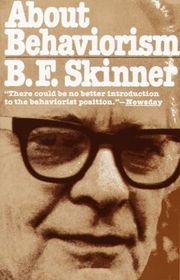
About Behaviorism
For readers who want to understand behaviorism’s philosophical commitments and responses to criticism. The direct explanation clarifies a particular school of thought, but it defends that position rather than offering a neutral survey of psychology.
What it's about
Skinner explains the principles of radical behaviorism and responds to common objections about its account of human life. He considers thought, feeling, knowledge, and social conduct while arguing for explanations centered on behavior and the conditions in which it occurs.
Designing for Behavior Change
For product teams who want to connect behavioral science with design and evaluation. The stepwise process gives ideas a practical workflow, but it depends on understanding users, measuring outcomes, and testing assumptions rather than simply applying a persuasive technique.
What it's about
Wendel presents a process for applying behavioral science to products and services. The updated edition connects understanding users’ actions and motivations with defining outcomes, designing interventions, and evaluating results, giving teams a framework for developing and testing behavior-focused product decisions.
For readers who want to identify the particular obstacle behind an unsuccessful change attempt. The problem-specific approach offers more flexibility than one universal technique, but applying the findings still requires selecting a suitable strategy and testing it in context.
What it's about
Katy Milkman examines obstacles that prevent people from changing their behavior, including procrastination, inertia, and forgetfulness. Drawing on behavioral research, she discusses strategies matched to different barriers and explores how timing, incentives, and social influences can support action.
Mistakes Were Made (But Not by Me): Why We Justify Foolish Beliefs, Bad Decisions, and Hurtful Acts
For readers interested in why people defend choices after evidence becomes uncomfortable. The cognitive-dissonance framework connects personal and institutional examples, but the breadth of the cases can encourage interpreting complicated conflicts through one explanatory lens.
What it's about
Carol Tavris and Elliot Aronson examine how cognitive dissonance leads people to defend mistaken beliefs and harmful decisions. Examples from relationships, institutions, and public life show how self-justification works and why acknowledging error can be difficult.
Science and Human Behavior
For readers who want a foundational behaviorist account of learning and the environment. Its systematic argument connects individual conduct with social institutions, but it is a historical theoretical work rather than a summary of all contemporary psychological approaches.
What it's about
Skinner examines human behavior through learning, reinforcement, and environmental conditions, extending the analysis from individuals to social practices and institutions. The book develops a behaviorist account of explanation, prediction, and control, presenting a framework that shaped later debates in psychology.
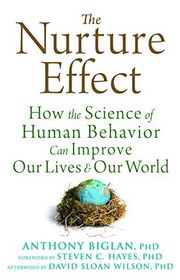
The Nurture Effect
For readers interested in how environments shape behavior across families, schools, and communities. The focus on supportive conditions broadens individual-change accounts, but its expansive reform argument requires attention to the evidence and feasibility of each particular application.
What it's about
Biglan argues that nurturing social environments can support wellbeing and reduce harmful patterns of behavior. The book connects behavioral research with examples from families, education, organizations, and public policy, considering how conditions around people influence the actions available to them.

For readers who want to understand why organizations keep reacting to preventable problems. The systems perspective broadens the focus beyond individual habits, but the case-based approach requires translating lessons into a specific institution’s incentives and constraints.
What it's about
Dan Heath explores efforts to prevent problems before they occur, using cases from organizations and public services. He examines the barriers to prevention and the systems, incentives, and habits that keep people focused on responding to recurring crises.
Also recommended by
1 person Adam Grant recommended this book
Adam Grant
"Now that you have a better handle on solving the problems, it’s time to learn how to prevent them from occurring in the first place." - Adam Grant
Adam Grant's recommendation of this book

Games People Play
For readers interested in a historical framework for recognizing recurring interpersonal patterns. The memorable examples make hidden expectations discussable, but the dated categories and clinical assumptions should not be treated as a complete contemporary explanation of relationships.
What it's about
Eric Berne introduces transactional analysis through recurring patterns of interaction that he calls games. Examples explore the hidden motives and predictable exchanges within human relationships, offering readers a framework for recognizing the roles they and others adopt.

For readers who want a contemporary interpretation of Maslow and humanistic psychology. The links between growth, creativity, and connection invite reflection, but the broad synthesis is more an interpretive framework than a focused experimental or practical behavior-change manual.
What it's about
Scott Barry Kaufman revisits Abraham Maslow's ideas about self-actualization and transcendence. Drawing on psychological research and Maslow's unpublished writings, he explores attachment, creativity, love, and purpose, proposing an approach to personal growth that includes connection with others.
Sources
- 1
Best Psychology Books on Human Behavior
hookedtobooks.com
- 2
86 Best Books to Understand Human Behavior (and Mind Tricks)
makeheadway.com
- 3
Our Top 10 Human Psychology Books That Changed The Way We Understood Human Behavior
blinkist.com
- 4
100 Best Behavioral Psychology Books of All Time
shortform.com
- 5
Behavioral Design Books
habitweekly.com
- 6
Behavioral Psychology Books
goodreads.com
- 7
The best 11 Behavioral Psychology books
blinkist.com
- 8
Best books about human behavior
reddit.com
- 9
I need help choosing psychology books!
reddit.com
- 10
Behavioral Scientist’s Summer Book List 2020
behavioralscientist.org


Edited by
Software engineer whose passion for tracking book recommendations from podcasts inspired the creation of MRB.
Lead investor at 3one4 Capital whose startup expertise and love for books helped shape MRB and its growth.
Comments
Spotted a missing book, a wrong order or a mistake? Tell us and we'll fix this page.
We're a reading guide, not the author or publisher, so we can't send books or pass on messages.