
6 Best Set Theory Books
The best set theory books, ranked by how many expert sources recommend each one, with notes on prerequisites, reader level and a sensible place to start.
Our take
Set theory provides a language for collections, functions, relations and different sizes of infinity. At an introductory level, it supports the proofs used across mathematics. Further study asks what follows from particular axioms and which questions those axioms cannot settle. These books cover both purposes, so choosing by your current preparation matters more than simply choosing the most advanced title.
Naive Set Theory offers a compact foundation for readers already comfortable with mathematical arguments. A Book of Set Theory and Elements of Set Theory provide more room to develop the basic constructions. Introduction to Set Theory can prepare you for a deeper axiomatic course. Kunen’s Set Theory moves toward independence methods, while Set Theory and the Continuum Hypothesis presents Cohen’s historically important approach. If you are still learning how to read proofs, build that skill alongside an introductory text before attempting forcing.
6 books · 9 sources · Last updated
As an Amazon Associate, we earn from qualifying purchases (at no extra cost to you).
How to choose from this list
Skip to the full rankingIf you want a compact mathematical foundation: Naive Set Theory
If you want a fuller first course: Elements of Set Theory → Introduction to Set Theory
If you prefer explanatory commentary: A Book of Set Theory
If you know logic and axiomatic set theory: Set Theory
If you want Cohen’s historical proof: Set Theory and the Continuum Hypothesis
The 6 books, ranked
Ranked by how many expert sources name each book. Ties go to the book more people recommend.

Naive Set Theory
For students comfortable with proofs who want the set-theoretic language used throughout mathematics. Its short chapters make a focused foundation, though the compact explanations offer less support than a fuller course when an argument becomes difficult.
What it's about
Paul Halmos introduces set theory using informal mathematical language and short proofs. Brief chapters develop basic concepts, cardinal numbers, and transfinite methods, offering the set-theoretic foundations needed by students beginning more advanced mathematics.

Set Theory and the Continuum Hypothesis
For readers with logic and set-theory foundations who want Cohen’s own account of independence. Its historical perspective distinguishes it from later textbooks, though the compressed arguments are harder to learn from without a modern companion.
What it's about
Paul Cohen explains his proof that the continuum hypothesis is independent of the usual axioms of set theory. Background in mathematical logic and axiomatic set theory leads into detailed arguments, including Gödel's earlier consistency result.

A Book of Set Theory
For readers who want elementary set arguments developed into a more systematic axiomatic treatment. Its explanatory commentary helps connect definitions and constructions, though the older presentation requires patience and is not a guide to current research.
What it's about
Pinter builds set theory from elementary arguments toward axiomatic systems and more abstract concepts. Topics include functions, relations, the axiom of choice, cardinal and ordinal numbers, infinite sets and transfinite recursion, with commentary explaining each development.
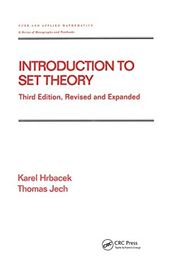
Introduction to Set Theory
For students with proof experience who want a substantial introduction before advanced set theory. Its systematic foundations provide useful preparation for deeper texts, though readers who only need working notation may prefer something shorter.
What it's about
Karel Hrbacek and Thomas Jech introduce axiomatic set theory through sets, relations, functions and the arithmetic of infinite sizes. Their course develops ordinals, cardinals and the axiom of choice as preparation for more advanced mathematical study.
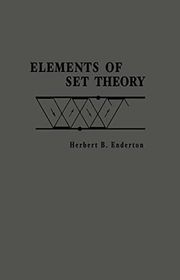
Elements of Set Theory
For undergraduates who want more space for the foundations than Halmos’s compact account provides. Its systematic progression supports a first dedicated course, though the proofs still require active work rather than casual reading.
What it's about
Herbert Enderton develops the basic concepts and axioms of set theory, including functions, relations, cardinality and ordered sets. The treatment builds toward infinite constructions, giving students a foundation for further study in mathematical logic and advanced mathematics.

Set Theory
For readers ready to study independence methods after basic logic and axiomatic set theory. Its sustained treatment of forcing and constructibility offers a route into advanced work, though it is demanding as a first textbook.
What it's about
Kenneth Kunen develops independence proofs for readers already familiar with mathematical logic and axiomatic set theory. Constructibility, forcing, and infinitary combinatorics support detailed treatments of the continuum hypothesis, cardinal exponentiation, and questions in topology and measure theory.
Sources
- 1
The 10 Best Set Theory Books—any Level, any Price
celsiuselements.com
- 2
Set Theory · Jiayu Chen
jiayuchen-math.github.io
- 3
MATHGarden – Literature about Set Theory
math-garden.com
- 4
Reading List – PROMYS | Program in Mathematics for Young Scientists
promys.org
- 5
Set Theory Books
goodreads.com
- 6
set and number theory book recommendations
reddit.com
- 7
[University] Good textbooks on set theory, as in things like forcing and consistency?
reddit.com
- 8
Mathematics Textbooks for Self Study --- A Guide for the Autodidactic
marktomforde.com
- 9
European Set Theory Society
settheory.eu





Edited by
Software engineer whose passion for tracking book recommendations from podcasts inspired the creation of MRB.
Lead investor at 3one4 Capital whose startup expertise and love for books helped shape MRB and its growth.
Comments
Spotted a missing book, a wrong order or a mistake? Tell us and we'll fix this page.
We're a reading guide, not the author or publisher, so we can't send books or pass on messages.