
31 Best Math Books
The best math books, ranked by how many expert sources recommend each one, with notes on prerequisites, reader level, and where to start learning.
Our take
Math books serve very different purposes. Some help you recover the pleasure of an idea; others teach a course through definitions, proofs, and difficult exercises. A reference can show how subjects connect without teaching every step between them. Choosing well depends less on a book’s reputation than on what you already know and whether you want to read, calculate, or prove.
For a broad introduction, The Joy Of X connects familiar situations with mathematical ideas, while Journey Through Genius lets you follow selected proofs in their historical setting. Basic Mathematics rebuilds foundations for further study, and How to Prove It teaches the arguments needed in higher mathematics. Beyond that, calculus, linear algebra, probability, and topology lead toward different goals. The more advanced texts assume that you will work through problems and sometimes need another explanation. Start with The Joy Of X for curiosity, or Basic Mathematics if you want to prepare for a course.
31 books · 9 sources · Last updated
As an Amazon Associate, we earn from qualifying purchases (at no extra cost to you).
How to choose from this list
Skip to the full rankingIf you want to explore without taking a course: The Joy Of X → Journey Through Genius
If you need foundations before calculus: Basic Mathematics → Calculus Made Easy
If you are learning to write proofs: How to Prove It → Understanding Analysis
If you want conceptual linear algebra: Linear Algebra Done Right
If you are beginning abstract algebra: Contemporary Abstract Algebra → Abstract Algebra
If you want a map of advanced mathematics: The Princeton Companion to Mathematics
The 31 books, ranked
Ranked by how many expert sources name each book. Ties go to the book more people recommend.

Linear Algebra Done Right
For readers who know basic matrix calculations and want to understand vector spaces and operators through proofs. Its conceptual approach complements computational courses, though it gives less attention to numerical methods and immediate applications.
What it's about
Sheldon Axler develops linear algebra through vector spaces and linear operators, postponing determinants until the end. Proofs, examples, and exercises explore eigenvalues, inner products, and operator structure, forming a conceptual second course for mathematics students.

Calculus Made Easy
For readers who want a friendly first feel for differentiation and integration. The worked explanations lower the barrier compared with proof-heavy calculus texts, though this primer does not supply the breadth or rigor of a complete modern course.
What it's about
Silvanus P. Thompson introduces differentiation and integration through straightforward explanations and worked examples. This edition, revised by Martin Gardner, adds introductory chapters on functions and limits, updates the language, and supplies further practice problems.
Also recommended by
1 person Naval Ravikant recommended this book
Naval Ravikant
"I love [this book]." - Naval Ravikant
Naval Ravikant's recommendation of this book

Abstract Algebra
For students already comfortable with proofs who want a broad algebra text to keep through advanced coursework. Its range makes it more useful as a long-term reference than a gentle first introduction, and the exercises can be demanding.
What it's about
David Dummit and Richard Foote develop abstract algebra from basic definitions toward more advanced results. Examples and exercises explore algebraic structures and their relationships, providing material for advanced undergraduate and graduate study and preparation for specialized topics.

Principles of Mathematical Analysis
For proof-confident students ready to work hard at analysis. Its compact presentation makes a useful reference once the ideas are familiar, but the terse arguments and difficult exercises can frustrate readers learning limits and rigor for the first time.
What it's about
Walter Rudin presents a rigorous introduction to mathematical analysis for advanced undergraduates and beginning graduate students. The text develops convergence, continuity, differentiation, and integration from their foundations, then extends the discussion to sequences of functions, vector analysis, and Lebesgue theory.
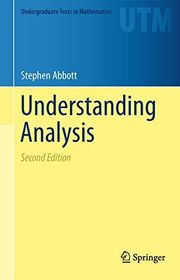
Understanding Analysis
For calculus students approaching rigorous analysis for the first time. Its motivating questions and explanations give more guidance than Rudin’s compact treatment, though the exercises still require proof-writing and the coverage is narrower than an advanced reference.
What it's about
Abbott develops real analysis from sequences and the real numbers through continuity, differentiation, integration, and sequences of functions. Motivating discussions and exercises explain why precise definitions matter and how they support the central results of calculus.

For curious readers with solid school mathematics who want to try mathematical reasoning across several fields. It offers more actual mathematics than a popular overview, though the word elementary should not be mistaken for effortless.
What it's about
Richard Courant and Herbert Robbins explore the ideas and methods underlying mathematics for readers seeking more than routine calculation. This second edition includes additional material by Ian Stewart, bringing later developments such as the four-color theorem and Fermat's Last Theorem into the discussion.

The Princeton Companion to Mathematics
For readers who want a map of mathematics and its connections rather than a single course. The specialist essays support browsing and orientation, but their difficulty varies and they cannot replace working through a textbook’s exercises.
What it's about
Edited by Timothy Gowers, this reference surveys the concepts, methods, history, and major problems of mathematics. Contributions from specialists introduce important branches of the subject, influential mathematicians, significant theorems, and connections with other fields.
Also recommended by
2 people- Naval Ravikant recommended this book
Naval Ravikant
Naval Ravikant tweeted about this book.
Naval Ravikant's recommendation of this book  Balaji Srinivasan recommended this book
Balaji Srinivasan
"The desert island book. So good." - Balaji Srinivasan
Balaji Srinivasan's recommendation of this book

A History of Pi
For readers who enjoy following one mathematical idea across history. Its narrow focus makes the development of pi easy to trace, though the author’s forceful political and religious commentary can distract from the mathematics.
What it's about
Petr Beckmann traces the history of pi as part of a wider account of mathematical discovery. He places advances and setbacks in their social context, exploring his argument about the effects of political and religious authority on science.

A Mathematical Introduction to Logic
For students who want a formal course in mathematical logic after gaining some proof experience. It develops logical systems more systematically than a proof-writing primer, though the notation and metatheorems require sustained concentration.
What it's about
Herbert Enderton introduces mathematical logic through its central concepts and theorems. The textbook develops sentential and first order logic, undecidability, and second order logic, explaining how these ideas connect with other areas of mathematics.

For mathematically prepared readers who want probability explained through substantial examples and discrete models. It builds intuition alongside theory, though it is more demanding than a beginner’s statistics text and is not a modern software-based introduction.
What it's about
William Feller introduces probability theory through mathematical explanations and applications. The first volume develops sample spaces, combinatorial methods, coin tossing, random walks, distributions, Markov chains, and stochastic processes, using examples to connect theory with problems.

Basic Mathematics
For readers rebuilding algebra and geometry before calculus or linear algebra. It emphasizes the reasoning behind school-level mathematics, though it moves more seriously than a remedial workbook and expects you to engage with the problems.
What it's about
Serge Lang develops foundational mathematical ideas for high school and college readers preparing for further study. His explanations emphasize how concepts connect and grow into one another, establishing groundwork for calculus, linear algebra, and related subjects.

Calculus
For students who want calculus to train their reasoning as well as their technique. Its proof-centered problems prepare you for analysis, but it is a demanding choice if your immediate need is routine computational practice.
What it's about
Michael Spivak introduces calculus through rigorous reasoning and proofs rather than computation alone. Beginning with properties of numbers, he develops limits, differentiation, integration, and infinite series, using challenging problems to build an understanding of mathematical analysis.

For students who want a full mathematical development of calculus with some linear algebra alongside it. The balance of proofs and techniques is useful for serious study, though its integration-first order may differ from your course.
What it's about
Tom Apostol introduces calculus by treating integration before differentiation, linking the two through theory and technique. Geometric explanations, historical context, theorem proofs, and exercises accompany the development of single variable calculus and an introduction to linear algebra.

Categories for the Working Mathematician
For experienced mathematics students who need category theory as a common language across subjects. Its breadth supports later reference, but familiarity with abstract examples is essential; beginners may understand the definitions without seeing why they matter.
What it's about
Saunders Mac Lane develops category theory through categories, functors, natural transformations, and duality. The text proceeds to adjoints, limits, and Kan extensions, using mathematical applications to illustrate the framework and its universal constructions.

For independent learners who want guided practice with sets, axioms, and infinity. The teaching structure gives more support than a terse reference, though it still asks you to reason through proofs rather than simply read explanations.
What it's about
D. C. Goldrei develops set theory for guided independent study, beginning with constructions of real and natural numbers. Exercises and teaching solutions explore axioms, paradoxes, choice, ordered sets, and the arithmetic of cardinal and ordinal numbers.

Contemporary Abstract Algebra
For students taking their first abstract algebra course who want many examples before generalizing. It offers a more approachable route than the larger Dummit and Foote text, though the breadth of advanced material is more limited.
What it's about
Joseph Gallian introduces abstract algebra through definitions, examples, computations, and proofs. The text develops group theory and related algebraic structures, with exercises encouraging students to generalize ideas and connect them with mathematical applications.

Elementary Number Theory
For students looking for a first proof-based course centered on integers. Concrete questions about divisibility and congruences give the abstractions a foothold, though comfort with algebra and a willingness to solve exercises are necessary.
What it's about
Gareth and Mary Jones introduce number theory through proofs, worked examples, and exercises. Topics include divisibility, primes, congruences, quadratic residues, arithmetic functions, and sums of squares, concluding with an account of Fermat's Last Theorem.

Encyclopedia of Mathematics
For readers who need to look up a term or recover the context of a mathematical idea. Its alphabetical structure is convenient for reference, but it offers less continuity and practice than a course organized around prerequisites.
What it's about
James Tanton's mathematical encyclopedia combines definitions, explanations of discoveries, and short biographies. Cross referenced entries and historical essays explore algebra, calculus, functions, geometry, probability, statistics, and trigonometry, with supporting timelines and reference resources.
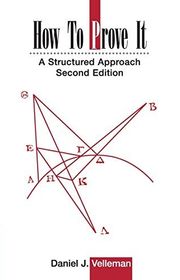
How to Prove It: A Structured Approach
For readers moving from calculations to their first proof-based course. It explicitly teaches how to organize an argument before tackling abstract algebra or analysis, though the logic and set notation require practice rather than casual reading.
What it's about
Velleman introduces the structure of mathematical arguments through logic, sets, relations, and functions. Worked examples and exercises develop methods such as contradiction and induction, helping students move from understanding a proof to constructing one themselves.

Introduction to Topology and Modern Analysis
For readers who want to understand how topology connects with analysis and linear structures. Its connected development offers more context than a short topology primer, though the later operator material assumes increasing mathematical maturity.
What it's about
George Simmons introduces topology and modern analysis through the related ideas of continuity and linearity. His textbook explores the mathematical structures behind these concepts, connecting geometric and analytical perspectives for readers developing their understanding of abstract mathematics.

Introductory Statistics
For students who want a conventional first statistics course with detailed explanations and practice. It supports learning inference step by step, though readers seeking probability theory or a programming-centered approach will need a different book.
What it's about
Neil Weiss introduces statistics through detailed explanations, data sets, and exercises emphasizing reasoning and critical thinking. Topics include descriptive statistics, probability, sampling, confidence intervals, hypothesis testing, regression, and analysis of variance.

The Four Pillars of Geometry
For readers who know some algebra and want several ways to understand geometry. Its comparison of constructions, coordinates, and transformations reveals connections a single-method course can hide, though the compact treatment requires active work.
What it's about
John Stillwell explores geometry through four approaches: Euclidean axioms, linear algebra, projective geometry, and transformation groups. Figures and exercises connect concrete constructions with more abstract ideas, showing how different methods illuminate the same geometric questions.

For students who have calculus and want to see differential equations emerge from models. Its applications connect techniques with questions outside pure mathematics, though readers seeking a current computational or software-focused treatment will need another resource.
What it's about
Martin Braun connects ordinary differential equations with applied mathematical modeling. Problems are introduced through their real world setting before equations are derived, alongside explanations of first and second order equations, systems, qualitative theory, and Fourier series.

Introduction to Algorithms
For readers interested in the mathematics of efficient computation. Its pseudocode and analysis connect proofs with algorithms more directly than the pure mathematics texts, though programming familiarity and discrete-math background make it much easier to use.
What it's about
This textbook develops algorithm design and analysis through mathematical explanations, pseudocode, and exercises. Chapters cover data structures, sorting, graphs, and broader design techniques, presenting individual topics as units that can support coursework or professional reference.

Introduction to Topology
For undergraduates who have met proofs and want a compact introduction to topology. The progression from sets and metric spaces builds toward abstraction, though its brevity means you may want more examples or outside help with exercises.
What it's about
Bert Mendelson develops the foundations of topology for undergraduates familiar with calculus proofs. Beginning with sets and metric spaces, the text progresses to topological spaces, connectedness, and compactness, with exercises supporting each stage.

For readers with high-school mathematics who want to follow real proofs in their historical setting. The selected theorems give more substance than a biography-only account, though the book offers episodes rather than a systematic course.
What it's about
William Dunham presents major mathematical theorems alongside the historical circumstances and lives of their creators. Step by step proofs connect figures such as Archimedes, Cardano, and Cantor with discoveries accessible to readers familiar with high school mathematics.

For physics students who want mathematical tools gathered around their applications. It connects methods more directly to physical problems than the abstract texts, though the range is too wide to replace foundational calculus and linear algebra study.
What it's about
Sadri Hassani introduces mathematical tools used in physics and related fields. Reviews of vectors and calculus lead to series, vector analysis, complex methods, and differential equations, with physical examples and discussions of numerical analysis and nonlinear dynamics.

Mathematics and Its History
For readers who want the history of mathematics to explain how its ideas connect. Its technical discussions and exercises go beyond a narrative survey, though some chapters are easier to appreciate after undergraduate coursework.
What it's about
John Stillwell connects mathematical ideas with their historical development. Discussions range across geometry, number theory, algebra, and analysis, examining topics such as polynomial equations and calculus alongside exercises and accounts of how mathematical problems evolved.

Measurement
For curious readers who want to explore geometry through their own questions and arguments. Pictures and plain language invite active discovery, though the open-ended challenges demand more patience than a popular book you can read passively.
What it's about
Paul Lockhart explores mathematics through questions about shape and motion, using plain language and pictures to invite active discovery. The book presents challenging ideas as opportunities for creative thought rather than a collection of formulas to memorize.

Principles and Techniques in Combinatorics
For students who want a problem-centered introduction to counting and combinatorial reasoning. Worked methods and competition-style exercises give it a practical focus, though the harder problems can feel abrupt without a strong grounding in elementary techniques.
What it's about
Chen Chuan-Chong and Koh Khee-Meng introduce combinatorial reasoning through counting methods and worked problems. Chapters cover permutations, combinations, the pigeonhole principle, Ramsey theory, inclusion and exclusion, generating functions, and recurrence relations, with exercises drawn partly from mathematics competitions.

For general readers who want to reconnect mathematical ideas with familiar situations. Its short explanations make a broader and gentler starting point than the textbooks, though it builds appreciation rather than the fluency that comes from sustained exercises.
What it's about
Steven Strogatz guides general readers through mathematical ideas from numbers and algebra to calculus and infinity. Everyday examples and connections with art, science, and business explain how these concepts work and why they offer useful ways to understand the world.
Sources
- 1
All The Math Books You’ll Ever Need (Updated 2024)
mathblog.com
- 2
13+ Best Math Books For Students In 2023
statanalytica.com
- 3
Recommended Books on Higher Mathematics
mathvault.ca
- 4
Calling All Math Enthusiasts: What Are Your Favorite Math Books?
reddit.com
- 5
What are your favorite books that you've read for self-study?
reddit.com
- 6
100 Best Math Books of All Time
shortform.com
- 7
How to Learn Math and Physics
math.ucr.edu
- 8
Math & Statistics
fivebooks.com
- 9
Best Books About Mathematics
goodreads.com


Edited by
Software engineer whose passion for tracking book recommendations from podcasts inspired the creation of MRB.
Lead investor at 3one4 Capital whose startup expertise and love for books helped shape MRB and its growth.
Comments
Did we miss something? Have feedback?
Help us improve this page by sharing your thoughts