
14 Best Linear Algebra Books
The best linear algebra books, ranked by how many expert sources recommend each one, with notes for beginners, proof-based courses, and numerical applications.
Our take
Linear algebra studies vectors, matrices, linear maps, and the structures that connect them. It supports subjects as varied as geometry, statistics, computing, and differential equations. The books here differ most in how they teach: some begin with calculations and pictures, others organize the subject around definitions and proofs, and numerical texts ask how methods behave on a computer.
Gilbert Strang's Introduction to Linear Algebra is a strong route into the relationship between calculations and ideas. Kuldeep Singh's Linear Algebra gives more step-by-step support, while David Lay and David Poole offer substantial first-course textbooks. Linear Algebra Done Right and the books by Hoffman and Kunze or Friedberg and his coauthors suit readers ready for abstract reasoning. For numerical work, Numerical Linear Algebra and Matrix Computations build on foundations you should already know.
Start with an introductory book and solve problems regularly, then choose a proof-oriented or numerical follow-up according to your goals.
14 books · 8 sources · Last updated
As an Amazon Associate, we earn from qualifying purchases (at no extra cost to you).
How to choose from this list
Skip to the full rankingIf you're learning the subject for the first time: Introduction to Linear Algebra
If you want explicit worked calculations: Linear Algebra
If you're ready for a proof-based second course: Linear Algebra Done Right → Finite-Dimensional Vector Spaces
If you want applied matrix theory: Matrix Analysis and Applied Linear Algebra
If you want to study numerical algorithms: Numerical Linear Algebra → Matrix Computations
The 14 books, ranked
Ranked by how many expert sources name each book. Ties go to the book more people recommend.

Linear Algebra Done Right
For students ready for a conceptual second course. Its operator-centered approach makes vector-space structure clearer without relying early on determinants, though it offers less routine computational practice than a typical introductory textbook and expects comfort with proofs.
What it's about
Sheldon Axler develops linear algebra through vector spaces and linear operators, postponing determinants until the end. Proofs, examples, and exercises explore eigenvalues, inner products, and operator structure, forming a conceptual second course for mathematics students.

Introduction to Linear Algebra
For learners who want to connect matrix calculations with geometry and the fundamental subspaces. Its conceptual emphasis gives a strong first-course foundation, though you need to work the exercises rather than expect the informal explanations to do everything.
What it's about
Gilbert Strang introduces linear algebra through vectors, systems of equations, and fundamental subspaces. Explanations and problems develop orthogonality, determinants, eigenvalues, singular value decomposition, and applications, connecting concrete examples with the mathematical ideas that organize the subject.
Also recommended by
1 person Eric Weinstein recommended this book
Eric Weinstein
Eric Weinstein tweet about books that mattered enough to him.
Eric Weinstein's recommendation of this book

Linear Algebra
For mathematics students who want a full transition from matrices to abstract vector spaces. Its theorem-and-proof treatment offers a broader theoretical course than a short guide, though the pace assumes willingness to build proofs independently.
What it's about
Stephen Friedberg, Arnold Insel, and Lawrence Spence present a theoretical treatment of linear algebra emphasizing abstract vector spaces. Theorem-and-proof discussions connect linear transformations with matrices, while applications illustrate links with geometry, physics, economics, and differential equations.

Linear Algebra
For students ready to study vector spaces and operators through proofs. Its rigorous, systematic development offers more theoretical depth than a calculation-first introduction, though the compressed presentation is difficult without some experience reading and writing arguments.
What it's about
Kenneth Hoffman and Ray Kunze develop linear algebra through intuitive introductions, examples, and theoretical results. Topics include vector spaces, linear transformations, determinants, canonical forms, inner product spaces, operators, and bilinear forms.

Linear Algebra and Its Applications
For readers who want matrix methods connected with applications across disciplines. Its informal discussion supports physical and computational intuition, though readers seeking a tightly organized abstract course may prefer a more theorem-centered alternative.
What it's about
Gilbert Strang combines linear algebra theory with examples from engineering, computing, physics, biology, and economics. The text develops systems of equations, projections, least squares, determinants, and related methods, emphasizing their usefulness in solving problems across disciplines.

Linear Algebra and Its Applications
For beginners who want computation to lead gradually into abstract concepts. Its concrete development and many applications make a more forgiving first course than Axler, though readers mainly interested in elegant proofs may find the textbook apparatus lengthy.
What it's about
David Lay and his coauthors introduce linear algebra through equations, matrices, and their applications. The text develops vector spaces, eigenvalues, orthogonality, least squares, and quadratic forms, helping readers connect concrete calculations with more abstract concepts.
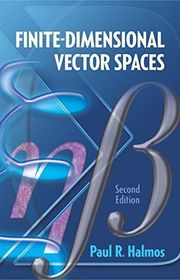
Finite-Dimensional Vector Spaces
For readers who want a concise, proof-led account of vector spaces and linear transformations. Its compact structure gives a different reading experience from modern course textbooks, though older terminology and limited hand-holding make it demanding for beginners.
What it's about
Paul Halmos develops finite-dimensional vector spaces, linear transformations, and inner-product spaces in a concise abstract treatment. Proofs and exercises connect algebraic structure with the operator ideas that underlie more advanced work in analysis and Hilbert spaces.

For independent learners who want calculations explained in small steps. Its worked examples provide more explicit scaffolding than a compact proof-based text, though that slower pace may feel repetitive if you already handle routine matrix problems confidently.
What it's about
Kuldeep Singh teaches linear algebra through detailed examples and step-by-step explanations. Exercises and solutions support independent study, while interviews with practitioners connect vector spaces, transformations, determinants, and eigenvalues with uses in professional and academic work.

For readers comfortable with older mathematical exposition who want connections among algebra, geometry, and analysis. Its substantial content makes a useful alternative reference, though terminology and presentation require more interpretation than a modern beginner textbook.
What it's about
Georgi Shilov presents linear algebra with an approach that connects algebra, geometry, and analysis. Examples, problems, hints, and answers support classroom or independent study, with emphasis on understanding the subject's ideas and learning practical techniques.

For beginners who benefit from a vectors-first presentation and concrete applications. Its balanced computational development offers more initial guidance than an abstract proof text, though experienced readers may find the explanations and course-style layout slow.
What it's about
David Poole introduces linear algebra through vectors, balancing computation, theory, and applications. The fourth edition connects equations, matrices, eigenvalues, orthogonality, and vector spaces with modeling problems from a range of disciplines.

Matrix Analysis and Applied Linear Algebra
For readers moving from an introductory course toward applied matrix work. Its detailed examples link theory with algorithms more closely than a purely abstract text, though its breadth makes it less convenient as a quick first introduction.
What it's about
Carl Meyer develops matrix analysis and applied linear algebra through problems and detailed examples. Applications, historical notes, and discussion of algorithms connect theory with practical computation, while exercises and their solutions support further study.
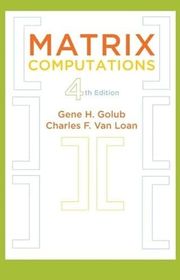
Matrix Computations
For advanced students and practitioners who need a substantial reference on matrix algorithms. Its computational depth goes beyond the first-course books here, though the density and prerequisites make it better for targeted study than initial learning.
What it's about
Golub and Van Loan examine the mathematical foundations and implementation of numerical matrix methods. The book develops algorithms for linear systems, least squares and eigenvalue problems, with derivations and exercises that support scientific computing and numerical software development.
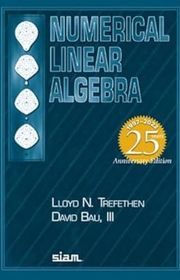
Numerical Linear Algebra
For readers who know basic linear algebra and want to understand reliable numerical computation. Its short lectures emphasize conditioning and stability more directly than general textbooks, though the concise proofs and algorithms require mathematical maturity.
What it's about
Trefethen and Bau present numerical linear algebra in forty lecture-sized chapters. Topics connect matrix factorizations, least squares, eigenvalues and iterative methods, explaining how mathematical structure and finite-precision computation shape the algorithms used in scientific work.

No Bullshit Guide to Linear Algebra
For readers who prefer a compact, conversational guide linking calculations with geometry. Its direct style makes it an approachable alternative to a large course textbook, though the informal presentation and compressed coverage won't suit every learner.
What it's about
Ivan Savov introduces linear algebra by connecting computational techniques with geometry and mathematical theory. Definitions, worked examples, and exercises cover the subject's core ideas, with practical applications and computer tools supporting the explanations.
Sources
- 1
Best Linear Algebra Books: Any Level, Wide Range
celsiuselements.com
- 2
Linear Algebra Resources
opentext.uleth.ca
- 3
Linear Algebra Books
goodreads.com
- 4
99 Best Linear Algebra Books of All Time
shortform.com
- 5
10 recommended books on Linear Algebra
nibcode.com
- 6
Whats the best intoductory linear algebra book?
reddit.com
- 7
How to learn linear algebra using books, and which are the best books for this subject?
reddit.com
- 8
Additional Linear Algebra Literature
math.iit.edu


Edited by
Software engineer whose passion for tracking book recommendations from podcasts inspired the creation of MRB.
Lead investor at 3one4 Capital whose startup expertise and love for books helped shape MRB and its growth.
Comments
Spotted a missing book, a wrong order or a mistake? Tell us and we'll fix this page.
We're a reading guide, not the author or publisher, so we can't send books or pass on messages.