
10 Best Graph Theory Books
The best graph theory books, ranked by how many expert sources recommend each one, with notes on reader fit, prerequisites, applications, and where to start.
Our take
Graph theory studies relationships through vertices and edges, giving a common language to paths, networks, coloring, and connectivity. The same simple diagrams can lead to an accessible puzzle, a demanding proof, or a model for an engineering problem. Books differ less in their basic definitions than in how quickly they expect you to reason abstractly and what they do once those foundations are in place.
Trudeau's Introduction to Graph Theory offers a focused starting point, while A First Course in Graph Theory provides a broader undergraduate path. Graph Theory and Complex Networks connects the mathematics with network applications. More advanced texts by Diestel, Bondy and Murty, and Bollobás assume greater comfort with proofs and sustained problem solving. These are mathematical books, so programming experience alone is not a substitute for working through their arguments. Start with Trudeau for an approachable introduction, or Chartrand and Zhang if you're ready for a full first course.
10 books · 8 sources · Last updated
As an Amazon Associate, we earn from qualifying purchases (at no extra cost to you).
How to choose from this list
Skip to the full rankingIf you're new to the mathematics: Introduction to Graph Theory
If you want a first proof-based course: A First Course in Graph Theory
If you want network applications: Graph Theory and Complex Networks → Graph Theory and Its Applications
If you want engineering models: Graph Theory with Applications to Engineering and Computer Science
If you're ready for advanced study: Modern Graph Theory
The 10 books, ranked
Ranked by how many expert sources name each book. Ties go to the book more people recommend.
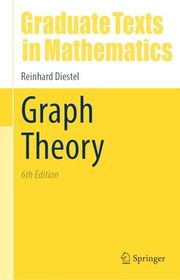
Graph Theory
For mathematically mature readers seeking a concise route into structural graph theory. Its complete proofs and advanced directions reward close study, though the compressed presentation makes it demanding as a first encounter with mathematical argument.
What it's about
Reinhard Diestel develops modern graph theory through definitions, theorems, and proofs. Core topics include connectivity, matching, coloring, and planar graphs, with later material extending toward deeper structural methods and questions for advanced study.

A First Course in Graph Theory
For students beginning a proof-based course who want examples and mathematical background close at hand. The appendices and guided explorations support independent study, though meaningful progress still requires working through proofs and exercises.
What it's about
Chartrand and Ping Zhang introduce undergraduate graph theory through historical context, examples and proofs. Optional explorations encourage experimentation, while appendices review sets, logic, relations, functions and proof methods, with hints or solutions for selected exercises.

Graph Theory and Its Applications
For students who want substantial theory alongside models, algorithms, and applications. Its breadth makes it a useful course companion across disciplines, though the size and range require more selection than a concise introductory text.
What it's about
Gross, Jay Yellen and Mark Anderson combine classical graph theory with methods, models and applications. The text supports study across algorithms, operations research, algebra and topology, linking mathematical development with problems relevant to computing and other fields.

Introduction to Graph Theory
For beginners who want a manageable introduction built around pictures and clear explanations. Its focused route through classical topics helps develop intuition, though it covers less breadth than a full undergraduate course text.
What it's about
Trudeau introduces graph theory for readers seeking an accessible mathematical starting point. Exercises accompany discussions of planar graphs, Euler's formula, coloring and graph genus, progressing to Euler and Hamilton walks through explanations intended to build intuition.
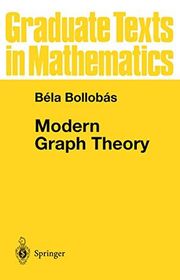
Modern Graph Theory
For readers with proof experience who want a more advanced theoretical perspective. Bollobás connects classical graph theory with deeper methods and results, though the mathematical density makes an introductory course useful preparation.
What it's about
Béla Bollobás surveys central ideas and methods in graph theory, progressing from foundational concepts to more advanced topics. The treatment includes extremal and probabilistic perspectives, alongside exercises intended to develop readers' ability to reason about graphs.

For computing students interested in how graph mathematics connects with real networks. Its transition into random and social networks gives the theory a clear destination, though it is less comprehensive as a pure-mathematics reference.
What it's about
Van Steen develops graph theory for computing students, explaining notation and proof techniques before connecting the mathematics with network applications. Later sections explore random networks, small worlds, internet structure and social networks at an introductory level.
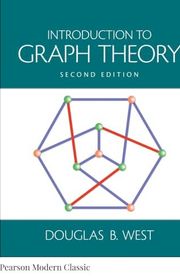
Introduction to Graph Theory
For undergraduates ready for a rigorous first course and substantial exercise work. West offers a systematic proof-based foundation, though its pace and problem demands make it a harder independent start than Trudeau's introduction.
What it's about
Douglas West introduces graph-theoretic concepts through examples, theorems, proofs, and exercises. Topics include trees, connectivity, matching, coloring, planarity, and selected advanced ideas, providing a foundation for further mathematical study of graphs and their applications.
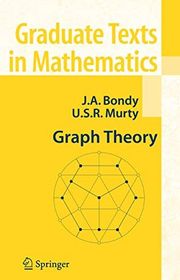
Graph Theory
For advanced undergraduates and beginning graduate students who want extensive theory and problems. The broad treatment supports sustained study beyond an introductory course, though its length and challenging exercises make it less suitable for casual browsing.
What it's about
Adrian Bondy and U. S. R. Murty present a wide-ranging treatment of graph theory for advanced study. The text develops fundamental results alongside algorithms and deeper topics, using examples and exercises to build mathematical understanding.

For engineering and computer-science readers interested in classical network models. Its emphasis on circuits, cutsets, and applications gives the mathematics a practical setting, though older computing examples need interpretation in light of later developments.
What it's about
Deo develops graph-theoretic concepts for engineering and computing applications. Chapters on paths, circuits, trees and cutsets establish mathematical foundations, while algorithms and network models connect the theory with problems involving discrete objects and their relationships.

Introductory Graph Theory
For curious readers who want elementary ideas connected to recognizable problems. Its illustrated applications provide a less intimidating entry than advanced texts, though readers aiming for graduate study will need a more extensive proof-based treatment.
What it's about
Chartrand introduces elementary graph theory through illustrations, proofs and applications. Transportation, connection problems, games, social relationships and coloring demonstrate how graphs model situations, while exercises and an appendix develop the mathematical tools needed to explore them.
Sources
- 1
Best Graph Theory Resources (2026)
learngraphtheory.org
- 2
LTCC Course: Graph Theory
personal.lse.ac.uk
- 3
Graph Theory Books
goodreads.com
- 4
Best Graph Theory book?
reddit.com
- 5
What are some good beginner graph theory texts?
mathoverflow.net
- 6
Graph theory (Spring 2024)
math.nagoya-u.ac.jp
- 7
The top 13 graph theory and algorithm books for fundamentals
neo4j.com
- 8
20 Best Books on Graph Theory (2022 Review)
bestbookshub.com






Edited by
Software engineer whose passion for tracking book recommendations from podcasts inspired the creation of MRB.
Lead investor at 3one4 Capital whose startup expertise and love for books helped shape MRB and its growth.
Comments
Spotted a missing book, a wrong order or a mistake? Tell us and we'll fix this page.
We're a reading guide, not the author or publisher, so we can't send books or pass on messages.