
9 Best Game Theory Books
The best game theory books, ranked by how many expert sources recommend each one, with notes for curious beginners, history readers, and economics students.
Our take
Game theory studies decisions whose outcomes depend on other people’s choices as well as your own. Its books range from stories about competition and cooperation to mathematical models that make assumptions explicit. A general introduction helps you recognize strategic situations; a textbook asks you to represent them precisely and work through what follows from the model.
The Art of Strategy and The Joy of Game Theory offer accessible examples, while Game Theory 101 begins the move toward solving formal problems. An Introduction to Game Theory and Steven Tadelis’s Game Theory provide more sustained undergraduate study. Game Theory for Applied Economists emphasizes translating economic situations into models. For historical context, Prisoner’s Dilemma connects ideas with people and Cold War strategy, while Theory of Games and Economic Behavior presents the original mathematical foundation. Start with examples if the subject is new, then choose a textbook if you want to calculate and defend solutions yourself.
9 books · 7 sources · Last updated
As an Amazon Associate, we earn from qualifying purchases (at no extra cost to you).
How to choose from this list
Skip to the full rankingIf you are curious about everyday strategy: The Art of Strategy → The Joy of Game Theory
If you want to start solving models: Game Theory 101 → An Introduction to Game Theory
If you want a formal undergraduate course: An Introduction to Game Theory → Game Theory
If you study economics: Game Theory for Applied Economists
If you want historical foundations: Prisoner's Dilemma → Theory of Games and Economic Behavior
The 9 books, ranked
Ranked by how many expert sources name each book. Ties go to the book more people recommend.
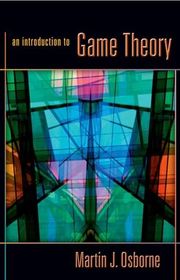
An Introduction to Game Theory
For undergraduates who want precise concepts without jumping immediately into a graduate reference. Its careful explanations and exercises build a coherent foundation, though the notation and sustained reasoning still require active mathematical study.
What it's about
Martin Osborne introduces strategic interaction through models of simultaneous and sequential decisions, bargaining, uncertainty, and repeated play. Definitions, examples, and exercises develop the concepts needed to analyze how players’ choices depend on one another.

For general readers who want to recognize strategic interactions in familiar situations. Its varied examples make the ideas accessible without a formal course, though it offers less mathematical practice than the dedicated textbooks.
What it's about
Avinash Dixit and Barry Nalebuff explain how game theory illuminates decisions in business and everyday life. Examples from negotiation, politics, sports, and other settings show how anticipating others' choices changes the possibilities for competition and cooperation.

For students ready for a formal course that includes uncertainty and sequential decisions. Its exercises connect mathematical definitions with applications, though readers without comfort in algebra and probability may need a gentler introduction first.
What it's about
Steven Tadelis provides a formal introduction to strategic interaction, moving from decision theory to games with complete and incomplete information. Examples and exercises connect mathematical models with economics and politics, including situations where players act sequentially or hold different information.

For beginners who want to move beyond strategic anecdotes into solving models. Its gradual sequence gives formal ideas a manageable starting point, though progress depends on working through examples rather than reading passively.
What it's about
William Spaniel introduces game theory through progressively more complex models of strategic decision-making. Matrix games and extensive-form representations provide the foundation for analyzing choices when outcomes depend on other players, with explanations connecting formal methods to economic and political problems.
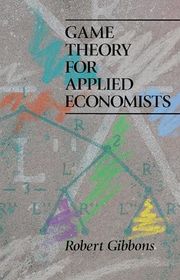
Game Theory for Applied Economists
For economics students who want to translate practical situations into formal models. Its applications give equilibrium concepts a concrete purpose, though the compressed presentation works better with prior economics and mathematical preparation.
What it's about
Robert Gibbons presents static and dynamic games with complete and incomplete information. Economic applications show how informal strategic situations become models, linking each class of games with the equilibrium concepts used to analyze it.

For curious readers who prefer short puzzles and concrete stories. Its approachable format lets you sample strategic ideas in small portions, though the collection is less systematic than a textbook built around a course sequence.
What it's about
Presh Talwalkar collects selections from his Game Theory Tuesdays blog column to introduce strategic thinking through stories and illustrations. Familiar games, including the Prisoner's Dilemma and the Game of Chicken, show how individual decisions shape outcomes for a group.

Theory of Games and Economic Behavior
For readers who want to study the field’s foundations in their original mathematical form. Its historical importance gives modern concepts valuable context, though the notation, organization, and scope make it a demanding starting point.
What it's about
John von Neumann and Oskar Morgenstern develop a mathematical theory of economic and social interaction based on games of strategy. The book establishes formal approaches to utility, competing choices, and cooperation, providing foundational models for the study of game theory.

For readers interested in the history and political stakes behind the mathematical ideas. Its biographical approach gives the subject a human setting, though it teaches less technique than a contemporary introductory course.
What it's about
William Poundstone combines John von Neumann’s biography with a history of game theory and its role in the Cold War. He explains the prisoner’s dilemma and explores how tensions between individual advantage and cooperation influenced nuclear strategy and public policy.

The Complete Idiot's Guide to Game Theory
The Fascinating Math Behind Decision-Making
For newcomers who want an informal survey with everyday examples and visual aids. Its broad introduction lowers the initial barrier, though readers seeking proofs or a rigorous model building course will need another text.
What it's about
Edward Rosenthal introduces the mathematics behind decisions whose outcomes depend on other people's actions. Everyday examples, charts, and discussions of game theory's development connect strategic models with questions in economics, social behavior, and psychology for readers approaching the subject.
Sources
- 1
General Game Theory Books
gametheorysociety.org
- 2
Readings: Game Theory with Engineering Applications
ocw.mit.edu
- 3
Game Theory Books
goodreads.com
- 4
Best book/course to do to start learning game theory?
reddit.com
- 5
7 Best Books on Game Theory
bestbookshub.com
- 6
15 Best Books on Game Theory
wiredforyouth.com
- 7
Game Theory Explained
pbs.org



Edited by
Software engineer whose passion for tracking book recommendations from podcasts inspired the creation of MRB.
Lead investor at 3one4 Capital whose startup expertise and love for books helped shape MRB and its growth.
Comments
Spotted a missing book, a wrong order or a mistake? Tell us and we'll fix this page.
We're a reading guide, not the author or publisher, so we can't send books or pass on messages.