
16 Best Problem Solving Books
The best problem solving books, ranked by how many expert sources recommend each one, with notes on who each suits, from beginners to professionals.
Our take
Problem solving involves more than producing a clever answer. You need to understand what is wrong, separate causes from symptoms, compare possible responses and decide what to do next. These books approach those tasks from different directions, so the right choice depends on whether you face a workplace challenge, a difficult decision or an unfamiliar mathematical problem.
Problem Solving 101 offers an accessible introduction to organizing a question and breaking it down. Bulletproof Problem Solving and Cracked It! develop more substantial professional methods, while Sprint gives teams a process for testing an idea with users. Thinking in Systems and Upstream help explain why problems recur. For visual thinkers, The Back of the Napkin turns relationships into simple pictures. Mathematical learners can move from the guiding questions in How to Solve It to the demanding practice in The Art and Craft of Problem Solving.
Start with Problem Solving 101 for everyday structure, or How to Solve It if your main goal is mathematical reasoning.
16 books · 9 sources · Last updated
As an Amazon Associate, we earn from qualifying purchases (at no extra cost to you).
How to choose from this list
Skip to the full rankingIf you're new to structured problem solving: Problem Solving 101 → Think Smarter
If you need to solve a professional challenge: Bulletproof Problem Solving → Cracked It!
If a team needs to test an idea: Sprint
If the same problems keep returning: Thinking in Systems → Upstream
If you want to explain options visually: The Back of the Napkin
If you want mathematical problem-solving practice: How to Solve It → The Art and Craft of Problem Solving
The 16 books, ranked
Ranked by how many expert sources name each book. Ties go to the book more people recommend.

For professionals facing ambiguous problems that need a structured analytical approach. Its seven-step process links framing, prioritization and communication, but the consulting-style discipline can feel elaborate for small questions with straightforward answers.
What it's about
Charles Conn and Robert McLean present a seven-step method for tackling difficult problems. Examples show how to define a question, break it into parts, prioritize analysis, plan work, synthesize findings, and communicate solutions while addressing uncertainty and bias.

Cracked It!
How to Solve Big Problems and Sell Solutions Like Top Strategy Consultants
For professionals who must both develop a sound solution and persuade others to adopt it. Its integration of analysis, design thinking and presentation addresses the full assignment, though the consulting cases make it a substantial read.
What it's about
Bernard Garrette, Corey Phelps, and Olivier Sibony combine consulting methods, cognitive psychology, and design thinking in a four-stage approach to problem solving. Cases demonstrate how to state, structure, solve, and sell solutions while avoiding common reasoning traps.
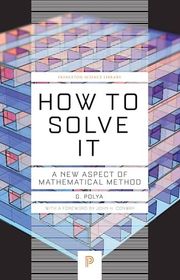
How to Solve It
For students and teachers who want a general approach to unfamiliar mathematical problems. Its questions encourage planning and checking rather than memorized procedures, but the advice becomes useful through active practice rather than passive reading.
What it's about
George Pólya explains how to understand a problem, devise a plan, carry it out and review the result. Mathematical examples and a dictionary of heuristic ideas explore analogy, working backward and other ways to approach unfamiliar questions.

For beginners who want a short introduction to breaking problems into manageable parts. Simple scenarios make logic trees and option comparisons easy to grasp, but the deliberately basic examples offer limited depth for experienced analysts.
What it's about
Ken Watanabe introduces practical problem-solving tools through accessible everyday scenarios. Logic trees, matrices, and diagrams help readers analyze causes, compare options, and plan action, using examples such as organizing a concert, choosing a school, and saving for a computer.

The Art and Craft of Problem Solving
For mathematically prepared learners who want to develop skill through challenging problems. Its strategies and exercises encourage experimentation and discovery, but it demands more sustained effort and mathematical background than the general workplace guides.
What it's about
Paul Zeitz develops mathematical problem-solving habits through strategies, examples and exercises. Drawing on competition coaching, the book encourages students to investigate unfamiliar questions and build mathematical intuition by working through problems rather than only studying finished solutions.

For teams that need to turn a specific challenge into a prototype and customer feedback. Its scheduled exercises make collaboration concrete, but the five-day format requires preparation, access to users and time from the right people.
What it's about
Knapp, Zeratsky, and Kowitz describe a five-day process for tackling difficult problems and testing ideas. Their design sprint guides teams from identifying a challenge through selecting a solution, building a prototype, and learning from customer responses before committing further resources.
Also recommended by
1 person Marty Cagan recommended this book
Marty Cagan
Marty Cagan mentioned this book on twitter.
Marty Cagan's recommendation of this book

For people who think or communicate more effectively with pictures. Its simple drawing tools help make relationships and options visible, but visual clarity still needs supporting evidence and does not replace detailed analysis when a decision demands it.
What it's about
Dan Roam explains how simple drawings can help people understand problems and communicate ideas. Business examples and visual-thinking techniques guide readers in identifying patterns, organizing information, and using pictures to explore solutions without needing advanced drawing skills.
Also recommended by
1 person Shane Parrish recommended this book
Shane Parrish
"Consider this a smart primer on visual thinking." - Shane Parrish
Shane Parrish's recommendation of this book

For leaders and teams tired of repeatedly responding to the same failures. Its prevention-focused stories shift attention toward underlying conditions, but applying that perspective often requires coordination and investment before the benefits become visible.
What it's about
Dan Heath explores efforts to prevent problems before they occur, using cases from organizations and public services. He examines the barriers to prevention and the systems, incentives, and habits that keep people focused on responding to recurring crises.
Also recommended by
1 person Adam Grant recommended this book
Adam Grant
"Now that you have a better handle on solving the problems, it’s time to learn how to prevent them from occurring in the first place." - Adam Grant
Adam Grant's recommendation of this book
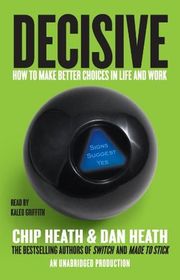
Decisive
For readers who have identified a problem but struggle to choose a response. Its four-step decision process turns awareness of bias into practical habits, though it focuses more on evaluating options than diagnosing technical causes.
What it's about
Chip and Dan Heath examine the biases that distort decisions in work and personal life. Their four-step process helps readers broaden options, test assumptions, gain perspective and prepare for uncertainty, using stories to illustrate how choices can improve.
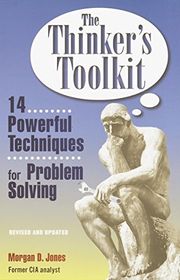
The Thinker's Toolkit
For professionals who want several analytical techniques available for different kinds of questions. Its collection supports breaking down problems and comparing options, but choosing and applying the right tool takes more effort than following one fixed process.
What it's about
Morgan Jones presents fourteen techniques for organizing thought, examining problems and making decisions. The book connects common reasoning difficulties with practical analytical tools, giving managers and other professionals ways to structure information and consider alternatives more deliberately.

Thinking in Systems
For readers whose problems keep returning after local fixes. Its account of feedback and interconnected parts helps explain unintended consequences, but it develops a way of seeing complex situations rather than a quick troubleshooting checklist.
What it's about
Donella Meadows introduces systems thinking as a way to understand connected problems from everyday life to global crises. Edited by Diana Wright, the primer explains why isolated fixes can fail and encourages attention to relationships within a larger whole.
Also recommended by
3 people Tobi Lütke recommended this book
Tobi Lütke
Mentioned on "The Knowledge Project" podcast.
Tobi Lütke's recommendation of this book  Patrick O'Shaughnessy recommended this book
Patrick O'Shaughnessy
"If you want a new way to think about yourself, your business, the market, or any other system of parts and interactions, this is the book for you." - Patrick O'Shaughnessy
Patrick O'Shaughnessy's recommendation of this book  Ryan Shea recommended this book
Ryan Shea
Ryan Shea recommended this book on his website.
Ryan Shea's recommendation of this book

The Art of Thinking Clearly
For readers who prefer brief introductions to common thinking traps they can consider one at a time. The short chapters make browsing easy, but recognizing a bias does not provide a complete method for solving a problem.
What it's about
Rolf Dobelli examines common errors in reasoning through ninety-nine short chapters. Everyday examples illustrate cognitive biases and mistaken judgments, inviting readers to recognize recurring traps and reconsider how they make decisions at work and in personal life.
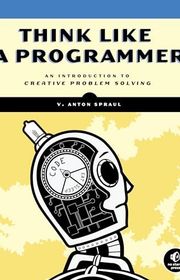
Think Like a Programmer
For novice programmers who know some syntax but freeze when facing an open-ended assignment. Its exercises develop decomposition and solution-building habits, but the C++ examples require language familiarity and do not form a general business problem-solving guide.
What it's about
V. Anton Spraul explores how programmers turn unfamiliar requirements into working solutions. Chapters and exercises develop decomposition, experimentation and reasoning through topics such as recursion, pointers and classes, using C++ examples to teach habits that extend beyond one language.

Think Smarter
Critical Thinking to Improve Problem-Solving and Decision-Making Skills
For professionals who want practical questions and exercises for clarifying workplace problems. Its progression from understanding to conclusions and decisions gives critical thinking a usable structure, though the business setting limits its coverage of mathematical problem solving.
What it's about
Michael Kallet offers a practical framework for critical thinking in workplace decisions. Tools, exercises, and business examples help readers clarify problems, examine assumptions, ask stronger questions, reach conclusions, and turn their reasoning into decisions and action.

For readers who want to examine attention and observation through a familiar fictional detective. The Holmes framework makes psychological ideas approachable, but it offers fewer ready-to-use analytical templates than the workplace-focused books here.
What it's about
Maria Konnikova uses Sherlock Holmes's habits of observation and deduction to examine how people think. Drawing on psychology and neuroscience, she explores attention, memory and reasoning, with practices intended to make perception and judgment more deliberate.

For readers who want to improve judgment by connecting ideas across disciplines. Its attention to recurring mental errors supports more careful reasoning, but the wide-ranging reflections are less immediately usable than a step-by-step problem-solving workbook.
What it's about
Peter Bevelin explores why people make errors in judgment and how they can improve their thinking. Drawing on Charles Darwin, Charlie Munger, and ideas from many disciplines, he examines mental influences and tools for avoiding damaging mistakes.
Also recommended by
5 people Jason Fried recommended this book
Jason Fried
"I think any book that reviews Charlie Munger’s ideas is worth reading, and this one in particular weaves in wisdom from some of history’s greatest minds." - Jason Fried
Jason Fried's recommendation of this book  Derek Sivers recommended this book
Derek Sivers
"A great overview of the lessons of Charlie Munger (partner of Warren Buffett) - and his approach to checklists of multi-disciplinary models to guide clear thinking." - Derek Sivers
Derek Sivers's recommendation of this book  Nassim Taleb recommended this book
Nassim Taleb
"A wonderful book on wisdom and decision-making written by a wise decision-maker." - Nassim Taleb
Nassim Taleb's recommendation of this book - Shane Parrish recommended this book
Shane Parrish
"Inspired by Munger, [the author's] put together a book of the big ideas that carry a lot of weight in life." - Shane Parrish
Shane Parrish's recommendation of this book  Tai Lopez recommended this book
Tai Lopez
"Good book." - Tai Lopez
Tai Lopez's recommendation of this book
Sources
- 1
12 Best Problem Solving Books to Read
teambuilding.com
- 2
Problem Solving Books
goodreads.com
- 3
100 Best Problem Solving Books of All Time
shortform.com
- 4
Books on methodology
reddit.com
- 5
The Best Books on Problem Solving
digitalfridays.co.uk
- 6
The Best 17 Problem Solving Books
blinkist.com
- 7
Problem Solving Books
reddit.com
- 8
Books to Recommend to Maths Students
aperiodical.com
- 9
5 of The Best Problem Solving Books I’ve Read
theexceptionalskills.com






Edited by
Software engineer whose passion for tracking book recommendations from podcasts inspired the creation of MRB.
Lead investor at 3one4 Capital whose startup expertise and love for books helped shape MRB and its growth.
Comments
Spotted a missing book, a wrong order or a mistake? Tell us and we'll fix this page.
We're a reading guide, not the author or publisher, so we can't send books or pass on messages.