
17 Best Precalculus Books
The best precalculus books, ranked by how many expert sources recommend each one, with notes on who each book suits and where to start learning.
Our take
Precalculus brings algebra, functions, graphs, and trigonometry together so that calculus has something solid to build on. The right book depends on whether you need a full course, a review of forgotten techniques, or harder problems that stretch your reasoning. A student following a class may need its assigned edition, while an independent learner benefits from clear explanations and enough worked solutions to check mistakes.
Several books here share the title Precalculus but differ in approach. Stewart emphasizes functions and modeling, Blitzer uses everyday applications, and Rusczyk’s problem-led treatment expects stronger preparation. Abramson provides a broad course with a free online version. For a gentler review, Pre-Calculus Demystified offers staged explanations and quizzes. Precalculus Mathematics in a Nutshell is shorter and more conceptual, with fewer opportunities for extended practice. Start with a self-teaching guide if you are returning to the subject, or a complete textbook if you need to cover a syllabus.
17 books · 10 sources · Last updated
As an Amazon Associate, we earn from qualifying purchases (at no extra cost to you).
How to choose from this list
Skip to the full rankingIf you want a gentle independent review: Pre-Calculus Demystified
If you want conversational explanations: Pre-Calculus For Dummies
If you want a short conceptual refresher: Precalculus Mathematics in a Nutshell
If algebra is your main gap: College Algebra
The 17 books, ranked
Ranked by how many expert sources name each book. Ties go to the book more people recommend.

Precalculus
For students who want a complete course they can also access freely online. Its modular chapters and worked examples support selective review, though the extensive coverage is more material than most readers need at once.
What it's about
Jay Abramson and his coauthors introduce precalculus through learning objectives, worked examples, and exercises. The text progresses from functions and logarithms to trigonometry, systems of equations, analytic geometry, sequences, probability, and an introduction to calculus.

For students who want a full course organized around functions and preparation for calculus. Its worked examples connect algebra, graphs, and modeling, though the large volume and calculator material can overwhelm readers seeking a brief review.
What it's about
Stewart, Redlin, and Watson develop the function concept as a foundation for calculus. Explanations, problem solving, mathematical modeling, and graphing-calculator material help students connect algebraic ideas with graphs and build the reasoning skills needed for further mathematics.

Precalculus
For students who want a conventional course with structured practice and applications. Larson’s treatment links functions with mathematical models, though the comprehensive format requires more sustained study than a compact review guide.
What it's about
Larson develops the concepts and skills needed before studying calculus through structured explanations, exercises, and applications. The textbook reviews functions and graphs and treats polynomial, rational, exponential, and logarithmic functions, helping students connect algebraic methods with mathematical models.
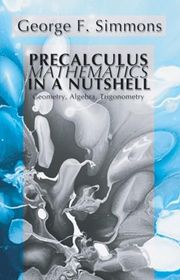
Precalculus Mathematics in a Nutshell: Geometry, Algebra, Trigonometry
For returning students who want a compact explanation of the ideas behind familiar procedures. Its short geometry, algebra, and trigonometry sections suit review, though it lacks the breadth and exercise volume of a complete course.
What it's about
Simmons revisits geometry, algebra, and trigonometry in three concise sections aimed at preparing readers for calculus. The explanations emphasize how central ideas fit together, offering a short conceptual review rather than a full textbook sequence.
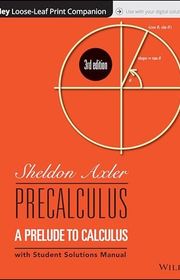
Precalculus: A Prelude to Calculus
For self-learners who want definitions developed carefully with substantial feedback. Its complete worked solutions to odd-numbered exercises support independent study, though the deliberate focus on calculus preparation leaves less room for broader enrichment.
What it's about
Axler develops functions, algebra, exponential and logarithmic ideas, and trigonometry as preparation for calculus. Examples connect the concepts, while complete solutions to odd-numbered exercises let students check their reasoning and learn from a worked approach.

Precalculus
For students who understand mathematics better through recognizable applications. Blitzer’s everyday examples give abstract functions a concrete setting, though readers who prefer a spare mathematical presentation may find the contextual material distracting.
What it's about
Robert Blitzer uses examples from everyday life and varied academic fields to connect precalculus with students’ interests. Explanations, exercises, and review of prerequisite material support both mathematical techniques and conceptual understanding as students prepare for further coursework.

For students who need to connect equations with graphs and numerical evidence. Its multiple-representation approach encourages flexible problem solving, though calculator-based exploration adds another skill to manage while learning the underlying algebra.
What it's about
Franklin Demana and his coauthors teach precalculus through graphical, numerical, and algebraic approaches to functions and problems. The textbook develops conceptual understanding alongside problem-solving skills, covering functions, trigonometry, and related topics in preparation for calculus.

Precalculus
For students who benefit from a consistent cycle of preparation, practice, and review. Sullivan’s organized exercise structure supports steady coursework, though independent readers still need discipline to work through the repeated skills practice.
What it's about
Michael Sullivan's precalculus textbook combines explanations and exercises with a prepare, practice, and review approach. It develops skills in functions, graphs, and related mathematics, connecting concepts with applications and providing practice for students preparing to study calculus.

Pre-Calculus Demystified
For independent learners who want explanations broken into manageable steps. Its quizzes and final exam help check progress without an instructor, though the scope is narrower than a comprehensive classroom textbook.
What it's about
Rhonda Huettenmueller provides a self-study introduction to precalculus, moving from basic concepts to more complex problems. Worked examples cover functions, logarithms, matrices, trigonometry, and conic sections, while chapter quizzes and a final exam support review.

Pre-Calculus For Dummies
For learners who want a conversational explanation alongside a demanding class. Its broad review connects functions, trigonometry, and graphs in accessible language, though it provides less depth than a full college textbook.
What it's about
Mary Jane Sterling reviews functions, trigonometry, analytic geometry, systems, and sequences in preparation for calculus. Explanations move from prerequisite number skills to more advanced topics, connecting algebraic procedures with graphs and applications throughout the guide.

For strong algebra students who enjoy discovering ideas through demanding problems. Rusczyk’s approach develops more inventive problem solving than a routine course text, though it assumes preparation and patience with challenging exercises.
What it's about
Richard Rusczyk teaches trigonometry, complex numbers, vectors, and matrices through problems that invite students to develop ideas before reading solutions. The textbook combines routine exercises with challenging competition problems, including examples from the AIME and USAMO.
Precalculus
For students whose algebra preparation needs reinforcement alongside new precalculus material. Its worked examples and practice address gaps before they grow, though the course-length format is less convenient for a quick refresher.
What it's about
Julie Miller and Donna Gerken introduce the algebraic and trigonometric foundations needed for calculus. The textbook builds skills through worked examples and practice, addressing gaps in preparation while connecting mathematical concepts to applications students may encounter.

For returning learners who want to rebuild confidence at their own pace. Its frequent self-tests make progress visible across algebra, functions, and trigonometry, though it offers less breadth than a full college textbook.
What it's about
Steve Slavin and Ginny Crisonino offer a self-paced introduction to precalculus. An algebra review leads into exponential and logarithmic functions and trigonometry, with exercises and frequent self-tests designed to reinforce understanding as readers work through the material.

For secondary-school students who want systematic algebra and trigonometry before calculus. Its organized lessons emphasize building techniques in sequence, though the classroom orientation gives independent learners less guidance on choosing a study path.
What it's about
This mathematics textbook develops algebraic reasoning alongside trigonometry. It covers equations, inequalities, real numbers, and expressions before examining trigonometric functions, triangle problems, graphs, identities, vectors, and complex numbers, with organized lessons for secondary-school study.

College Algebra
For students whose main obstacle to precalculus is weak algebra. Blitzer’s contextual examples can help connect symbolic work with familiar situations, though the book does not provide the trigonometry needed for a complete precalculus course.
What it's about
Robert Blitzer teaches college algebra through applications connected to students’ lives, including borrowing, grades, and sleep habits. Prerequisite reviews, conceptual exercises, and worked instruction combine skills practice with explanations of how mathematics describes everyday situations.

Pre-Calculus Workbook For Dummie
For students who understand explanations but need more practice applying them. Its worked solutions help diagnose mistakes across precalculus topics, though the brief reviews make it a supplement rather than a complete first course.
What it's about
Mary Jane Sterling pairs concise concept reviews with examples and extensive precalculus practice. Exercises cover functions, trigonometry, polar coordinates, sequences, and limits, with working space and step-by-step solutions that explain how to approach and check each problem.

For high-school students who want a course-length bridge from algebra to calculus. Its broad advanced-math coverage supports structured classroom study, though independent learners may need extra explanation and feedback outside the textbook.
What it's about
McGraw Hill’s student textbook supports advanced high-school mathematics before calculus, extending earlier work with algebra and functions. It provides a course-length treatment of precalculus for classroom study, bridging familiar mathematical concepts and the demands of later coursework.
Sources
- 1
The 10 Best Precalculus Textbooks
wiki.ezvid.com
- 2
81 Best Pre-Calculus Books of All Time
shortform.com
- 3
Precalculus Books
goodreads.com
- 4
AP Precalculus Course Audit
apcentral.collegeboard.org
- 5
The 9 Best Precalculus Books—For Any Budget
celsiuselements.com
- 6
Find your textbook — Divide and Conquer Math
divideandconquermath.com
- 7
Open Educational Resources and Mathematics
asccc-oeri.org
- 8
Precalculus self study books recs
reddit.com
- 9
If you could choose one Precalculus book for self studying , what would that be?
reddit.com
- 10
What is a good book to learn all of precalculus?
math.stackexchange.com



Edited by
Software engineer whose passion for tracking book recommendations from podcasts inspired the creation of MRB.
Lead investor at 3one4 Capital whose startup expertise and love for books helped shape MRB and its growth.
Comments
Did we miss something? Have feedback?
Help us improve this page by sharing your thoughts