
15 Best Calculus Books
The best calculus books, ranked by how many expert sources recommend each one, with notes on prerequisites, learning goals, and the best place to start.
Our take
Calculus studies change and accumulation, but books teach it in very different ways. A general reader may want to know what its ideas explain. A student may need worked examples and enough exercises to become fluent. Someone preparing for advanced mathematics needs a third kind of book, one that develops definitions and proofs rather than relying mainly on calculations.
Choose your route before choosing a large textbook. Infinite Powers offers motivation and context without functioning as a course. Calculus Made Easy provides a gentler introduction, while the standard texts by Stewart, Larson, and Hass suit a structured college sequence. Kline connects techniques with physical intuition. Spivak and Calculus Deconstructed demand more attention to reasoning. The workbooks help when practice is the missing piece. Most routes assume comfortable algebra, and many need trigonometry as well. Start with the book that matches your present skills, and plan to solve problems as you read.
15 books · 8 sources · Last updated
As an Amazon Associate, we earn from qualifying purchases (at no extra cost to you).
How to choose from this list
Skip to the full rankingIf you want to understand the big ideas: Infinite Powers → Calculus Made Easy
If you want physical intuition: Calculus
If you need more worked explanations: The Calculus Lifesaver
If you want extra practice: The Humongous Book of Calculus Problems → Essential Calculus
If you want proofs with Spivak: Calculus → Calculus Deconstructed
If you want a rigorous course with linear algebra: Calculus, Volume 1
The 15 books, ranked
Ranked by how many expert sources name each book. Ties go to the book more people recommend.

Calculus
For students ready to learn why calculus works through proofs and demanding problems. It develops mathematical reasoning more deeply than the computational texts here, though strong algebra and patience with abstraction are essential.
What it's about
Michael Spivak introduces calculus through rigorous reasoning and proofs rather than computation alone. Beginning with properties of numbers, he develops limits, differentiation, integration, and infinite series, using challenging problems to build an understanding of mathematical analysis.

For students who need a comprehensive text for the usual science or engineering sequence. The extensive exercises support regular practice, though its size and computational emphasis make it less inviting for a first encounter with proofs.
What it's about
Stewart develops calculus through functions, mathematical models, explanations, and exercises. Beginning with limits, derivatives, and integrals, the textbook progresses to differential equations, series, vectors, partial derivatives, multiple integrals, and vector calculus, including applications throughout.

For learners who want physical meaning and geometric intuition before formal proofs. Its applications explain why the techniques were developed, though the older presentation and notation may differ from a current course.
What it's about
Kline introduces calculus through intuition and applications to the physical sciences. Worked examples and exercises develop differentiation and integration, including the chain rule, trigonometric, exponential, and logarithmic functions, and polar coordinates, connecting mathematical techniques with the problems they solve.

For learners who want to strengthen the calculation skills used in science and engineering. Full solutions make independent checking practical, though the workbook’s focused scope needs a main text for broader theory and context.
What it's about
McMullen provides calculus practice problems with complete solutions for checking each step. Topics include differentiation rules, higher derivatives, limits, extrema, antiderivatives, integration by substitution and parts, and multiple integrals, emphasizing the computational skills used in science and engineering.

Calculus Made Easy
For beginners who find modern textbook explanations intimidating. Its informal worked examples make the first ideas approachable, though the older style and limited scope mean you’ll need a fuller text for a complete course.
What it's about
Silvanus P. Thompson introduces differentiation and integration through straightforward explanations and worked examples. This edition, revised by Martin Gardner, adds introductory chapters on functions and limits, updates the language, and supplies further practice problems.
Also recommended by
1 person Naval Ravikant recommended this book
Naval Ravikant
"I love [this book]." - Naval Ravikant
Naval Ravikant's recommendation of this book

Calculus
For students who want a conventional course with numerous worked examples. Its instructional structure supports steady practice, though the large textbook format is less suitable for someone seeking a short conceptual overview.
What it's about
Larson and Edwards present a comprehensive calculus course supported by explanations, worked examples, and exercises. Preparatory material on graphs, models, and rates of change helps students build the mathematical foundation needed for the calculus topics that follow.

For mathematically confident students who want calculus and an introduction to linear algebra together. Its rigorous development offers a broader foundation than a computational course, though the integration-first sequence and challenging exercises need sustained effort.
What it's about
Tom Apostol introduces calculus by treating integration before differentiation, linking the two through theory and technique. Geometric explanations, historical context, theorem proofs, and exercises accompany the development of single variable calculus and an introduction to linear algebra.

For curious readers who want to understand why calculus matters before solving exercises. The historical stories and applications give the ideas context, though this is an introduction to their significance rather than a calculus course.
What it's about
Steven Strogatz explains how calculus uses infinity to make sense of change. Following its development from ancient mathematical problems to modern science, he connects its central ideas with technologies and discoveries that shape daily life.
Also recommended by
2 people- Naval Ravikant recommended this book
Naval Ravikant
Naval Ravikant tweeted about this book.
Naval Ravikant's recommendation of this book  Michael Mauboussin recommended this book
Michael Mauboussin
"Awesome." - Michael Mauboussin
Michael Mauboussin's recommendation of this book

Calculus For Dummies
For beginners who want conversational explanations alongside step-by-step examples. It can make a first course feel less opaque, though it does not offer the depth or range of a comprehensive college textbook.
What it's about
Ryan introduces calculus in plain language, explaining both how its techniques work and why they are useful. Step-by-step examples develop the foundations of differentiation and integration, giving readers a practical route through concepts that can initially seem abstract.
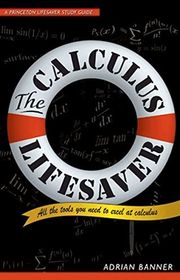
The Calculus Lifesaver
For students who need a patient companion to lectures or a terse textbook. The extended explanations address common sticking points in single-variable calculus, though the detail makes it a substantial read rather than a quick reference.
What it's about
Adrian Banner explains single-variable calculus through detailed discussions and worked examples, developing limits, derivatives, integrals, and series. Written to accompany the learning process, it addresses the reasoning behind methods as well as their execution.

For students who want a full college sequence with substantial diagrams and conceptual explanation. It provides a structured alternative to Stewart or Larson, though its length and exercise load call for a syllabus or study plan.
What it's about
Designed for a full college calculus sequence, this textbook emphasizes understanding concepts rather than memorizing formulas. Intuitive explanations, applications, and increasingly general mathematical ideas support students in mathematics, engineering, and science as they develop their problem-solving skills.

Calculus & Its Applications
For students taking an applied calculus course who want ideas connected with practical models. The intuitive treatment supports problem solving, though it offers less preparation for proof-based mathematics than the more theoretical choices.
What it's about
This applied calculus textbook introduces key ideas intuitively before developing their analytical foundations. Geometric explanations of derivatives and net-change interpretations of integrals accompany worked examples, exercises, and applications, including differential equations used to model exponential and logarithmic phenomena.

For readers who have completed calculus and want to understand its logical foundations. Its second-pass approach bridges familiar techniques and proof, though it assumes enough previous calculus to revisit rather than introduce the subject.
What it's about
Nitecki revisits single-variable calculus for readers who have already studied the subject but have little experience with proofs. The book develops its logical foundations through examples, historical context, and rigorous treatment of real numbers, limits, continuity, differentiation, integration, and series.

Calculus with Applications
For business, life science, and social science students whose course emphasizes applications. Its algebra review and contextual problems offer a practical route in, though it is less suited to a full engineering or mathematics sequence.
What it's about
Margaret Lial and her coauthors teach calculus through problems relevant to business, life science, and social science. Reviews of algebra and functions lead into limits, continuity, and derivatives, connecting mathematical techniques with applications such as growth and change.

The Humongous Book of Calculus Problems
For students who understand a lesson but need to see more problems worked through. The annotated solutions help reveal intermediate steps, though it works best beside a teaching text rather than replacing one.
What it's about
Kelley presents 1,000 calculus problems with complete solutions and explanatory notes. The collection covers limits, continuity, derivatives, integrals, series, and applications such as velocity, acceleration, areas, and volumes, alongside proof-oriented material and Riemann sums.
Sources
- 1
Best Calculus Textbooks – 10 Excellent Choices For Your Learning
wisdomfuel.com
- 2
I need a great calculus book!!!
reddit.com
- 3
Textbook Recommendation?
reddit.com
- 4
Recommended Supplementary Books
web.mit.edu
- 5
Calculus Books
goodreads.com
- 6
20 Best Calculus Books for Students in 2026
gauravtiwari.org
- 7
8 Best Calculus Books for Self Study [2026 Updated] - iMath
imathist.com
- 8
Best Calculus Books for Students and Self-Learners
celsiuselements.com





Edited by
Software engineer whose passion for tracking book recommendations from podcasts inspired the creation of MRB.
Lead investor at 3one4 Capital whose startup expertise and love for books helped shape MRB and its growth.
Comments
Did we miss something? Have feedback?
Help us improve this page by sharing your thoughts