
9 Best Number Theory Books
The best number theory books, ranked by how many expert sources recommend each one, with notes on prerequisites, reader level and where to begin.
Our take
Number theory studies whole numbers, from primes and divisibility to equations whose solutions must be integers. Its questions can be easy to state and surprisingly hard to prove. These books suit curious readers learning to write proofs, undergraduates taking a first course, and students ready to connect arithmetic with algebra or analysis.
The main difference is how much mathematics each book assumes. A Friendly Introduction to Number Theory builds from examples and conjectures, while Burton's Elementary Number Theory offers a more conventional course with historical context. Andrews's Number Theory brings a combinatorial perspective. A Classical Introduction to Modern Number Theory is a better fit once you know abstract algebra, and Introduction to Analytic Number Theory develops tools that eventually require complex analysis. For a first encounter, start with Silverman and work the exercises before choosing a more specialized direction.
9 books · 9 sources · Last updated
As an Amazon Associate, we earn from qualifying purchases (at no extra cost to you).
How to choose from this list
Skip to the full rankingIf you're learning to write proofs: A Friendly Introduction to Number Theory
If you want a structured first course: Elementary Number Theory
If you enjoy counting arguments: Number Theory
If you already know abstract algebra: A Classical Introduction to Modern Number Theory
If you're ready for analytic methods: Introduction to Analytic Number Theory
The 9 books, ranked
Ranked by how many expert sources name each book. Ties go to the book more people recommend.

Elementary Number Theory
For undergraduates learning proof through a structured first course. Historical context and a conventional progression help make the core ideas approachable, though readers seeking open exploration may prefer a less textbook-driven approach.
What it's about
David Burton introduces classical number theory within its historical development. Mathematical induction, divisibility, the Euclidean algorithm and Diophantine equations provide foundations for an undergraduate course, connecting formal mathematical ideas with the subject's long history.

A Classical Introduction to Modern Number Theory
For students who already know abstract algebra and want a route beyond elementary number theory. Its connections to finite fields and algebraic methods offer more depth than introductory texts, but the prerequisites matter.
What it's about
Kenneth Ireland and Michael Rosen connect elementary number theory with advanced algebraic topics. Their text develops congruences, reciprocity, finite fields, number fields and elliptic curves, combining historical context with a framework requiring basic abstract algebra.

An Introduction to the Theory of Numbers
For undergraduates who want a substantial traditional course with numerical examples alongside proofs. Its breadth supports further study across number theory, though working through the many exercises requires more time than a short introduction.
What it's about
Ivan Niven, Herbert Zuckerman and Hugh Montgomery introduce number theory through congruences, quadratic reciprocity and arithmetic functions. Worked numerical examples and exercises develop the theory, while topics including public-key cryptography connect it with modern applications.

An Introduction to the Theory of Numbers
For readers with proof experience who want a broad reference to revisit over time. The range of classical results makes it rewarding to browse, though its compact explanations are demanding for a first course.
What it's about
G. H. Hardy and E. M. Wright’s textbook surveys number theory, from primes and divisibility to deeper properties of integers. This revised sixth edition extends the classic treatment with updated material and developments in the subject.

For students drawn to computation and cryptography who want classical theory tied to applications. Projects and practical examples give the subject a concrete purpose, though the textbook breadth can feel lengthy for casual reading.
What it's about
Kenneth Rosen connects classical number theory with computational methods and contemporary applications. Topics including primes, divisibility, integer representations and cryptology are developed through explanations, exercises and projects that bring mathematical ideas into practical use.
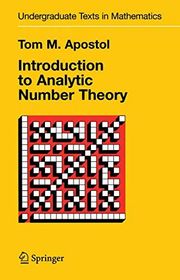
Introduction to Analytic Number Theory
For students with calculus and proof experience who want to understand arithmetic functions and the distribution of primes. Its systematic development connects elementary results with analytic techniques, but later chapters require complex analysis.
What it's about
Tom Apostol develops number theory from divisibility and arithmetic functions through congruences, Dirichlet series and prime distribution. Exercises accompany the theory, with calculus supporting the earlier material and complex analysis needed for the later chapters.
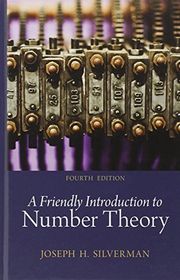
A Friendly Introduction to Number Theory
For beginners who know high school algebra and want to learn how proofs emerge from experiments. Numerical patterns lead naturally into conjectures and arguments, though its leisurely pace may frustrate students seeking a compact reference.
What it's about
Joseph Silverman introduces number theory through numerical examples, patterns and conjectures before developing proofs. Starting with high school algebra, readers explore divisibility, primes and equations while learning how to ask and investigate mathematical questions.

Number Theory
For readers who enjoy counting arguments and want an elementary course with a combinatorial angle. That perspective distinguishes it from broader traditional surveys, though it offers less guidance toward later algebraic or analytic study.
What it's about
George Andrews introduces number theory using a combinatorial approach. Starting with divisibility and the fundamental theorem of arithmetic, his textbook develops congruences, arithmetic functions, primitive roots and prime numbers, emphasizing elementary methods and computation.

An Introduction to Number Theory
For students who want elementary techniques developed toward quadratic fields. Its exercises encourage active mathematical thinking, but readers looking for a standard course that includes quadratic reciprocity will need another text alongside it.
What it's about
Harold Stark introduces elementary number theory through divisibility, congruences, Diophantine equations, irrational numbers and continued fractions. Numerous exercises accompany the exposition, which culminates in quadratic fields and encourages students to reconsider familiar mathematical assumptions.
Sources
- 1
Number Theory: more books
math.berkeley.edu
- 2
Recommended Books in Number Theory
mathstat.dal.ca
- 3
Number Theory Books
goodreads.com
- 4
Looking for number theory textbook recommendations
reddit.com
- 5
Learning number theory
reddit.com
- 6
Syllabus | Theory of Numbers | Mathematics | MIT OpenCourseWare
ocw.mit.edu
- 7
Best Number Theory Books: 10 Honest Picks
gauravtiwari.org
- 8
reference request - Books on Number Theory for Layman - Mathematics Stack Exchange
math.stackexchange.com
- 9
NTIC General References
math-cs.gordon.edu






Edited by
Software engineer whose passion for tracking book recommendations from podcasts inspired the creation of MRB.
Lead investor at 3one4 Capital whose startup expertise and love for books helped shape MRB and its growth.
Comments
Spotted a missing book, a wrong order or a mistake? Tell us and we'll fix this page.
We're a reading guide, not the author or publisher, so we can't send books or pass on messages.