
8 Best Manufacturing Books
The best manufacturing books, ranked by how many expert sources recommend each one, with notes on who each suits, from product designers to plant leaders.
Our take
Manufacturing combines decisions about products, processes, people, and the flow of work. Books on the subject therefore serve different readers. A designer comparing materials and production methods needs a different reference from a plant manager trying to improve throughput or a team leader introducing new working habits. Some titles explain operations directly; others provide historical context or management principles.
Manufacturing Processes for Design Professionals connects product ideas with ways to make them, while The Design of Everyday Things asks whether the result makes sense to its users. The Toyota Way focuses on management thinking, and How To Implement Lean Manufacturing moves toward organizational change. For production flow, The Goal introduces constraints through a story and Factory Physics offers a more technical treatment. Start with the problem closest to your work, then read across design, operations, and leadership to see how improvements in one area affect the others.
8 books · 11 sources · Last updated
As an Amazon Associate, we earn from qualifying purchases (at no extra cost to you).
How to choose from this list
Skip to the full rankingIf you’re new to production flow: The Goal → Factory Physics
If you lead a lean improvement effort: The Toyota Way → How To Implement Lean Manufacturing
If you design physical products: Manufacturing Processes for Design Professionals → The Design of Everyday Things
If you want industry history: Faster, Better, Cheaper in the History of Manufacturing
If you want to improve frontline leadership: Make It Right
The 8 books, ranked
Ranked by how many expert sources name each book. Ties go to the book more people recommend.

For managers who want to understand the thinking behind Toyota’s production approach. Its attention to leadership and culture gives tools a wider purpose, though applying the principles requires adaptation rather than copying Toyota’s visible practices.
What it's about
Jeffrey Liker examines Toyota's management philosophy and production system through fourteen principles. This second edition explores how organizations can develop an improvement approach suited to their circumstances, with updated frameworks for innovation and quality.

The Design of Everyday Things
For manufacturers and designers who want products and interfaces people can understand. Its focus on users supplies a useful counterweight to production efficiency, though it offers little detail on factory operations or process engineering.
What it's about
Don Norman examines why everyday objects can be difficult to use, locating many failures in design rather than their users. He connects human psychology with product design to explain how objects can better support understandable interaction.
Also recommended by
4 people Scott Adams recommended this book
Scott Adams
One of the books on Scott Adams' "Persuasion Reading List."
Scott Adams's recommendation of this book  Jeff Atwood recommended this book
Jeff Atwood
"Will give you a new appreciation of the 'devil in the details.'" - Jeff Atwood
Jeff Atwood's recommendation of this book  Tobi Lütke recommended this book
Tobi Lütke
Tobi Lütke mentioned this book on the "Invest Like the Best" podcast.
Tobi Lütke's recommendation of this book  Marissa Mayer recommended this book
Marissa Mayer
"Makes you think about design in new ways." - Marissa Mayer
Marissa Mayer's recommendation of this book

For readers who want an accessible introduction to production constraints without beginning with a textbook. Its business-story format makes operational tradeoffs memorable, though the fictional setting simplifies the complexity of an actual factory.
What it's about
Plant manager Alex Rogo has ninety days to rescue his struggling factory while his marriage also unravels. Guidance from Jonah pushes him to question conventional measures of productivity in this business novel introducing the Theory of Constraints.
Also recommended by
3 people Jeff Bezos recommended this book
Jeff Bezos
Part of "Jeff's Reading List."
Jeff Bezos's recommendation of this book  Kevin Systrom recommended this book
Kevin Systrom
"About basically manufacturing and supply chain management. It sounds really boring, but I promise you it’s really good." - Kevin Systrom
Kevin Systrom's recommendation of this book  Trung Phan recommended this book
Trung Phan
"About the Operations industry." - Trung Phan
Trung Phan's recommendation of this book

Faster, Better, Cheaper in the History of Manufacturing
For readers who want manufacturing placed in a long historical context. Its connection between technical and organizational change broadens the subject beyond lean tools, though it is a history rather than an implementation manual.
What it's about
Christoph Roser traces manufacturing from early tools to modern industrial systems. His history considers technological and organizational innovations, the people behind them, and examples of success and failure, including automation and the development of lean production.

How To Implement Lean Manufacturing
For manufacturing leaders who want an organized approach to introducing lean practices. Its connection between production methods and organizational change makes it practical, though the breadth requires choosing priorities for your own operation.
What it's about
Lonnie Wilson presents a sequence for implementing lean manufacturing across an organization. The second edition combines production methods and case studies with discussion of leadership, culture, inventory, lead times, constraints, and sustaining improvements.

Manufacturing Processes for Design Professionals
For product designers who need to compare ways of making physical objects. Its illustrated process profiles connect design choices with production realities, though the broad reference format cannot replace specialized engineering advice for a particular part.
What it's about
Rob Thompson explains manufacturing processes for designers through illustrated accounts of forming, cutting, joining, and finishing materials. Process profiles compare practical considerations such as cost, speed, and environmental impact, while examples connect production methods with finished products.
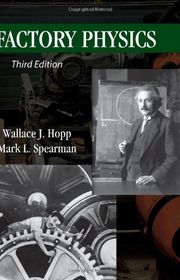
Factory Physics
For engineers and operations managers who want a quantitative understanding of production systems. Its treatment of variability, inventory, and flow gives more analytical depth than management narratives, though the mathematics demands sustained study.
What it's about
Wallace Hopp and Mark Spearman explain manufacturing systems through relationships among variability, capacity, inventory, and production flow. The textbook connects models and operational principles with decisions about managing factories, helping readers analyze performance beyond individual machines or tasks.

Make It Right
5 Steps to Align Your Manufacturing Business from the Frontline to the Bottom Line
For plant leaders who want to connect frontline work with the business’s wider aims. Its leadership framework gives people and communication a central role, though readers seeking detailed process calculations will need a technical companion.
What it's about
Kevin Snook presents a manufacturing leadership approach that connects company purpose with frontline work. His ALIGN framework examines information, support, feedback, and the conditions employees need to make decisions that serve the wider business.
Sources
- 1
Manufacturing Books
goodreads.com
- 2
100 Best Manufacturing Books of All Time
shortform.com
- 3
Lean Manufacturing Books
planview.com
- 4
The best lean and manufacturing improvement books, with honest summaries
theleansuite.com
- 5
25 Best Manufacturing Books to Boost Your Business
navigatecontent.com
- 6
Top 7 Books Every Manufacturer Should Read
weidert.com
- 7
5 Books Every Manufacturer Must Read
benkoproducts.com
- 8
The Best Manufacturing Books for Beginners to Consider Reading
solutionsreview.com
- 9
Book recommendations
reddit.com
- 10
Looking for Must-Read Books on Lean Manufacturing
reddit.com
- 11
Best Books on the Manufacturing Industry
umbrex.com


Edited by
Software engineer whose passion for tracking book recommendations from podcasts inspired the creation of MRB.
Lead investor at 3one4 Capital whose startup expertise and love for books helped shape MRB and its growth.
Comments
Spotted a missing book, a wrong order or a mistake? Tell us and we'll fix this page.
We're a reading guide, not the author or publisher, so we can't send books or pass on messages.