
11 Best Probability Theory Books
The best probability theory books, ranked by how many expert sources recommend each one, with notes on who each text suits and where to start learning.
Our take
Probability theory gives a mathematical language for uncertainty, from counting possible outcomes to studying random processes over time. Learning it involves choosing models, understanding what information changes a probability, and knowing when an intuitive answer needs checking. These books range from first courses using calculus to graduate treatments built on real analysis and measure theory.
A First Course in Probability and Bertsekas and Tsitsiklis’s Introduction To Probability offer structured introductions. Blitzstein and Hwang’s Introduction to Probability gives particular attention to problem-solving intuition. Understanding Probability draws motivation from everyday applications, while Fifty Challenging Problems in Probability with Solutions makes a useful companion for testing your reasoning. Feller’s first volume offers deeper classical examples, and A Course in Probability Theory or Probability: Theory and Examples suits more advanced study. Jaynes’s Probability Theory takes a distinctive route through inference and plausible reasoning. Start at the level of mathematics you can use confidently, then work problems alongside the text.
11 books · 8 sources · Last updated
As an Amazon Associate, we earn from qualifying purchases (at no extra cost to you).
How to choose from this list
Skip to the full rankingIf you want a first calculus-based course: A First Course in Probability
If you want applications to motivate the ideas: Understanding Probability → Introduction To Probability
If you want to sharpen your problem solving: Fifty Challenging Problems in Probability with Solutions → An Introduction to Probability Theory and Its Applications
If you want probability leading into statistics: Probability and Statistics
If you want reasoning under uncertainty: Probability Theory
If you're ready for graduate probability: A Course in Probability Theory → Probability: Theory and Examples
The 11 books, ranked
Ranked by how many expert sources name each book. Ties go to the book more people recommend.

Introduction to Probability
For readers taking a first calculus-based course who want explanations of how to think through problems. Blitzstein and Hwang give intuition and practice substantial attention, though the extensive exercises require active study.
What it's about
Joseph Blitzstein and Jessica Hwang develop probability through examples involving coincidences, paradoxes, and applications in several fields. Based on Harvard statistics lectures, the book combines the tools for reasoning about uncertainty with problems that connect mathematical ideas to practical situations.

A Course in Probability Theory
For readers moving into rigorous probability after an introductory course and real analysis. Chung develops the foundations with mathematical care, though the proof-based treatment is a substantial step beyond learning standard probability calculations.
What it's about
Kai Lai Chung develops probability theory for mathematically advanced readers through rigorous explanations and exercises. Topics include distributions, random variables, expectation, convergence, limit theorems, conditioning, and martingales, offering a foundation for further study in probability and statistics.

For readers who enjoy deriving ideas from rich discrete examples. Feller gives classical probability unusual depth and variety, though the older exposition and demanding problems make it better for sustained study than quick reference.
What it's about
William Feller introduces probability theory through mathematical explanations and applications. The first volume develops sample spaces, combinatorial methods, coin tossing, random walks, distributions, Markov chains, and stochastic processes, using examples to connect theory with problems.

For readers interested in probability as reasoning under incomplete information. Jaynes develops a sustained Bayesian viewpoint with physical examples, though its argumentative style and inferential focus make it an unconventional first probability textbook.
What it's about
E. T. Jaynes develops probability as a framework for reasoning with incomplete information. Treating probability theory and statistical inference as connected, he explores principles of plausible reasoning and their applications to problems such as hypothesis testing and parameter estimation.
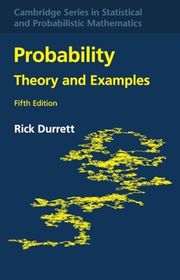
Probability: Theory and Examples
For readers ready for graduate probability with a background in real analysis. Durrett connects rigorous results with many examples and stochastic processes, though the pace and measure-theoretic foundations make it unsuitable as a first course.
What it's about
Rick Durrett develops measure-based probability through laws of large numbers, central limit theorems, martingales, Markov chains, and Brownian motion. Examples and exercises link the general theory with processes and questions that motivate further mathematical study.

A First Course in Probability
For students who know elementary calculus and want a conventional first probability course. Ross supplies many examples and exercises for building technique, though understanding why a model fits a problem still requires deliberate practice.
What it's about
Sheldon Ross introduces the mathematical theory of probability through explanations, examples, and applications. Coverage includes counting, conditional probability, random variables, expectation, and limit theorems, with problems and exercises supporting students who have a background in elementary calculus.

Introduction To Probability
For readers who want probability connected with engineering and other applications. Bertsekas and Tsitsiklis balance intuitive explanations with precise mathematics, though working through the examples and exercises requires comfort with calculus.
What it's about
Dimitri Bertsekas and John Tsitsiklis introduce probability theory and its applications in science, engineering, and economics. The textbook develops random variables, stochastic processes, statistical inference, laws of large numbers, and the central limit theorem with intuitive but precise explanations.

Fifty Challenging Problems in Probability with Solutions
For readers who want to test whether their probability intuition survives carefully chosen puzzles. The worked solutions reveal useful reasoning strategies, though this collection supplements a course rather than teaching its foundations in order.
What it's about
Frederick Mosteller presents fifty probability puzzles ranging from elementary to advanced ideas, each accompanied by a solution. Problems such as an apparently unfair subway choice challenge readers to examine assumptions and apply mathematical reasoning to surprising situations.

Probability and Statistics
For students who want probability to lead directly into statistical inference. DeGroot and Schervish connect distributions with estimation and testing, though readers focused only on probability may find much of the later material outside their goal.
What it's about
Morris DeGroot and Mark Schervish connect probability foundations with statistical inference, balancing classical and Bayesian approaches. This calculus-based textbook covers distributions, estimation, hypothesis testing, linear models, and simulation, with real-data examples supporting the transition from theory to analysis.

For mathematically prepared readers who want a short account of the main ideas. Rozanov keeps the treatment compact and focused, though that economy leaves fewer worked examples than the larger introductory textbooks.
What it's about
Y. A. Rozanov offers a concise introduction to probability theory for readers with some mathematical background. The treatment develops events, dependence, random variables, and Bernoulli trials, then examines important distributions and applications while keeping the presentation self-contained.

Understanding Probability
For readers who want everyday questions to motivate formal probability. Tijms connects intuition with applications and computational ideas, though the later mathematical development still needs more preparation than a purely popular introduction.
What it's about
Henk Tijms introduces probability through everyday applications before developing its mathematical foundations. Exercises and examples cover topics including Bayesian inference, random walks, Monte Carlo simulation, and Markov chains, connecting intuition about chance with formal methods.
Sources
- 1
What is the best book to learn probability?
math.stackexchange.com
- 2
20 Best Books To Learn Probability and Statistics (Mathematical Theory & Calculation)
bestbookshub.com
- 3
Probability Theory Books
goodreads.com
- 4
[Q] Book reccomendation for probability
reddit.com
- 5
Books on Probability Theory
reddit.com
- 6
Top 10 Probability And Statistics Books Suggested By Experts
statanalytica.com
- 7
STA 711 Books
stat.duke.edu
- 8
Readings | Theory of Probability
ocw.mit.edu






Edited by
Software engineer whose passion for tracking book recommendations from podcasts inspired the creation of MRB.
Lead investor at 3one4 Capital whose startup expertise and love for books helped shape MRB and its growth.
Comments
Spotted a missing book, a wrong order or a mistake? Tell us and we'll fix this page.
We're a reading guide, not the author or publisher, so we can't send books or pass on messages.