
7 Best Quantum Field Theory Books
The best quantum field theory books, ranked by expert source recommendations, with notes to help you choose introductory courses, conceptual guides, and references.
Our take
Quantum field theory brings quantum mechanics together with fields and relativity, providing tools for studying particles and many-body systems. Learning it requires more than a familiarity with popular quantum ideas: these books assume substantial mathematics and prior physics. They differ in how much calculation they show, how they motivate the framework, and which applications they emphasize.
For a gradual transition from undergraduate study, consider Quantum Field Theory for the Gifted Amateur. Peskin and Schroeder’s An Introduction To Quantum Field Theory and Schwartz’s Quantum Field Theory and the Standard Model provide substantial graduate-course routes. Srednicki’s Quantum Field Theory organizes the subject into shorter, focused chapters. Zee’s Quantum Field Theory in a Nutshell offers an informal companion with broad conceptual connections. Weinberg’s The Quantum Theory of Fields develops the foundations from a distinctive starting point, while Itzykson and Zuber’s Quantum Field Theory serves as a demanding technical reference. Start with one main course text and use a second viewpoint when an idea or calculation needs clarification.
7 books · 9 sources · Last updated
As an Amazon Associate, we earn from qualifying purchases (at no extra cost to you).
How to choose from this list
Skip to the full rankingIf you want a gradual first course: Quantum Field Theory for the Gifted Amateur
If you want a particle-physics course: An Introduction To Quantum Field Theory → Quantum Field Theory and the Standard Model
If you prefer short, focused chapters: Quantum Field Theory (Srednicki)
If you want conceptual connections: Quantum Field Theory in a Nutshell
If you want to revisit the foundations: The Quantum Theory of Fields
If you need a technical reference: Quantum Field Theory (Itzykson and Zuber)
The 7 books, ranked
Ranked by how many expert sources name each book. Ties go to the book more people recommend.

An Introduction To Quantum Field Theory
For graduate students who want a substantial particle-physics route through field theory and calculations. The worked development connects formalism with physical applications, though the density and technical pace can make unaided first study difficult.
What it's about
Michael Peskin and Daniel Schroeder introduce quantum field theory for graduate physics students. Relativistic quantum mechanics, quantum electrodynamics and Feynman diagrams are developed through worked examples and intuitive explanations linking technical calculations with physical meaning.

Quantum Field Theory
For physics students who prefer a modular sequence of short, focused chapters. The organization makes individual topics easier to revisit, though the apparently manageable sections still require mathematical fluency and work through the exercises.
What it's about
Mark Srednicki develops quantum field theory from basic examples to advanced topics in elementary particle physics. Self-contained chapters and exercises cover renormalization, scattering, instantons, supersymmetry, and unification, assuming undergraduate knowledge of quantum mechanics and special relativity.
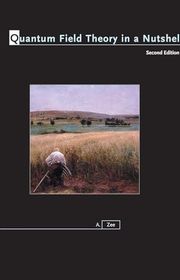
Quantum Field Theory in a Nutshell
For readers who want conceptual connections and an informal voice alongside more systematic study. The broad perspective makes it a useful companion, though the compressed reasoning is less suited to learning every computational step from scratch.
What it's about
A. Zee introduces quantum field theory through physical ideas and the path-integral approach. The discussion connects techniques with applications across particle and condensed-matter physics, developing themes such as symmetry, interactions, and the collective behavior of quantum systems.

Quantum Field Theory and the Standard Model
For students who want physical motivation developed alongside calculations toward the Standard Model. The self-contained explanations offer a coherent course structure, though the breadth requires sustained graduate-level study rather than a quick conceptual overview.
What it's about
Beginning with radiation and relativistic fields, Schwartz builds the tools of quantum electrodynamics and renormalization before developing the Standard Model. Advanced discussions extend the framework to effective theories, heavy-quark physics and jets.

For readers who want to examine the conceptual foundations rather than only learn calculational rules. The first volume’s systematic construction offers a distinctive perspective, though its demanding and individual approach is easier after an initial course.
What it's about
Steven Weinberg develops the foundations of quantum field theory from relativity, quantum mechanics, and particle properties. This first volume examines quantum electrodynamics, path integrals, and renormalization, combining mathematical development with examples from particle physics.
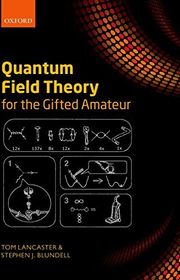
Quantum Field Theory for the Gifted Amateur
For readers with undergraduate physics who want a more gradual first encounter with field theory. Worked examples and explanatory steps help bridge the transition, though the playful title does not remove the need for quantum mechanics and substantial mathematics.
What it's about
Tom Lancaster and Stephen Blundell develop quantum field theory through explanations, worked examples, and mathematical guidance. The book introduces fields, interactions, and diagrammatic methods while connecting the formalism with physical problems, helping readers make the transition from undergraduate quantum mechanics.

Quantum Field Theory
For readers who already know the basics and want a substantial technical reference. The detailed derivations cover ground often compressed elsewhere, though the pace and formal treatment make it less welcoming as a first textbook.
What it's about
Claude Itzykson and Jean-Bernard Zuber combine formal development of quantum field theory with worked calculations. Starting with quantized electrodynamics and renormalization, the text proceeds to functional methods, bound states, broken symmetries, and nonabelian gauge fields.
Sources
- 1
Readings | Relativistic Quantum Field Theory I
ocw.mit.edu
- 2
Quantum Field Theory (2020-21): Reading List
courses.maths.ox.ac.uk
- 3
Home Page of Physics 582-Bibliography
eduardo.physics.illinois.edu
- 4
How to Learn Math and Physics
math.ucr.edu
- 5
Quantum Field Theory
damtp.cam.ac.uk
- 6
Quantum Field Theory Books
goodreads.com
- 7
What is a complete book for introductory quantum field theory?
physics.stackexchange.com
- 8
Recommendation for introductory quantum field theory books
reddit.com
- 9
Textbook recommendation on quantum physics and quantum field theory
reddit.com







Edited by
Software engineer whose passion for tracking book recommendations from podcasts inspired the creation of MRB.
Lead investor at 3one4 Capital whose startup expertise and love for books helped shape MRB and its growth.
Comments
Spotted a missing book, a wrong order or a mistake? Tell us and we'll fix this page.
We're a reading guide, not the author or publisher, so we can't send books or pass on messages.