
20 Best Electronics Engineering Books
The best electronics engineering books, ranked by expert-source recommendations, with notes to help beginners, students and working circuit designers choose.
Our take
Electronics engineering connects an understanding of components with the ability to build circuits that behave as intended. These books range from first experiments to semiconductor design, digital signal processing and radio-frequency systems. Some assume a workbench and curiosity; others require university mathematics and a solid grounding in circuit analysis.
Make: Electronics and Getting Started in Electronics offer approachable starting points through construction and observation. Practical Electronics for Inventors broadens the component toolkit, while the main The Art of Electronics volume develops practical design judgment. Its advanced companion goes deeper for experienced readers. Microelectronic Circuits provides a more structured academic route, and The Circuit Designer's Companion concentrates on reliability, boards and the demands of a finished product. Specialist texts cover electromagnetics, microwave circuits, feedback and digital signals; the power-engineering references serve readers working with larger electrical systems.
Start with a practical introduction if you have never built a circuit, or choose a specialist textbook once your foundations are secure.
20 books · 8 sources · Last updated
As an Amazon Associate, we earn from qualifying purchases (at no extra cost to you).
How to choose from this list
Skip to the full rankingIf you're building your first circuits: Make: Electronics → Make: More Electronics
If you want a broad practical reference: Practical Electronics for Inventors → The Art of Electronics
If you're studying circuit design formally: Electrical Engineering 101 → Microelectronic Circuits
If you're moving toward reliable products: The Circuit Designer's Companion
If you're specializing in radio frequencies: Fundamentals of Applied Electromagnetics → Microwave Engineering
If you want to repair equipment: How to Diagnose and Fix Everything Electronic
The 20 books, ranked
Ranked by how many expert sources name each book. Ties go to the book more people recommend.

The Art of Electronics
For engineers who want practical judgment alongside circuit theory. Its detailed discussions of components and real circuit behavior make it a working design reference, but beginners will benefit from building simple circuits before tackling its breadth.
What it's about
Paul Horowitz and Winfield Hill explain electronic circuit design through practical examples and engineering judgment. The reference covers analog and digital electronics, including transistors, amplifiers, filters, oscillators, and power conversion, connecting component behavior with the choices involved in building circuits.

Practical Electronics for Inventors
For inventors who want one reference spanning components, analog circuits and digital electronics. Its application focus helps turn an idea into a circuit, but the breadth can overwhelm readers who have never built anything.
What it's about
Paul Scherz and Simon Monk explain electronics for inventors, hobbyists, and students through an application-centered approach. Coverage moves from circuit components to semiconductors, amplifiers, power supplies, and digital electronics, connecting principles with the skills needed to design working devices.

Electrical Engineering 101
Everything You Should Have Learned in School...but Probably Didn't
For students who can follow formulas but struggle to connect them with working circuits. Its plain explanations bridge classroom knowledge and troubleshooting, though it offers less mathematical depth than the specialist engineering textbooks here.
What it's about
Darren Ashby explains electronics through basic principles, components, and real-world examples, beginning with what electricity is. Discussions of tools and troubleshooting connect theory with practical design work, emphasizing how circuits function and how engineers can understand and maintain their projects.

Microelectronic Circuits
For students who need a structured course in analyzing and designing electronic circuits. Its treatment connects semiconductor devices with integrated circuit practice, but the textbook depth requires sustained study and a sound circuit-analysis foundation.
What it's about
Adel Sedra and his coauthors develop the fundamentals of electronic circuits while introducing integrated circuit technology. The textbook helps engineering students move from analyzing circuits to designing them, emphasizing the skills and insights needed to make practical design decisions.

For complete beginners who learn by building and testing things. Its experiments introduce theory after hands-on discovery, making early concepts tangible, but you need components, tools and time at a workbench to get the benefit.
What it's about
Charles Platt teaches electronics through experiments that let readers build circuits and observe components in action. Illustrated projects develop an understanding of capacitors, transistors, breadboards, and microcontrollers, progressing toward Arduino and introductory programming.

Encyclopedia of Electronic Components Volume 1
Resistors, Capacitors, Inductors, Switches, Encoders, Relays, Transistors
For builders who need to identify a component and understand its practical behavior. The organized entries make quick reference easier than a project tutorial, but this first volume covers only part of the wider component range.
What it's about
Charles Platt explains what common electronic components do, how they work, and when to use them. Photographs, diagrams, and schematics illustrate resistors, capacitors, inductors, switches, encoders, relays, and transistors, with guidance on variants and practical applications.

Fundamentals of Applied Electromagnetics
For students ready to connect circuit theory with transmission lines and electromagnetic fields. Its application-led progression makes the transition more concrete, but the underlying mathematics still demands preparation beyond an introductory electronics course.
What it's about
Fawwaz Ulaby and Umberto Ravaioli connect circuit theory with electromagnetics, beginning with transmission lines and progressing to more advanced concepts. Engineering applications, illustrations, and simulation modules help students relate electromagnetic principles to practical technologies.

Getting Started in Electronics
For newcomers who prefer drawings and small circuits to a conventional textbook. Its compact, handwritten presentation makes components and experiments approachable, but the brevity leaves less explanation and modern device coverage than larger introductory guides.
What it's about
Forrest M. Mims III introduces electronic components, analog and digital principles, and circuit assembly through illustrated explanations. Numerous circuits and projects connect basic theory with practical applications, giving beginners a foundation for experimenting with electronics.
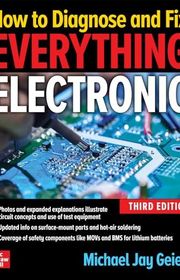
How to Diagnose and Fix Everything Electronic
For readers who want to troubleshoot and repair existing electronic equipment. Its bench-focused process develops fault-finding judgment alongside component work, but repair requires tools and careful practice, and it is less suited to learning circuit design.
What it's about
Michael Jay Geier explains how to investigate faults in electronic devices, organize a repair bench and use diagnostic tools. The guide covers component testing, replacement and reassembly, connecting troubleshooting methods with the practical work of repairing consumer equipment.

Microwave Engineering
For engineering students specializing in radio-frequency and microwave circuits. Its progression from fundamental principles to design provides technical depth unavailable in general electronics guides, but it assumes comfort with electromagnetics and mathematical analysis.
What it's about
David Pozar develops radio-frequency and microwave engineering from fundamental electrical principles to practical circuits and devices. The textbook connects theory with analysis and design, providing students a foundation for understanding the behavior and applications of systems operating at microwave frequencies.

Modern Control Systems
For students who want to analyze feedback and design control systems systematically. Its combination of time-domain, frequency-domain and state-variable methods offers several ways into a problem, but the mathematical focus requires more than bench experience.
What it's about
Richard Dorf and Robert Bishop introduce feedback control through an integrated approach to analysis and design. The textbook develops time- and frequency-domain methods, state-variable models, and control system behavior, connecting theoretical concepts with engineering problems and computer-assisted analysis.

Basic Electricity
For beginners who want illustrated explanations of electrical principles before choosing a specialty. Its Navy training approach builds understanding methodically, but the older examples and emphasis on motors offer limited coverage of modern electronic devices.
What it's about
Prepared as a U.S. Navy training text, this guide introduces electrical theory and its practical applications. Illustrated chapters cover direct- and alternating-current circuits, batteries, conductors, magnetism, motors, and generators, supported by reference tables, formulas, and explanations of technical terminology.

Introduction to Modern Digital Electronics
For undergraduates who want to understand digital hardware at the CMOS circuit level. Its coverage links logic, timing and layout with semiconductor behavior, but it is a more technical route than learning through hobby projects.
What it's about
Charles Hawkins and Jaume Segura introduce digital CMOS electronics for undergraduate engineering students. Beginning with circuit and logic theory, the text develops semiconductor devices, logic gates, low-power design, timing, memory, programmable logic, layout, and chip manufacturing through examples and exercises.

Power System Analysis and Design
For engineering students concentrating on electrical power networks and system modeling. Its progression toward practical analysis supports grid-related study, but it is a specialist power-engineering choice rather than a guide to designing electronic devices.
What it's about
Duncan Glover and his collaborators introduce power systems through theory, modeling, and practical analysis tools. The textbook builds from basic concepts toward more complex engineering situations, showing students how to apply models and assess designs for electrical power systems.

Standard Handbook for Electrical Engineers
For engineers who need a broad reference on power equipment and electrical systems. Its extensive technical coverage supports professional lookup, but its emphasis on generation and distribution makes it less useful for small electronic circuits.
What it's about
Edited by Surya Santoso and H. Wayne Beaty, this reference covers electric power generation, transmission, distribution, and operation. Contributions from engineers address equipment, protection, insulation, and renewable generation, connecting theory and analysis with the design and application of power systems.

For experienced designers who already use the main Art of Electronics volume and want deeper technical detail. These advanced companion chapters explore component behavior and specialized techniques, but they assume substantial practical electronics knowledge.
What it's about
Paul Horowitz and Winfield Hill expand on the third edition of The Art of Electronics with advanced circuit-design topics. This companion develops discussions begun in the main volume, exploring component behavior and specialized techniques for readers seeking deeper practical electronics knowledge.

The Circuit Designer's Companion
For designers moving from a working circuit to a reliable manufactured product. Its attention to grounding, boards, interference and testing addresses practical integration problems, but it assumes you already understand the circuit itself.
What it's about
Tim Williams explains practical electronic design with attention to reliable performance, manufacturing, and cost. Topics include analog and digital circuits, component selection, grounding, printed circuit boards, power supplies, electromagnetic compatibility, testing, and the wider requirements of product design.

Basic Electrical Engineering
For early engineering students who need circuit analysis before tackling electronics design. Its introduction to instrumentation and machines provides a broad foundation, but readers seeking transistor circuits will need a more focused follow-up.
What it's about
K. Uma Rao and A. Jayalakshmi introduce electrical engineering through circuit analysis, basic instrumentation, and electrical machines. Written for early engineering students across disciplines, the textbook emphasizes essential concepts and connects them with the electrical applications encountered in everyday life.

Discrete-Time Signal Processing
For engineering students moving into digital signal analysis and filter design. Its mathematical treatment gives sampling and discrete systems a rigorous foundation, but it assumes more preparation than the practical circuit-building books here.
What it's about
Alan Oppenheim and Ronald Schafer develop the foundations of discrete-time signal processing for engineering students. The text examines linear systems, sampling, filtering, and Fourier analysis, connecting mathematical principles with the methods used to analyze and process digital signals.

Practical Electrical Engineering
For students across engineering disciplines who need useful circuit and electronics skills. Its emphasis on functionality connects analysis with applications, but it provides a broader foundation rather than the depth of a specialist microelectronics course.
What it's about
Sergey Makarov, Reinhold Ludwig, and Stephen Bitar introduce circuits and electronics with an emphasis on functionality and applications. Written for students across engineering disciplines, the textbook combines explanations, figures, and problems to develop practical analysis and design skills.
Sources
- 1
10 Best Electrical Engineers Reference Books of All Time
keysight.com
- 2
Best Books for Self-Learning Analog and Digital Electronics
industrialmonitordirect.com
- 3
21 Best Electronics Books in 2026(Hand-Picked)
etechnophiles.com
- 4
7 Best Electronics Engineering Books
electricalvoice.com
- 5
100 Best Electrical Engineering Books of All Time
shortform.com
- 6
Circuits Books
goodreads.com
- 7
7 Top Books for Electronics Engineering
electronicslovers.com
- 8
Which books are the most used?
reddit.com




Edited by
Software engineer whose passion for tracking book recommendations from podcasts inspired the creation of MRB.
Lead investor at 3one4 Capital whose startup expertise and love for books helped shape MRB and its growth.
Comments
Spotted a missing book, a wrong order or a mistake? Tell us and we'll fix this page.
We're a reading guide, not the author or publisher, so we can't send books or pass on messages.