
12 Best Econometrics Books
The best econometrics books, ranked by how many expert sources recommend each one, with notes on beginner courses, causal inference and graduate study.
Our take
Econometrics uses statistical methods to investigate economic questions with data. Learning it means more than estimating a regression: you need to understand assumptions, decide what a result can establish and recognize when a method fits the question. These books serve different stages, from students revising introductory statistics to researchers working with panel data or trying to identify a causal effect.
Introductory Econometrics gives a broad route into applied analysis. Econometrics For Dummies and A Guide to Econometrics can help clarify unfamiliar ideas alongside a course. For cause-and-effect questions, Mastering 'Metrics offers an accessible introduction before the more technical Mostly Harmless Econometrics. Causal Inference: The Mixtape adds coding examples for practice. Graduate readers can turn to Econometric Analysis for breadth or Econometric Analysis of Cross Section and Panel Data for a more focused treatment. Start with the book that matches your statistical background, then work through examples rather than collecting methods without their assumptions.
12 books · 6 sources · Last updated
As an Amazon Associate, we earn from qualifying purchases (at no extra cost to you).
How to choose from this list
Skip to the full rankingIf you're beginning a first course: Introductory Econometrics → Using Econometrics
If you need clearer explanations alongside class: Econometrics For Dummies → A Guide to Econometrics
If you want to understand causal claims: Mastering 'Metrics → Mostly Harmless Econometrics
If you want to practice causal methods with code: Causal Inference: The Mixtape
If you're ready for graduate study: Econometric Analysis → Econometric Analysis of Cross Section and Panel Data
The 12 books, ranked
Ranked by how many expert sources name each book. Ties go to the book more people recommend.

For undergraduates who want a broad introduction organized around empirical questions. Wooldridge connects assumptions with applied regression work, though understanding the examples still requires basic statistics and sustained practice rather than simply reading the explanations.
What it's about
Jeffrey Wooldridge introduces econometric methods through the questions facing applied researchers. This textbook connects statistical theory with empirical work in business and the social sciences, developing tools for policy evaluation, forecasting, and conducting independent research projects.
Also recommended by
1 person Eric Weinstein recommended this book
Eric Weinstein
Eric Weinstein tweet about books that mattered enough to him.
Eric Weinstein's recommendation of this book

For readers who already know regression and want to evaluate causal claims in applied research. Its focus on identification and practical estimation is distinctive, though the compressed treatment assumes more statistical confidence than the introductory books.
What it's about
Joshua Angrist and Jörn-Steffen Pischke present practical tools for empirical research that seeks causal explanations. They examine regression, instrumental variables, natural experiments, differences in differences, and regression discontinuity, alongside quantile methods and the interpretation of standard errors.

Basic Econometrics
For students who want a traditional progression through regression assumptions, diagnostics and extensions. The detailed worked treatment supports a conventional course, though its length and method-by-method organization are less direct than a short causal-inference introduction.
What it's about
This introductory textbook develops the fundamentals of econometrics through regression models and their applications. It examines departures from classical assumptions before moving to simultaneous equations and time series, connecting statistical techniques with the analysis of economic data.

A Guide to Econometrics
For students who can follow procedures but want a clearer sense of why they work. Kennedy emphasizes intuition, interpretation and practical cautions, though the older examples and companion format do not replace a current course's technical exercises.
What it's about
Peter Kennedy offers an intuitive introduction to econometric concepts and the practical use of statistical methods in economics. Explanations emphasize modeling choices, assumptions, and interpretation, helping readers understand techniques and the difficulties encountered in applied empirical work.
Also recommended by
1 person Nassim Taleb recommended this book
Nassim Taleb
"The best intuition builder in both statitics and econometrics." - Nassim Taleb
Nassim Taleb's recommendation of this book

Introduction to Econometrics
For students who learn best when econometric methods answer concrete questions. Stock and Watson link statistical reasoning with evidence, though the introductory treatment provides less mathematical depth than the graduate references and still needs accompanying exercises.
What it's about
James Stock and Mark Watson introduce econometrics by developing theory around real-world questions and data. This textbook emphasizes the relationship between assumptions and applications, preparing students to interpret empirical research using mathematics appropriate to an introductory course.
Also recommended by
1 person- Eric Weinstein recommended this book
Eric Weinstein
Eric Weinstein tweet about books that mattered enough to him.
Eric Weinstein's recommendation of this book
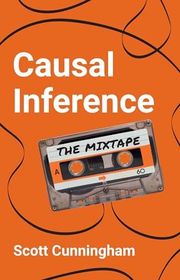
Causal Inference: The Mixtape
For readers who want to connect causal identification with actual data analysis. Coding examples in R and Stata make the methods easier to practice, though the emphasis on causal designs leaves other econometric purposes less developed.
What it's about
Scott Cunningham introduces methods for estimating causal effects from experimental and observational data. Economic examples and coding instructions in R and Stata connect identification assumptions with practical analysis, helping readers distinguish causal explanations from patterns of association.

Econometric Analysis of Cross Section and Panel Data
For graduate students and researchers analyzing cross-sectional or panel data. Wooldridge connects estimators with their assumptions across linear and nonlinear models, though the mathematical density makes it unsuitable as a first encounter with econometrics.
What it's about
Jeffrey Wooldridge develops graduate-level methods for analyzing cross-sectional and panel data, emphasizing estimation of treatment and marginal effects. The text distinguishes causal inference from statistical association and integrates linear and nonlinear models with assumptions, exercises, and applications.

Econometrics For Dummies
For students who need a plain-language companion while learning basic models and tests. Its approachable explanations help reduce unfamiliar terminology, though it works better alongside a course or fuller textbook than as preparation for advanced research.
What it's about
Roberto Pedace introduces econometric methods in accessible language, explaining how to build models, work with data, estimate relationships, and test hypotheses. The guide connects statistical procedures with economic questions and helps students interpret quantitative results.

For students who want to carry out and assess an applied regression project. Its practical single-equation focus keeps the tasks manageable, though readers needing extensive panel-data, nonlinear or advanced time-series methods will need another text.
What it's about
A. H. Studenmund introduces econometrics through practical applications of single-equation linear regression. Examples and exercises guide students through estimating models, evaluating results, and recognizing problems that arise when applying statistical methods to economic questions.
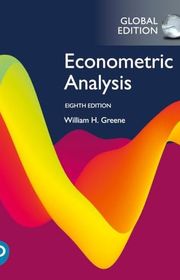
Econometric Analysis
For graduate students who need a wide-ranging technical reference across models and estimation methods. Its depth and worked numerical examples support advanced coursework, though the mathematical requirements and length make it a poor first textbook.
What it's about
William Greene develops econometric theory and methods for graduate study in the social sciences. The text connects models and estimation with worked numerical examples, providing the theoretical background needed to understand advanced techniques and apply them to empirical questions.

Introduction to Econometrics
For beginners who benefit from revisiting statistics while learning econometric reasoning. Dougherty's explanations, exercises and simulations support gradual understanding, though independent readers still need to work through the mathematics and cannot rely on intuition alone.
What it's about
Christopher Dougherty introduces econometric analysis through explanations, mathematical arguments, exercises, and simulation examples. Topics progress from regression and hypothesis testing to measurement errors, binary choice, time series, and panel data, with statistical revision supporting the methods.

For readers who want the logic of causal inference before a full technical treatment. Studies make the main identification strategies concrete, though the accessible presentation offers less estimation detail than Mostly Harmless Econometrics or a comprehensive textbook.
What it's about
Joshua Angrist and Jörn-Steffen Pischke explain five approaches to identifying cause and effect: randomized experiments, regression, instrumental variables, regression discontinuity, and differences in differences. Real studies show how these methods address questions about education, health insurance, and economic policy.
Sources




Edited by
Software engineer whose passion for tracking book recommendations from podcasts inspired the creation of MRB.
Lead investor at 3one4 Capital whose startup expertise and love for books helped shape MRB and its growth.
Comments
Spotted a missing book, a wrong order or a mistake? Tell us and we'll fix this page.
We're a reading guide, not the author or publisher, so we can't send books or pass on messages.