
14 Best Data Science Books
The best data science books, ranked by how many expert sources recommend each one, with notes on who they suit for statistics, programming, or applied analysis.
Our take
Data science combines several kinds of work: asking a useful question, preparing data, choosing a method, and deciding what the results justify. No single book treats all of those equally. Some build statistical judgment, some teach a programming workflow, and others develop the mathematics behind models. Your starting point depends on whether you already know a language, understand basic statistics, or need to connect analysis with a practical decision.
Naked Statistics and The Art of Statistics build intuition without making code the main task. Python for Data Analysis concentrates on preparing and exploring data, while R for Data Science offers an alternative workflow in R. Data Science from Scratch explains methods through implementation; Pattern Recognition and Machine Learning demands much stronger mathematics. Data Science for Business helps frame the problem before implementation begins. Start with a statistics overview if the concepts are unfamiliar, then choose one programming route and practice on a real dataset.
14 books · 7 sources · Last updated
As an Amazon Associate, we earn from qualifying purchases (at no extra cost to you).
How to choose from this list
Skip to the full rankingIf you’re new to statistical ideas: Naked Statistics → The Art of Statistics
If you want a Python workflow: Python for Data Analysis → Python Data Science Handbook
If you want an R workflow: R for Data Science → Practical Statistics for Data Scientists
If you want predictive modeling: An Introduction to Statistical Learning → Hands-On Machine Learning with Scikit-Learn, Keras, and TensorFlow
If you want mathematical depth: Introduction to Probability → Pattern Recognition and Machine Learning
If you need to frame business problems: Data Science for Business
The 14 books, ranked
Ranked by how many expert sources name each book. Ties go to the book more people recommend.
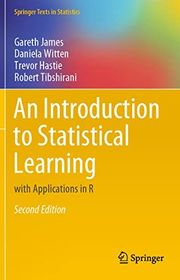
An Introduction to Statistical Learning: with Applications in R
For readers who want an accessible bridge from introductory statistics to predictive modeling. Its explanations and R labs connect concepts with practice, though the examples assume basic statistical familiarity and require working through the material.
What it's about
This textbook introduces statistical learning through regression, classification, resampling, model selection, and other methods. Explanations of the ideas behind each approach are paired with R labs that let readers apply the techniques and examine their behavior.

For programmers who learn by implementing ideas themselves. Its small Python constructions reveal what algorithms do beneath library interfaces, though those teaching implementations are not substitutes for efficient, tested tools in production work.
What it's about
Joel Grus teaches data science by implementing tools and algorithms in Python from first principles. This second edition connects programming with the mathematics and statistics behind analysis, helping readers understand how methods work rather than relying entirely on ready-made libraries.

For readers who want to understand statistical claims before tackling code or formal derivations. Its everyday examples build intuition about evidence and misuse, though it provides limited mathematical detail and no systematic programming practice.
What it's about
Charles Wheelan introduces statistics through everyday examples, explaining how data can illuminate questions and mislead audiences. Topics include probability, inference, polling, and regression, with attention to the assumptions and mistakes behind apparently convincing numbers.
Also recommended by
1 person Keith Rabois recommended this book
Keith Rabois
Keith Rabois recommended this book on a Medium blog post.
Keith Rabois's recommendation of this book

Data Science for Business
What You Need to Know about Data Mining and Data-Analytic Thinking
For managers and analysts who need to frame a useful data question before choosing an algorithm. Its business examples connect models with decisions, though readers seeking coding exercises will need a separate practical guide.
What it's about
Foster Provost and Tom Fawcett explain the principles underlying data mining and data-analytic thinking. Business examples illustrate how to frame problems, evaluate solutions, communicate with data scientists, and treat organizational data as an asset requiring thoughtful investment.

For Python users who want a broad reference across arrays, tables, visualization, and modeling. Its linked toolkit provides a useful overview, though the printed edition’s older library interfaces need comparison with current documentation.
What it's about
Jake VanderPlas introduces the Python tools commonly used for scientific computing and data analysis. Examples show how to work interactively with IPython, manipulate arrays and tables with NumPy and pandas, visualize results, and build machine-learning models with scikit-learn.

For learners choosing R who want a connected workflow from importing data to communicating findings. Its tidyverse-centered approach gives the stages coherence, though the original edition’s tools differ from more recent R practice.
What it's about
Hadley Wickham and Garrett Grolemund introduce data analysis with R, RStudio, and the tidyverse. Examples guide readers through importing, organizing, transforming, visualizing, and modeling data, then communicating results, connecting the stages of an analysis into a repeatable workflow.

Hands-On Machine Learning with Scikit-Learn, Keras, and TensorFlow
Concepts, Tools, and Techniques to Build Intelligent Systems
For Python programmers who want extended examples of building and evaluating models. Its progression links practical workflows with neural networks, though the substantial code requires active study and this title specifically follows the TensorFlow-based toolset.
What it's about
Aurelien Geron teaches machine learning through Python examples using Scikit-Learn, Keras, and TensorFlow. Practical exercises develop an intuitive understanding of algorithms and neural networks, connecting the concepts behind intelligent systems with the tools used to build them.

For programmers who need statistical concepts connected to everyday analytical work. Its R and Python examples make methods easier to apply and compare, though the concise coverage assumes some background and cannot replace a full statistics course.
What it's about
Peter Bruce, Andrew Bruce, and Peter Gedeck connect statistical concepts with practical data science. This second edition supplies examples in both R and Python, explaining how to apply methods and recognize misuses for readers with programming experience and some statistical background.

For analysts who spend more time cleaning and reshaping data than building models. Its detailed pandas workflow makes that work the central focus, though this edition predates current APIs and is not a general machine-learning course.
What it's about
Wes McKinney demonstrates how to prepare and analyze data using Python, pandas, NumPy, and IPython. Practical examples cover loading datasets, handling missing values, combining and reshaping tables, plotting results, grouping data, and working with time series.

For Python users who want to start applying machine learning without deriving every algorithm. Its emphasis on practical workflow makes model-building approachable, though older library examples need checking and mathematical depth is limited.
What it's about
Andreas Muller and Sarah Guido introduce practical machine learning for Python users. Examples emphasize applying algorithms to real problems rather than developing their mathematics in depth, showing readers how to assemble machine learning solutions and reason about the choices involved.

Pattern Recognition and Machine Learning
For readers with calculus and linear algebra who want a mathematical treatment of learning from data. Its probabilistic framework develops concepts beyond recipes, though dense notation and limited modern implementation guidance demand substantial independent work.
What it's about
Christopher Bishop introduces pattern recognition and machine learning through statistical methods and worked exercises. Written for readers with calculus and linear algebra knowledge, the textbook includes probability foundations while developing the mathematical concepts used to understand learning from data.

For readers who want to judge how evidence supports a conclusion. Its real examples emphasize questions, uncertainty, and interpretation, though it is a guide to statistical reasoning rather than a software tutorial or problem-heavy textbook.
What it's about
David Spiegelhalter explains how statistical reasoning can turn data into understanding. Real-world problems illustrate the choices and uncertainties involved in collecting evidence, interpreting patterns, and drawing conclusions, giving general readers tools for judging what numbers do and do not show.

For learners who benefit from puzzles, visual explanations, and frequent participation. Its workbook-like style keeps introductory statistics active, though the busy presentation may distract readers who prefer concise prose or a formal mathematical treatment.
What it's about
Dawn Griffiths teaches statistics through stories, puzzles, quizzes, and visual examples. Charts, averages, probability, expectation, distributions, and hypothesis testing become practical problems to work through, offering students and other learners an interactive introduction to interpreting and presenting data.

Introduction to Probability
For learners who want a stronger foundation for reasoning about uncertainty. Its examples and substantial exercises develop probability more systematically than the coding guides, though the mathematical workload makes it unsuitable as a quick overview.
What it's about
Joseph Blitzstein and Jessica Hwang develop probability through examples involving coincidences, paradoxes, and applications in several fields. Based on Harvard statistics lectures, the book combines the tools for reasoning about uncertainty with problems that connect mathematical ideas to practical situations.
Sources
- 1
54 of the Best Data Science Books (Vetted by Experts)
dataquest.io
- 2
The 23 Best Data Science Books to Read in 2026
datacamp.com
- 3
20 Best Data Science Books to Know
builtin.com
- 4
Data Science References
cmap.polytechnique.fr
- 5
Data Science Books
goodreads.com
- 6
Are there any good, practical Data Science "Cookbook" style books/materials? Ie with step by step instructions, code
reddit.com
- 7
Suggest me some books on Data Analytics or related sub fields
reddit.com







Edited by
Software engineer whose passion for tracking book recommendations from podcasts inspired the creation of MRB.
Lead investor at 3one4 Capital whose startup expertise and love for books helped shape MRB and its growth.
Comments
Spotted a missing book, a wrong order or a mistake? Tell us and we'll fix this page.
We're a reading guide, not the author or publisher, so we can't send books or pass on messages.