
18 Best Statistics Books
The best statistics books, ranked by how many expert sources recommend each one, with notes on who each book suits, prerequisites and the best place to start.
Our take
Statistics helps you turn data into evidence while keeping uncertainty in view. These books range from explanations for curious readers to full courses, programming references and mathematical treatments of inference. The right choice depends on whether you want to understand a research claim, analyze your own data or learn why a statistical method works.
Naked Statistics and The Art of Statistics introduce the reasoning without demanding a long mathematical preparation. OpenIntro Statistics offers a more structured course with exercises, while Head First Statistics uses visual problems and activities. Programmers can move toward Practical Statistics for Data Scientists or An Introduction to Statistical Learning. Readers comfortable with calculus can tackle All of Statistics and Statistical Inference; the Bayesian books add a different framework for building models and revising beliefs. Statistics Done Wrong helps expose weaknesses in research at several levels. Start with Naked Statistics for orientation or OpenIntro Statistics if you are ready to practice.
18 books · 10 sources · Last updated
As an Amazon Associate, we earn from qualifying purchases (at no extra cost to you).
How to choose from this list
Skip to the full rankingIf you want an accessible first read: Naked Statistics → The Art of Statistics
If you want a full introductory course: OpenIntro Statistics
If you want to analyze data with code: Practical Statistics for Data Scientists → An Introduction to Statistical Learning
If you want mathematical foundations: All of Statistics → Statistical Inference
If you want Bayesian modeling: Statistical Rethinking → Bayesian Data Analysis
If you want to assess research claims: How to Lie with Statistics → Statistics Done Wrong
The 18 books, ranked
Ranked by how many expert sources name each book. Ties go to the book more people recommend.
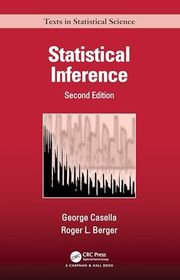
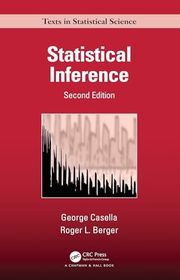
Statistical Inference
For students ready to derive statistical procedures from probability theory. Its systematic treatment of estimation and testing provides deeper foundations than the applied books, though calculus, mathematical maturity and considerable exercise work are essential.
What it's about
George Casella and Roger Berger develop the probability foundations behind estimation, hypothesis testing and other inferential methods. The second edition combines theoretical results with examples and exercises for advanced undergraduates and graduate students learning why statistical procedures work.

OpenIntro Statistics
For beginners who want a full applied course with exercises and real datasets. Its orderly progression supports independent study more systematically than the popular introductions, though developing confidence means doing the problems rather than skimming chapters.
What it's about
David Diez, Mine Çetinkaya-Rundel, and Christopher Barr introduce applied statistics through real data, examples, and exercises. This fourth edition progresses from summarizing data and probability to statistical inference, linear regression, and multiple and logistic regression methods.
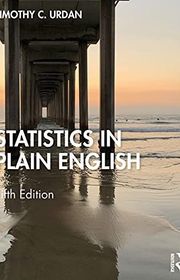
Statistics in Plain English
For students who need clear explanations of the terms and tests used in research. Its reference style helps decode results more directly than the narrative introductions, though it favors common social science methods over mathematical derivations.
What it's about
Timothy Urdan explains descriptive statistics, inference and common research procedures in accessible language. The fifth edition adds person-centered analyses and expands discussion of nonparametric tests and assumptions, helping readers interpret statistical techniques used in the social sciences.

How to Lie with Statistics
For readers who want a short introduction to misleading numbers and graphics. Its memorable examples make common distortions easy to spot, though the dated settings and limited scope cannot teach a complete statistical method.
What it's about
Darrell Huff explains how numbers can mislead through biased samples, distorted graphs, and selectively presented averages. Illustrated examples introduce basic statistical reasoning and show readers how to examine claims made in advertising, reporting, and public argument.
Also recommended by
2 people Bill Gates recommended this book
Bill Gates
"A great introduction to the use of statistics, and a great refresher for anyone who’s already well versed in it." - Bill Gates
Bill Gates's recommendation of this book  Neil deGrasse Tyson recommended this book
Neil deGrasse Tyson
"A cute little tiny book that tells you all the things who people who want to fool you into thinking something that’s true, that’s not, and how they manipulate statistics in order to accomplish this." - Neil deGrasse Tyson
Neil deGrasse Tyson's recommendation of this book

For curious readers who want statistical ideas explained through familiar situations. Its narrative examples make an easier first encounter than a textbook, though reading it alone will not develop the calculation or coding skills needed for analysis.
What it's about
Charles Wheelan introduces statistics through everyday examples, explaining how data can illuminate questions and mislead audiences. Topics include probability, inference, polling, and regression, with attention to the assumptions and mistakes behind apparently convincing numbers.
Also recommended by
1 person Keith Rabois recommended this book
Keith Rabois
Keith Rabois recommended this book on a Medium blog post.
Keith Rabois's recommendation of this book

For mathematically confident readers wanting a compact route from probability to modern inference. Its breadth connects classical methods to topics such as resampling and classification, though the compressed explanations make it demanding for a first course.
What it's about
Larry Wasserman offers a concise course in probability and statistical inference for readers with calculus and basic linear algebra. The text extends beyond introductory topics to include bootstrapping, nonparametric estimation, classification, and connections with modern data analysis.

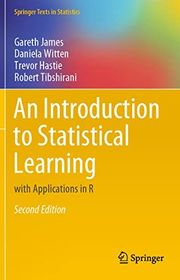
For readers moving from basic statistics toward prediction with R. Its explanations and labs provide a gentler learning path than The Elements of Statistical Learning, though some statistical background and willingness to code are needed.
What it's about
Gareth James, Daniela Witten, Trevor Hastie, and Robert Tibshirani introduce statistical learning through accessible explanations, examples, and R tutorials. This second edition covers modeling and prediction, including regression, classification, resampling, deep learning, survival analysis, and multiple testing.
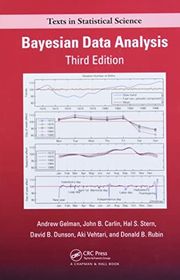
Bayesian Data Analysis
For advanced students and researchers needing a broad Bayesian reference. Its applied examples and hierarchical models reach beyond introductory treatments, though the mathematical detail and scope make it a substantial commitment rather than an easy first read.
What it's about
Andrew Gelman and his coauthors explain Bayesian inference through probability models, computation and applied examples. The third edition develops methods from basic estimation to hierarchical modeling and model checking, with exercises that connect statistical reasoning to research problems.

For beginners who learn by doing puzzles and looking at diagrams. Its interactive format makes the basic ideas less abstract than conventional texts, though the busy pages and playful presentation will not suit every learner.
What it's about
Dawn Griffiths teaches statistics through stories, puzzles, quizzes, and visual examples. Charts, averages, probability, expectation, distributions, and hypothesis testing become practical problems to work through, offering students and other learners an interactive introduction to interpreting and presenting data.

For programmers who need a working statistical reference for data science. Its examples connect concepts with R and Python workflows more directly than the general textbooks, though the brisk coverage assumes some background and offers limited derivations.
What it's about
Peter Bruce, Andrew Bruce, and Peter Gedeck connect statistical concepts with practical data science. This second edition supplies examples in both R and Python, explaining how to apply methods and recognize misuses for readers with programming experience and some statistical background.
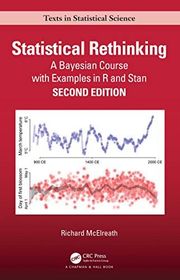
Statistical Rethinking
For readers who want to build Bayesian models and understand their assumptions. Its constructive approach connects causal questions with computation more directly than a survey text, though working through the R examples requires sustained practice.
What it's about
Richard McElreath develops Bayesian inference by building and testing models with examples in R and Stan. The second edition connects model construction with causal diagrams, prior choices and computational methods, encouraging readers to reason about how data are generated.

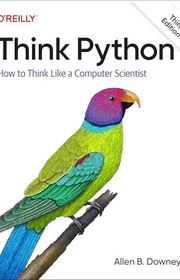
For Python users who learn statistics by examining data and running experiments. Its continuing case study connects the analysis steps more closely than a formula driven text, though this second edition uses an older software environment.
What it's about
Allen Downey introduces exploratory data analysis through Python programming and a continuing case study. This second edition follows the process from cleaning and summarizing data to examining relationships, testing hypotheses, using regression, and communicating results through visualization.

For mathematically prepared readers who want a detailed reference on statistical learning. Its unified treatment connects many prediction methods more deeply than the introductory companion, though linear algebra and statistical knowledge are needed to follow the development.
What it's about
Trevor Hastie, Robert Tibshirani, and Jerome Friedman present a statistical framework for supervised and unsupervised learning. This second edition covers regression, classification, neural networks, boosting, random forests, and other methods, illustrated through applications and graphics.
Also recommended by
1 person Nassim Taleb recommended this book
Nassim Taleb
"Very comprehensive, sufficiently technical to get most of the plumbing behind machine learning." - Nassim Taleb
Nassim Taleb's recommendation of this book

For researchers and readers who want to recognize unreliable statistical claims. Its focus on study design, false positives and reporting exposes mistakes that introductory courses can overlook, though it supplements a methods course rather than replacing one.
What it's about
Alex Reinhart examines common statistical mistakes in scientific research and explains why they matter. Accessible discussions address false positives, sample sizes, analysis choices, and reporting practices, helping readers recognize weaknesses in published findings and their own work.

For readers who want to understand how evidence becomes an answer to a real question. Its emphasis on uncertainty and interpretation goes deeper than quick debunking, though it is not a workbook for mastering statistical procedures.
What it's about
David Spiegelhalter explains how statistical reasoning can turn data into understanding. Real-world problems illustrate the choices and uncertainties involved in collecting evidence, interpreting patterns, and drawing conclusions, giving general readers tools for judging what numbers do and do not show.

For students preparing for AP Statistics who need focused review and timed practice. Its tests serve exam preparation more directly than the broader introductions, though this older edition should be checked against the current exam requirements.
What it's about
Martin Sternstein combines a review of statistical concepts with six practice tests and diagnostic material. Explanations and exercises address the skills assessed by AP Statistics, helping students identify weaknesses and practice interpreting data and drawing statistical conclusions.

Statistics
For students who want a conventional introduction with a gradual progression through procedures. Its structured coverage supports course study better than the narrative books, though learning the methods still requires working exercises rather than reading passively.
What it's about
Robert S. Witte and John S. Witte explain descriptive and inferential statistics through a methodical introductory approach. This eleventh edition develops core concepts and procedures, helping students understand how statistical reasoning supports the analysis and interpretation of data.

Statistics for Business & Economics
For students who want statistical methods tied to business decisions. Its forecasting and quality control applications give more commercial context than the general introductions, though the textbook scale and worked procedures can feel laborious for casual reading.
What it's about
David R. Anderson and his coauthors connect statistical methods with business decision-making. This fourteenth edition covers descriptive statistics, probability, inference, regression, forecasting, and quality control, using applications and exercises to relate analytical concepts to practical economic problems.
Sources
- 1
100 Best Statistics Books of All Time
shortform.com
- 2
The Best 10 Statistics Books
blinkist.com
- 3
Stats Resources | Introduction to Quantitative Analysis
clanfear.github.io
- 4
Probability & Statistics
goodreads.com
- 5
Best books to learn everything about statistics like how different things are derived and everything? [Q]
reddit.com
- 6
Statistics Books - List of 11 Best Statistics Textbooks [2026]
wallstreetmojo.com
- 7
9 Best Statistics Books for Data Science
careeralley.com
- 8
[Q] Intro to statistics book for the layperson?
reddit.com
- 9
14 Best Statistics for Data Science Book in 2026
upgrad.com
- 10
Recommended Statistics Books
zakvarty.com





Edited by
Software engineer whose passion for tracking book recommendations from podcasts inspired the creation of MRB.
Lead investor at 3one4 Capital whose startup expertise and love for books helped shape MRB and its growth.
Comments
Spotted a missing book, a wrong order or a mistake? Tell us and we'll fix this page.
We're a reading guide, not the author or publisher, so we can't send books or pass on messages.