
12 Best Analytics Books
The best analytics books, ranked by how many expert sources recommend each one, with notes for choosing business frameworks, practical tools, statistics, and charts.
Our take
Analytics connects questions, data, methods, and decisions. Some books explain the available techniques, others help frame business problems, and others teach the practical work of preparing data or communicating results. Those skills support one another, but they are not interchangeable. A clear chart cannot repair a weak comparison, and a sophisticated model is useful only when it answers a relevant question.
Data Analytics Made Accessible and Numsense! offer conceptual introductions. Data Science for Business develops the reasoning behind choosing and evaluating analytical approaches, while Python for Data Analysis provides hands-on work with data. Practical Statistics for Data Scientists adds statistical tools, and Storytelling with Data addresses communication. For product and startup teams, Lean Analytics concentrates on selecting useful metrics. Start with an overview if the terminology is unfamiliar, then pair a practical skills book with one that helps you interpret and explain the work.
12 books · 7 sources · Last updated
As an Amazon Associate, we earn from qualifying purchases (at no extra cost to you).
How to choose from this list
Skip to the full rankingIf you're new to the terminology: Numsense! → Data Analytics Made Accessible
If you need better business questions: Data Science for Business
If you want hands-on data work: Python for Data Analysis → Practical Statistics for Data Scientists
If you need to explain results: Storytelling with Data
If you choose product and startup metrics: Lean Analytics
If you're ready for a compact machine-learning overview: The Hundred-Page Machine Learning Book
The 12 books, ranked
Ranked by how many expert sources name each book. Ties go to the book more people recommend.

Data Science for Business
What You Need to Know about Data Mining and Data-Analytic Thinking
For managers and analysts who need to frame useful questions before building models. Provost and Fawcett connect technical principles with business decisions, though this develops analytical judgment rather than teaching a programming language step by step.
What it's about
Foster Provost and Tom Fawcett explain the principles underlying data mining and data-analytic thinking. Business examples illustrate how to frame problems, evaluate solutions, communicate with data scientists, and treat organizational data as an asset requiring thoughtful investment.

Storytelling with Data
A Data Visualization Guide for Business Professionals
For analysts whose results need to persuade or inform other people. Knaflic connects chart design with attention and narrative, though the communication focus assumes you already have an analysis worth explaining and does not establish statistical validity.
What it's about
Cole Nussbaumer Knaflic explains how to turn business data into clear visual communication. Examples guide readers through choosing charts, applying design principles, directing attention with color and annotations, and connecting individual graphs with a coherent story.

Data Analytics Made Accessible
For newcomers who want an overview of analytical techniques and their business uses. Maheshwari connects a broad range of ideas with examples, though the accessible survey offers less hands-on depth than a book devoted to one programming tool.
What it's about
Anil Maheshwari introduces data analytics and business intelligence through accessible explanations of major data mining techniques. Examples and a continuing case study connect the ideas with practical use, aiming to build understanding alongside familiarity with analytical tools.

The Hundred-Page Machine Learning Book
For technically comfortable readers who want a compact map of machine learning. Burkov joins mathematical ideas with practical concepts efficiently, though the compression assumes enough background to fill gaps and offers limited room for extended exercises.
What it's about
Andriy Burkov presents a compact introduction to machine learning that combines mathematical explanations with practical concepts. Coverage includes supervised and unsupervised methods, neural networks, clustering, feature engineering, and model tuning, connecting core algorithms with their use in applications.

For readers interested in how large-scale data changes organizations and society. The broad argument makes the stakes understandable beyond technical teams, though its examples and predictions reflect an earlier phase of the big-data conversation.
What it's about
Viktor Mayer-Schönberger and Kenneth Cukier explore how large-scale data analysis changes business, science, government, and everyday decisions. Their account examines the possibilities of detecting patterns and making predictions alongside concerns about privacy, regulation, and decisions made by algorithms.

For readers ready to clean and explore data in code. McKinney makes pandas and NumPy central to practical workflows, though you need to work through examples and some Python familiarity helps more than passive reading.
What it's about
Wes McKinney demonstrates how to prepare and analyze data using Python, pandas, NumPy, and IPython. Practical examples cover loading datasets, handling missing values, combining and reshaping tables, plotting results, grouping data, and working with time series.

For business readers who want concrete reasons to invest in data capabilities. Simon uses organizational examples to make the case accessible, though the focus is strategic motivation rather than the statistical and coding skills needed to perform an analysis.
What it's about
Phil Simon makes the business case for capturing, organizing, analyzing, and visualizing large and varied sources of data. Case studies and interviews with practitioners illustrate how organizations approach these resources and use them to inform decisions.

For readers who want context for judging claims about intelligent systems. Mitchell separates impressive performance from broader understanding through research stories, though the wide AI focus makes this background reading rather than an analytics workflow guide.
What it's about
Melanie Mitchell explores artificial intelligence through its history, methods, achievements, and unresolved problems. Stories from research illuminate the differences between impressive task performance and broader understanding, offering context for thinking about the capabilities and limits of intelligent machines.
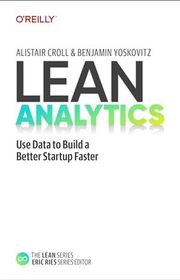
Lean Analytics: Use Data to Build a Better Startup Faster
For product teams and founders who need to choose what to measure. Croll and Yoskovitz connect metrics with business models and stages of development, though their startup focus needs adapting for established organizations and public-service goals.
What it's about
Alistair Croll and Benjamin Yoskovitz explain how startups can select metrics that support decisions at different stages. Business-model examples and case studies connect measurement with testing assumptions, understanding customers, and deciding what deserves attention next.

For beginners who want intuitive explanations before equations or code. Ng and Soo use visuals and everyday examples to distinguish methods, though the simplified treatment needs a technical companion when you start implementing or evaluating models.
What it's about
Annalyn Ng and Kenneth Soo introduce data science algorithms through intuitive explanations, visuals, and real-world examples. Chapters cover testing, clustering, regression, neural networks, and other techniques, with summaries and reference sheets comparing their strengths and limitations.

For experienced readers who want to question how organizations turn information into decisions. Devlin connects analytics with people, intuition, and systems design, though the conceptual framework is denser and less immediately practical than the beginner overviews.
What it's about
Barry Devlin argues that business decisions require intuition and tacit knowledge alongside analytical information. His models connect people, processes, and technology, extending conventional business intelligence toward collaborative systems that support interpretation, innovation, and action within organizations.

For analysts who need statistical reasoning connected to practical data work. The focused concepts and code examples bridge theory and application, though the brisk coverage assumes basic programming and provides less mathematical development than a full statistics textbook.
What it's about
Peter Bruce, Andrew Bruce, and Peter Gedeck connect statistical concepts with practical data science. This second edition supplies examples in both R and Python, explaining how to apply methods and recognize misuses for readers with programming experience and some statistical background.
Sources
- 1
12 Data Analytics Books for Beginners: A 2026 Reading List | Coursera
coursera.org
- 2
Top 10 Data Analytics Books
insights.btoes.com
- 3
10 Best Data Analytics Books You Should Read in 2026
wscubetech.com
- 4
40 Best Analytics Books [2026] - DigitalDefynd Education
digitaldefynd.com
- 5
Data Analytics Books
goodreads.com
- 6
10 must read Data Analytics books | Ironhack Blog
ironhack.com
- 7
9 Books to Start Your Business Analytics Journey
analyticsvidhya.com




Edited by
Software engineer whose passion for tracking book recommendations from podcasts inspired the creation of MRB.
Lead investor at 3one4 Capital whose startup expertise and love for books helped shape MRB and its growth.
Comments
Did we miss something? Have feedback?
Help us improve this page by sharing your thoughts