
9 Best PyTorch Books
The best PyTorch books, ranked by how many expert sources recommend each one, with notes on who each suits, from Python programmers to working ML developers.
Our take
PyTorch books can introduce tensors and training loops, build a complete machine-learning workflow, or concentrate on a field such as language processing or reinforcement learning. The right starting point depends on your Python experience and whether you already understand basic machine learning. Some books explain the framework directly; others use higher-level tools to reach working applications sooner.
Deep Learning with PyTorch develops understanding through a sustained project. Deep Learning for Coders with Fastai and PyTorch favors practical results before unpacking more of the machinery, while PyTorch Pocket Reference suits readers who need concise reminders during their own work. The specialist books are better follow-ups once training and evaluation feel familiar. Check the edition and accompanying code before starting: concepts can remain useful after APIs and software dependencies change. Begin with a general introduction, run its examples, and then choose a specialist title that matches the kind of model you want to build.
9 books · 9 sources · Last updated
As an Amazon Associate, we earn from qualifying purchases (at no extra cost to you).
How to choose from this list
Skip to the full rankingIf you know Python and want practical applications: Deep Learning for Coders with Fastai and PyTorch
If you want framework fundamentals: Deep Learning with PyTorch → PyTorch Pocket Reference
If you want a broader machine-learning course: Machine Learning with PyTorch and Scikit-Learn
If you want neural text-processing foundations: Natural Language Processing with PyTorch
If you want reinforcement-learning recipes: PyTorch 1.x Reinforcement Learning Cookbook
The 9 books, ranked
Ranked by how many expert sources name each book. Ties go to the book more people recommend.

For Python programmers who want to understand a complete training workflow rather than copy isolated examples. Its sustained project connects framework details with modeling decisions, though the older edition’s code needs checking against current PyTorch.
What it's about
Luca Antiga, Eli Stevens, and Thomas Viehmann teach neural network development with PyTorch through a tumor image classification project. Data preparation, tensors, training, diagnostics, and model improvements connect programming fundamentals with the practical decisions involved in building a deep learning pipeline.

For programmers who prefer building useful applications before studying every underlying detail. Its fastai layer makes early progress approachable, though readers seeking direct control of raw PyTorch should pair it with a framework-focused book.
What it's about
Jeremy Howard and Sylvain Gugger teach deep learning through practical applications using fastai and PyTorch. Programmers learn to train models for a range of tasks, connecting working examples with the concepts behind them without requiring an advanced academic background.
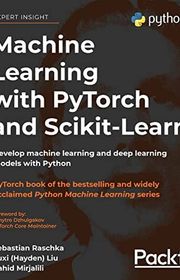
Machine Learning with PyTorch and Scikit-Learn: Develop machine learning and deep learning models with Python
For readers who want PyTorch within a broader machine-learning education. Its coverage connects classical methods with neural networks rather than treating deep learning alone, though the length and mathematical expectations demand more preparation than a quick introduction.
What it's about
Sebastian Raschka, Yuxi Liu, and Vahid Mirjalili develop machine-learning models using scikit-learn and PyTorch. The book moves from data preparation and classical methods into neural networks, combining explanations with Python implementations and guidance on evaluating results.

Programming PyTorch for Deep Learning
Creating and Deploying Deep Learning Applications
For developers who want an application-oriented route through model training and deployment. Its examples connect framework components with practical work, though older software and deployment choices need comparison with current documentation.
What it's about
Ian Pointer teaches deep learning application development with PyTorch, from setting up computing environments to building neural networks. Examples explore images, sound, and text, connecting individual framework components with training workflows and the practical work of creating and deploying models.
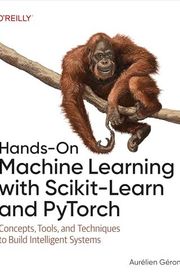
Hands-On Machine Learning with Scikit-Learn and PyTorch: Concepts, Tools, and Techniques to Build Intelligent Systems
For readers who want a substantial course connecting machine-learning concepts with runnable code. Its broad progression provides context before advanced neural models, though readers seeking only a short introduction to PyTorch may find the scope too wide.
What it's about
Aurélien Géron teaches machine learning through scikit-learn and PyTorch examples. The book develops a progression from foundational methods and model evaluation to neural networks, showing how concepts translate into practical systems through code and exercises.

PyTorch Recipes
A Problem-Solution Approach to Build, Train and Deploy Neural Network Models
For readers who want worked solutions to particular modeling and deployment tasks. Its recipe format makes selective consultation convenient, though it offers less continuity than a course built around one sustained project.
What it's about
Pradeepta Mishra teaches PyTorch through recipes for specific neural network development problems. Code snippets and explanations connect building and training models with distributed processing and production deployment, giving readers practical examples for carrying deep learning work through different stages.

Natural Language Processing with PyTorch
Build Intelligent Language Applications Using Deep Learning
For developers who want a foundation in neural text processing and its implementation. Its gradual treatment of representations and models helps explain the machinery, though the coverage predates today’s emphasis on large pretrained language models.
What it's about
Delip Rao and Brian McMahan introduce natural language processing and deep learning through PyTorch. Practical explanations develop text representations and neural algorithms, showing developers and data scientists how to build language applications suited to different problems.

For working developers who need a compact reminder of common PyTorch patterns. Its concise format supports looking things up during projects, though beginners will need fuller explanations and current documentation for APIs that have changed.
What it's about
Joe Papa provides a concise PyTorch reference with syntax, design patterns, and code examples. Guidance follows neural network development from loading data and customizing training loops to optimization and deployment, including approaches for accelerated computing, cloud environments, and edge devices.

PyTorch 1.x Reinforcement Learning Cookbook
Over 60 Recipes to Design, Develop, and Deploy Self-Learning AI Models Using Python
For readers who already know basic PyTorch and want to study reinforcement learning through worked recipes. Its specialized algorithmic focus adds depth beyond supervised learning, though the 1.x code and environment dependencies require updating.
What it's about
Yuxi Liu presents reinforcement learning through practical recipes implemented with PyTorch. Dynamic programming, Monte Carlo methods, temporal difference learning, and policy gradients connect algorithmic ideas with examples involving games, simulated environments, and other problems where agents learn from their actions.
Sources
- 1
Pytorch Books
goodreads.com
- 2
PyTorch Learning Resources [2026]
jobroadmaps.com
- 3
Top PyTorch Books recommended by experts (2026 Edition)
mentorcruise.com
- 4
Top 10 Best to Learn PyTorch (2023- 2024)
educba.com
- 5
Best PyTorch Books to Learn
stlplaces.com
- 6
BME 646 and ECE 60146: Deep Learning
engineering.purdue.edu
- 7
PyTorch Books Collection - Learn from Beginner to Advanced
devglan.com
- 8
Whats a good book like Aurelien Geron's book but for Pytorch?
reddit.com
- 9
Any AI and machine learning beginner book recommendations?
reddit.com







Edited by
Software engineer whose passion for tracking book recommendations from podcasts inspired the creation of MRB.
Lead investor at 3one4 Capital whose startup expertise and love for books helped shape MRB and its growth.
Comments
Spotted a missing book, a wrong order or a mistake? Tell us and we'll fix this page.
We're a reading guide, not the author or publisher, so we can't send books or pass on messages.