
14 Best Corporate Finance Books
The best corporate finance books, ranked by how many expert sources recommend each one, with notes on who each suits, from beginners to advanced students.
Our take
Corporate finance concerns the decisions a business makes about investment, funding, and returning money to its owners. Studying it means learning calculations, but also understanding the assumptions behind them and how managers weigh risk, incentives, and competing uses of capital.
The introductory textbooks differ mainly in depth and pace. Essentials of Corporate Finance offers a shorter route, while Fundamentals of Corporate Finance gives a fuller course foundation. Applied Corporate Finance connects principles with company decisions, and Lessons in Corporate Finance teaches through cases. Other books address specific problems: valuing private firms, managing international operations, or restructuring a company. The Theory of Corporate Finance belongs further along the path because it develops economic models rather than providing an introductory management manual.
Start with Corporate Finance For Dummies if the vocabulary is new, or Fundamentals of Corporate Finance if you want a structured course with room to practice.
14 books · 7 sources · Last updated
As an Amazon Associate, we earn from qualifying purchases (at no extra cost to you).
How to choose from this list
Skip to the full rankingIf you're new to finance terminology: Corporate Finance For Dummies → Essentials of Corporate Finance
If you want a full introductory course: Fundamentals of Corporate Finance → Principles of Corporate Finance
If you learn through company decisions: Applied Corporate Finance → Lessons in Corporate Finance
If you're studying business valuation: Valuation → Principles of Private Firm Valuation
If you're ready for advanced economic models: The Theory of Corporate Finance
The 14 books, ranked
Ranked by how many expert sources name each book. Ties go to the book more people recommend.

Applied Corporate Finance
For readers who want finance principles connected to actual companies, Damodaran makes investment, funding, and payout decisions concrete. The applied perspective gives theory a purpose, though working through the analysis assumes comfort with financial statements and numbers.
What it's about
Aswath Damodaran applies corporate finance principles to real companies, organizing decisions around investment, financing, and dividends. The textbook connects risk, returns, capital structure, and distributions with practical choices managers face when seeking to create value.

Fundamentals of Corporate Finance
For business students taking their first corporate finance course, Ross and his coauthors combine intuitive explanations with a consistent valuation framework. The structured coverage supports coursework, though independent learners need to spend time on exercises.
What it's about
Stephen Ross, Randolph Westerfield, and Bradford Jordan present an introduction to corporate finance for finance majors and other business students. The textbook combines intuitive explanations, a unified approach to valuation, and attention to the judgment required of financial managers.

The Theory of Corporate Finance
For advanced students ready to study corporate finance through economic models, Tirole offers a rigorous framework linking incentives, governance, and financing. Its theoretical depth is distinctive, though mathematical preparation matters much more than a desire for quick managerial rules.
What it's about
Jean Tirole develops a unified account of corporate finance theory, combining economic models with empirical studies. Topics include governance, managerial incentives, financing choices, liquidity, and risk, with corporations examined within their wider institutional and economic environments.

Corporate Finance For Dummies
For readers intimidated by corporate finance terminology, Taillard offers a gentler introduction than the main textbooks. The approachable explanations help establish vocabulary, though they don't replace the depth or problem practice of a full course.
What it's about
Michael Taillard explains corporate finance through plain-language instruction and examples. Topics include financial statements, risk, investment, mergers, asset valuation, bonds, and derivatives, offering students a foundation for understanding the financial decisions made within businesses.

Essentials of Corporate Finance
For students who need a compact introduction to financial management, this text concentrates on the essential decisions and their intuition. The selective scope suits a shorter course, though it offers less detail than the broader Fundamentals textbook.
What it's about
Stephen Ross, Randolph Westerfield, and Bradford Jordan introduce the essentials of corporate finance with an emphasis on intuitive explanations and managerial decisions. Valuation and net present value connect the concepts, helping students understand how financial choices affect a firm.

Lessons in Corporate Finance
A Case Studies Approach to Financial Tools, Financial Policies, and Valuation
For readers who learn by working through business decisions, Asquith and Weiss make cases the teaching vehicle. The questions connect calculations with judgment, though the format demands active participation rather than passive reference reading.
What it's about
Paul Asquith and Lawrence Weiss introduce corporate finance through case studies and progressively challenging questions. Numerical examples and discussion connect financial analysis, capital structure, investment policy, cash flows, and valuation with the decisions faced by real companies.

Principles of Corporate Finance
For students who want a substantial foundation before specializing, Brealey and his coauthors connect financial decisions with the principles behind them. Its breadth makes a useful long-term reference, though the analytical material requires sustained practice.
What it's about
Richard Brealey, Stewart Myers, and Franklin Allen explain investment decisions, risk, valuation, financing, and payout policy. The textbook combines financial theory with company examples and exercises, giving students a framework for evaluating how business choices affect value.

For students and practitioners seeking an international perspective, Vernimmen's author team connects finance theory with business applications. The range makes it a substantial reference, though its length and technical discussions can overwhelm a complete beginner.
What it's about
This corporate finance textbook combines theory with practical scenarios and a global perspective. The author team connects financial concepts with applications drawn from investment and business practice, helping students and professionals understand how finance informs corporate decisions.

Corporate Restructuring
For readers focused on reorganizing a business rather than routine financial management, de Caires offers a specialized perspective on restructuring choices. Its concentrated scope is useful, though the older institutional setting requires checking against current practice.

Multinational Business Finance
For students and managers dealing with finance across borders, Eiteman and his coauthors address questions a domestic textbook may underplay. The international focus gives currency and country risks context, though it assumes familiarity with basic finance.
What it's about
David Eiteman, Arthur Stonehill, and Michael Moffett examine financial management in multinational businesses. Concepts and mini-cases connect the global financial environment with strategic decisions, showing how managers address the distinctive challenges and opportunities of international markets.

Principles of Private Firm Valuation
For readers valuing privately held companies, Feldman concentrates on issues that public-market examples can obscure. Its treatment of control and marketability offers a useful specialization, though the technical scope makes it a follow-up to basic valuation.
What it's about
Stanley Feldman examines the factors that determine the value of privately held businesses. Research and practical examples address value creation, control, marketability, transparency, transaction values, and differences between business forms, with attention to valuation and deal structure.

The Revolution in Corporate Finance
For readers interested in how financial ideas entered management practice, this collection brings influential arguments together. The range supports comparison and discussion, though varied authors and a historical publication context make it less cohesive than a textbook.
What it's about
Edited by Joel Stern and Donald Chew, this collection brings together articles on advances in corporate finance and their practical implications. Contributions by financial economists connect theory with management decisions, including international finance and corporate governance.
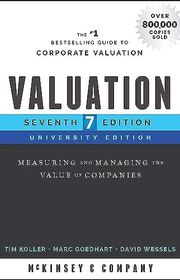
Valuation: Measuring and Managing the Value of Companies
For analysts moving from basic finance into company valuation, Koller and his coauthors connect business performance with modeling decisions. Its practical depth supports serious analysis, though financial statement fluency and patient work with assumptions are essential.
What it's about
Tim Koller, Marc Goedhart, and David Wessels explain how to assess company value through operating performance, cash flows, growth, and the cost of capital. Their framework connects financial analysis with strategy, investment decisions, and value creation.

For students who want the central corporate finance toolkit without the largest textbook treatment, Ross and his coauthors emphasize valuation and decisions. The narrower format supports a focused course, though some specialist topics receive less space.
What it's about
This concise corporate finance textbook centers on valuation and the financial manager’s decisions. Net present value provides a unifying framework for understanding how business choices affect value, with practical judgment emphasized alongside essential financial concepts.
Sources
- 1
Corporate Finance Books - List of 9 Best Textbooks [2026]
wallstreetmojo.com
- 2
10 Best Corporate Finance Books (Update 2023) - Wikiaccounting
wikiaccounting.com
- 3
The Best Corporate Finance Textbooks for 2026 | Benzinga
benzinga.com
- 4
Corporate Finance Books
goodreads.com
- 5
100 Best Corporate Finance Books of All Time (Updated for 2026)
shortform.com
- 6
Top Corporate Finance Textbooks on FacultyBookshelf.org
facultybookshelf.org
- 7
Best Corporate Finance Books - Learn More About Corporate Finance
corporatefinanceinstitute.com





Edited by
Software engineer whose passion for tracking book recommendations from podcasts inspired the creation of MRB.
Lead investor at 3one4 Capital whose startup expertise and love for books helped shape MRB and its growth.
Comments
Spotted a missing book, a wrong order or a mistake? Tell us and we'll fix this page.
We're a reading guide, not the author or publisher, so we can't send books or pass on messages.