
7 Best Combinatorics Books
The best combinatorics books, ranked by how many expert sources recommend each one, with notes for students choosing an introduction or advanced reference.
Our take
Combinatorics studies how discrete objects can be counted, arranged and connected. A good first book helps you recognize the structure of a problem rather than simply select a formula. These books suit students developing proof skills, programmers who want stronger mathematical tools and readers ready to study counting, graphs or designs in greater depth. Your experience with proofs matters more than how many formulas you remember.
A Walk Through Combinatorics and Introductory Combinatorics offer broad undergraduate routes. Cameron’s Combinatorics emphasizes reusable techniques, while A Course in Combinatorics ranges into designs, graphs and codes. Concrete Mathematics is especially useful for the sums and recurrences that appear in computer science. For a narrower goal, generatingfunctionology develops one powerful counting tool, while Enumerative Combinatorics provides a more demanding reference. Start with a broad introduction, work its exercises and move to a specialist text once you know which questions interest you.
7 books · 8 sources · Last updated
As an Amazon Associate, we earn from qualifying purchases (at no extra cost to you).
How to choose from this list
Skip to the full rankingIf you want a first undergraduate course: Introductory Combinatorics → A Walk Through Combinatorics
If you want techniques across the subject: Combinatorics
If you want mathematics for computer science: Concrete Mathematics
If you want to study generating functions: generatingfunctionology → Enumerative Combinatorics
If you want graphs, designs and codes: A Course in Combinatorics
The 7 books, ranked
Ranked by how many expert sources name each book. Ties go to the book more people recommend.

A Course in Combinatorics
For mathematically confident students who want designs, graphs and codes in one connected treatment. Its breadth makes it useful beyond enumeration, though difficult exercises and a brisk approach can make independent study challenging.
What it's about
J. H. van Lint and R. M. Wilson introduce combinatorics through connected themes in designs, graphs, and codes. Exercises accompany the theory, linking arrangements and distributions of objects with applications in coding, circuit design, and algorithm complexity.

For students seeking a first substantial course that balances counting with graph theory. Its examples build intuition before more advanced topics, though the later material still expects active problem solving and comfort with proofs.
What it's about
Miklós Bóna introduces combinatorial enumeration and graph theory through examples and problems of increasing difficulty. Core techniques lead into subjects such as Ramsey theory, pattern avoidance, and the probabilistic method, connecting introductory study with research questions.

For readers who already know the basics and want a deep counting reference. Its systematic treatment and extensive problems reward sustained study, though it is a demanding starting point for anyone still learning proof techniques.
What it's about
Richard Stanley develops methods for counting combinatorial objects, connecting generating functions with permutations, partially ordered sets, and related structures. Worked examples and exercises build the theory while showing how different counting problems fit into a common mathematical framework.
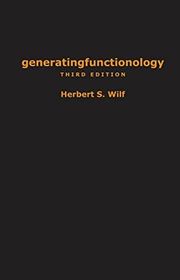
generatingfunctionology
For readers who know basic counting and want to become confident with generating functions. Its concentrated treatment links discrete questions to algebraic methods, though it covers a narrower slice of combinatorics than the general textbooks.
What it's about
Wilf explains how generating functions encode sequences and turn counting problems into algebraic calculations. Examples and exercises develop the method and its connections to recurrences, probability and asymptotic questions, building a focused toolkit for enumerative combinatorics.

For computer science students who want fluency with sums, recurrences and discrete calculations. Its demanding exercises develop useful mathematical habits, though the emphasis on computation gives less space to the wider structures of combinatorics.
What it's about
This textbook by Ronald L. Graham, Donald E. Knuth, and Oren Patashnik blends continuous and discrete mathematics for computing. Exercises and explanations develop skills in manipulating sums, solving recurrences, using generating functions, and analyzing probability and asymptotic behavior.

For students comfortable with proofs who want a broad toolkit rather than counting formulas alone. Its constructive approach and exercises connect recurring techniques, though the range of material requires more mathematical confidence than a gentle first introduction.
What it's about
Peter Cameron emphasizes recurring techniques in combinatorics, including generating functions and recursive construction. The textbook progresses to more advanced material through exercises and projects, favoring constructive and algorithmic proofs and including historical context.
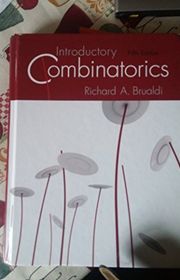
Introductory Combinatorics
For students who want a conventional undergraduate textbook with a wide range of counting and graph topics. Its organized progression supports a full course, though the exercises and proofs still demand steady work rather than casual reading.
What it's about
Brualdi develops core counting methods, including permutations, combinations, inclusion-exclusion, generating functions and recurrence relations. Later topics connect these techniques to graphs, matchings, designs and network flows, giving students a foundation for further study in discrete mathematics.
Sources
- 1
Good combinatorics textbooks for teaching undergraduates?
mathoverflow.net
- 2
Good resources to learn combinatorics?
reddit.com
- 3
Combinatorics Books
goodreads.com
- 4
Combinatorics
maa.org
- 5
What Books Should Everyone Read?
cstheory.stackexchange.com
- 6
Combinatorics Book Recommendations
reddit.com
- 7
Good Book On Combinatorics
math.stackexchange.com
- 8
Reading List
promys.org






Edited by
Software engineer whose passion for tracking book recommendations from podcasts inspired the creation of MRB.
Lead investor at 3one4 Capital whose startup expertise and love for books helped shape MRB and its growth.
Comments
Spotted a missing book, a wrong order or a mistake? Tell us and we'll fix this page.
We're a reading guide, not the author or publisher, so we can't send books or pass on messages.