
11 Best Discrete Mathematics Books
The best discrete mathematics books, ranked by how many expert sources recommend each one, with notes to help you choose proofs, course study, or coding.
Our take
Discrete mathematics studies structures such as sets, graphs, sequences, and logical statements. For many students it also marks a change from calculating an answer to explaining why an argument works. A useful first book therefore needs to fit both your background and your purpose: learning proof, supporting a computer science course, or applying mathematical ideas in programs. The exercises matter as much as the explanations.
The broad textbooks by Rosen and Johnsonbaugh cover a large part of the usual undergraduate course. Epp gives particular attention to logical reasoning, while Essential Discrete Mathematics for Computer Science keeps the computing connection close. Journey into Discrete Mathematics takes a more mathematical route into abstraction. For a different learning style, Practical Discrete Mathematics uses Python, and Discrete Mathematics: An Open Introduction encourages investigation. Concrete Mathematics belongs later, when you are ready for more demanding work related to algorithms. Start with Epp for careful proof development or Levin for an exploratory first course.
11 books · 9 sources · Last updated
As an Amazon Associate, we earn from qualifying purchases (at no extra cost to you).
How to choose from this list
Skip to the full rankingIf you are learning to write proofs: Discrete Mathematics with Applications
If you want Levin’s exploratory first course: Discrete Mathematics
If you want a broad computer science reference: Discrete Mathematics and Its Applications
If you want concise links to computer science: Essential Discrete Mathematics for Computer Science
If you learn through Python: Practical Discrete Mathematics
If you are ready for advanced algorithmic mathematics: Concrete Mathematics
The 11 books, ranked
Ranked by how many expert sources name each book. Ties go to the book more people recommend.

Discrete Mathematics and Its Applications
For readers who want a substantial reference covering the standard undergraduate topics. Its breadth and many applications support later return visits, though the encyclopedic structure can overwhelm beginners who need a slower introduction to writing proofs.
What it's about
Kenneth Rosen introduces discrete mathematics for students in computing, mathematics, and engineering. Explanations and exercises connect the subject's central ideas to applications in areas including data networks, science, business, and language.

Discrete Mathematics with Applications
For beginners who need the reasoning behind proofs explained carefully. Its emphasis on logic and common difficulties makes the transition to abstraction more gradual, though that detailed development can feel slow to readers who already write proofs comfortably.
What it's about
Susanna Epp develops discrete mathematics through logic, proof, and the reasoning behind abstract concepts. Topics including sets, relations, counting, graphs, recursion, and algorithm analysis connect mathematical foundations with computer science applications.

For readers who already have mathematical maturity and want stronger tools for analyzing algorithms. Its sustained work with sums, recurrences, and related techniques goes beyond introductory surveys, though the challenging exercises make it a poor first encounter with discrete mathematics.
What it's about
Ronald L. Graham, Donald E. Knuth, and Oren Patashnik develop mathematical techniques used in computer programming and algorithm analysis. Topics include sums, recurrences, number theory, generating functions, probability, and asymptotic methods, with extensive exercises and worked guidance.
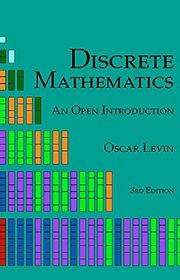
Discrete Mathematics: An Open Introduction
For learners who want to explore problems before settling into formal explanations. Its inquiry activities and freely available online text support independent study, though the selected topics are less comprehensive than a large computer science survey.
What it's about
Oscar Levin introduces counting, sequences, logic, and graph theory while developing techniques of proof. Investigative activities, examples, and exercises encourage students to form conjectures and explain their reasoning, serving as an introduction to both discrete topics and mathematical writing.

Discrete Mathematics
For students who want a broad course with algorithms alongside mathematical reasoning. Its combination of proof and computing applications gives a conventional foundation, though the range of material requires choosing a manageable path rather than reading everything at once.
What it's about
Richard Johnsonbaugh introduces discrete mathematics through an algorithmic approach to problem solving. Explanations and exercises emphasize understanding and constructing proofs, helping students develop the mathematical reasoning used in computing and further study.

Discrete Mathematics and Applications
For learners who want proof writing integrated with standard discrete topics and their applications. The progression links foundational ideas with later structures, though the textbook approach calls for sustained exercise work rather than quick computational recipes.
What it's about
Kevin Ferland introduces discrete mathematics with an emphasis on writing proofs and solving problems. Set theory and number theory lead into combinatorics, graph theory, trees, and algorithms, connecting mathematical reasoning with computation.

Essentials of Discrete Mathematics
For readers who want a compact course organized around different ways of thinking. Its recurring use of graphs helps connect topics, though the concise presentation gives less room for an encyclopedic selection of applications and examples.
What it's about
David Hunter organizes discrete mathematics around logical, relational, recursive, quantitative, and analytical thinking. Graphs appear throughout the text, building a foundation for applications and the later study of algorithms.

Schaum's Outline of Discrete Mathematics
For students who understand the lecture material but need more worked practice. Its solved problems make it useful for checking methods and finding gaps, though the compressed explanations are better as a supplement than as a first conceptual course.
What it's about
Seymour Lipschutz and Marc Lipson review discrete mathematics through worked problems and step-by-step explanations. The outline supports course study and independent practice, with attention to solving problems and applications in computer science.

Essential Discrete Mathematics for Computer Science
For computer science students who want proof to connect directly with the mathematics behind their subject. Its short chapters make individual ideas easier to revisit, though understanding the arguments still depends on working through exercises rather than only reading.
What it's about
Harry Lewis and Rachel Zax introduce the discrete mathematics underlying computer science through short chapters and an emphasis on proof. Illustrations, summaries, and exercises develop mathematical reasoning alongside topics connected with algorithms, combinatorics, and graph theory.

Journey into Discrete Mathematics
For learners who want discrete mathematics to serve as an introduction to abstraction. Revisiting topics at increasing depth helps develop reasoning over time, though the mathematical approach is less direct if your immediate goal is implementing algorithms.
What it's about
Owen Byer, Deirdre Smeltzer, and Kenneth Wantz introduce mathematical abstraction through logic, sets, proofs, relations, and functions. Counting, number theory, and graph theory are revisited at increasing depth to develop students' problem-solving habits.

Practical Discrete Mathematics
Discover Math Principles that Fuel Algorithms for Computer Science and Machine Learning with Python
For programmers who learn ideas by connecting them with Python examples. Its movement toward algorithms and data problems makes the applications visible, though familiarity with code helps and it offers a different experience from a proof centered mathematics course.
What it's about
Ryan White and Archana Tikayat Ray connect discrete mathematics to computing through Python examples. Logic, combinatorics, probability, graphs, and algorithms lead into practical problems in routing, searching, data analysis, and machine learning.
Sources
- 1
Resources for Discrete Math
khoury.northeastern.edu
- 2
COMPSCI 230 Resources
courses.cs.duke.edu
- 3
Recommended Outside Resources
logicallearning.co
- 4
Recommended Books on Higher Mathematics
mathvault.ca
- 5
What are the ways to teach myself discrete mathematics?
reddit.com
- 6
Discrete Mathematics Books
goodreads.com
- 7
Discrete Mathematics & Combinatorics
maa.org
- 8
Discrete Mathematics Books
whats-your-iq.com
- 9
MATH M21: Discrete Mathematics
moorparkcollege.edu




Edited by
Software engineer whose passion for tracking book recommendations from podcasts inspired the creation of MRB.
Lead investor at 3one4 Capital whose startup expertise and love for books helped shape MRB and its growth.
Comments
Did we miss something? Have feedback?
Help us improve this page by sharing your thoughts