
6 Best Clear Thinking Books
The best clear thinking books, ranked by expert source recommendations, with notes to help readers choose bias guides, forecasting habits, and tools for skepticism.
Our take
Clear thinking involves more than spotting a fallacy in someone else's argument. It means noticing uncertainty, checking the quality of evidence, separating a good decision from a lucky result, and revising an opinion when circumstances change. These books suit readers who want to examine their own judgments as well as the claims they encounter in work, news, and everyday conversation.
Thinking, Fast and Slow explains recurring patterns in human judgment, while The Art of Thinking Clearly offers shorter entries on common errors. Fooled by Randomness puts luck and uncertainty at the center. For a more active practice, Superforecasting emphasizes making and updating predictions. Algorithms to Live By approaches choices through ideas from computer science, and Calling Bullshit concentrates on misleading information and data.
Begin with Calling Bullshit if evaluating claims is your immediate goal, or Superforecasting if you want habits you can test against outcomes.
6 books · 8 sources · Last updated
As an Amazon Associate, we earn from qualifying purchases (at no extra cost to you).
How to choose from this list
Skip to the full rankingIf you want to evaluate data-heavy claims: Calling Bullshit
If you want to understand judgment errors: The Art of Thinking Clearly → Thinking, Fast and Slow
If you want to improve predictions: Superforecasting → Fooled by Randomness
If you like computational approaches: Algorithms to Live By
The 6 books, ranked
Ranked by how many expert sources name each book. Ties go to the book more people recommend.
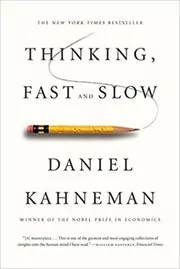
Thinking, Fast and Slow
For readers who want a substantial account of how intuitive judgments can go wrong. Its many experiments build a useful vocabulary for noticing errors, but it is lengthy and some research examples need later context.
What it's about
Kahneman explores two modes of thought: quick, intuitive responses and slower, deliberate reasoning. Drawing on psychological research, he examines how biases and impressions shape decisions, and when intuition helps or misleads in personal and professional life.
Also recommended by
19 people Bill Gates recommended this book
Bill Gates
List of books Bill Gates read in 2012.
Bill Gates's recommendation of this book  Ray Dalio recommended this book
Ray Dalio
Ray Dalio mentioned this book in his book, "Principles."
Ray Dalio's recommendation of this book  Scott Adams recommended this book
Scott Adams
One of the books on Scott Adams' "Persuasion Reading List."
Scott Adams's recommendation of this book  Naval Ravikant recommended this book
Naval Ravikant
"Fine book but it didn’t need to be an entire book. A blog post would have gotten the point across." - Naval Ravikant
Naval Ravikant's recommendation of this book  Ev Williams recommended this book
Ev Williams
"I love surprising scientific findings, as well as information about how our brains work. [This book] is a treasure trove of both." - Ev Williams
Ev Williams's recommendation of this book  Marc Andreessen recommended this book
Marc Andreessen
"Captivating dive into human decision making, marred by inclusion of several/many? psychology studies that fail to replicate. Will stand as a cautionary tale?" - Marc Andreessen
Marc Andreessen's recommendation of this book +13
More recommendations
- Stewart Brand
Stewart Brand recommended this book on his "Selected Books for the Manual for Civilization" blog post.
- Bryan Johnson
"I started reading [this book] and I became increasingly convinced of my own fickleness and inability to actually act rationally in life." - Bryan Johnson
- Derek Sivers
"If you liked 'Predictably Irrational' or 'Stumbling on Happiness' or any of those pop-psychology books, well, this is the Godfather of all of their work." - Derek Sivers
- Sam Altman
One of Sam Altman's answers to "What are some of the best books you recommend for a young startup founder?"
- Ron Conway
"Covers all three phases of [the author's] career: his early days working oncognitive bias, his work on prospect theory, and his later work on happiness." - Ron Conway
- Jason Fried
"I enjoyed [this book]. Fascinating." - Jason Fried
- Nassim Taleb
"A landmark book in social thought, in the same league as The Wealth of Nations by Adam Smith and The Interpretation of Dreams by Sigmund Freud." - Nassim Taleb
- Sahil Lavingia
Sahil Lavingia recommended this book on Notion.
- Mark Manson
Mark Manson recommended this book on his website.
- Jay Shetty
"[One] of my favourite books." - Jay Shetty
- Michiko Kakutani
"Has become essential reading in many baseball front offices and among coaching staffs." - Michiko Kakutani
- Preston Pysh
"An incredible book!" - Preston Pysh
- Ben Greenfield
Most Recommended Books reached out to Ben Greenfield directly.
- Stewart Brand
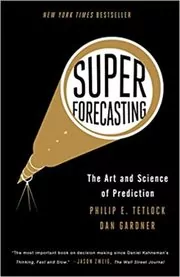
For readers willing to practice making predictions and checking them against outcomes. It turns uncertainty into habits of updating and comparison, but improvement requires recorded judgments over time rather than simply recognizing bias names.
What it's about
Philip Tetlock and Dan Gardner draw on forecasting research and a large prediction tournament to examine how people improve judgment under uncertainty. They discuss habits such as weighing evidence, considering alternatives, revising beliefs, and learning from outcomes.
Also recommended by
7 people Julia Galef recommended this book
Julia Galef
"[Has] some good advice on how to improve your ability to make accurate predictions." - Julia Galef
Julia Galef's recommendation of this book  Alexis Ohanian recommended this book
Alexis Ohanian
"Such a great book. Building software right now that's informed by this." - Alexis Ohanian
Alexis Ohanian's recommendation of this book  Anthony Pompliano recommended this book
Anthony Pompliano
"[One of the] best books I read in 2017." - Anthony Pompliano
Anthony Pompliano's recommendation of this book  Michael Mauboussin recommended this book
Michael Mauboussin
"Most important book since Thinking, Fast & Slow." - Michael Mauboussin
Michael Mauboussin's recommendation of this book  Sam Hinkie recommended this book
Sam Hinkie
"Remarkable." - Sam Hinkie
Sam Hinkie's recommendation of this book  Shane Parrish recommended this book
Shane Parrish
Shane Parrish recommended this book in his blog.
Shane Parrish's recommendation of this book +1
More recommendations
- Preston Pysh
"It's a really good book!" - Preston Pysh
- Preston Pysh
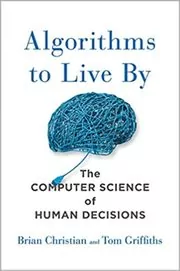
For readers who enjoy mathematical ideas connected with ordinary choices. Its computational perspective clarifies tradeoffs in searching and allocating time, but the models simplify human situations and do not supply literal instructions for every decision.
What it's about
Brian Christian and Tom Griffiths connect computer algorithms with everyday decisions constrained by time and information. They explore questions of searching, organizing, scheduling, and choosing between familiar options and new possibilities, showing how computational ideas illuminate human judgment.
Also recommended by
1 person- Anthony Pompliano recommended this book
Anthony Pompliano
"[One of the] best books I read in 2017." - Anthony Pompliano
Anthony Pompliano's recommendation of this book
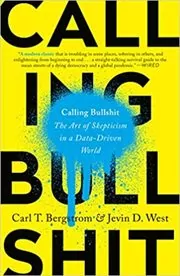
For readers who want to question claims dressed up in charts, statistics, or scientific language. Its concrete examples make skepticism usable without advanced mathematics, but it focuses on evaluating information rather than a complete decision-making process.
What it's about
Carl Bergstrom and Jevin West explain how to question misleading claims presented through data, mathematics, and scientific language. Examples examine selection bias, deceptive graphics, and confusion between correlation and causation, offering tools for evaluating information without advanced technical expertise.
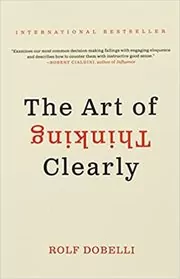
The Art of Thinking Clearly
For readers who prefer brief, browsable introductions to common thinking errors. The short chapters make concepts easy to revisit, but the compressed advice gives less room to evidence, exceptions, and competing explanations than Kahneman's longer treatment.
What it's about
Rolf Dobelli examines common errors in reasoning through ninety-nine short chapters. Everyday examples illustrate cognitive biases and mistaken judgments, inviting readers to recognize recurring traps and reconsider how they make decisions at work and in personal life.
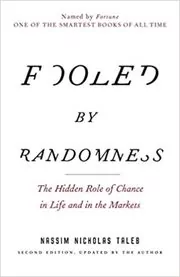
For readers who want to question whether success reflects skill or favorable luck. Its argumentative style makes uncertainty hard to ignore, but the finance-heavy examples and deliberate provocations may distract from the underlying ideas.
What it's about
Nassim Nicholas Taleb examines how people mistake luck for skill and build explanations around accidental outcomes. Drawing on financial markets, probability, and human behaviour, he explores the biases that make uncertainty difficult to recognize in everyday judgments.
Also recommended by
7 people Howard Marks recommended this book
Howard Marks
"Really about how much randomness there is in our world." - Howard Marks
Howard Marks's recommendation of this book  Nick Kokonas recommended this book
Nick Kokonas
"Almost everyone in my office is forced to read [this book]." - Nick Kokonas
Nick Kokonas's recommendation of this book - Ev Williams recommended this book
Ev Williams
On the "books read" section of Ev Williams' GoodReads profile.
Ev Williams's recommendation of this book  James Altucher recommended this book
James Altucher
James Altucher mentioned this book on "The Tim Ferriss Show" podcast.
James Altucher's recommendation of this book  Art De Vany recommended this book
Art De Vany
"I used [this book] is a class I taught on the economics of uncertainty." - Art De Vany
Art De Vany's recommendation of this book  Ryan Shea recommended this book
Ryan Shea
Ryan Shea recommended this book on Twitter.
Ryan Shea's recommendation of this book +1
More recommendations
- James Clear
"[One of] the 10 books with the most page-for-page wisdom." - James Clear
- James Clear
Sources
- 1
The Best Books on Critical Thinking
fivebooks.com
- 2
9 books that will change how you think about thinking.
medium.com
- 3
7 Books That Will Train Your Brain to Overachieve
inc.com
- 4
Bookstore
philosophy.hku.hk
- 5
Critical Thinking (211 books)
goodreads.com
- 6
Books on thinking?
reddit.com
- 7
The Best Books on Decision Making: How to Choose Well When You Can’t Be Sure
yalom.com
- 8
Best Books on Mental Models and Critical Thinking
crownleigh.com
Edited by
Software engineer whose passion for tracking book recommendations from podcasts inspired the creation of MRB.
Lead investor at 3one4 Capital whose startup expertise and love for books helped shape MRB and its growth.
Comments
Did we miss something? Have feedback?
Help us improve this page by sharing your thoughts