
9 Best C# Books
The best C# books, ranked by how many expert sources recommend each one, with notes on beginner lessons, detailed references, and who each book suits.
Our take
C# books serve several different jobs: teaching a first programming language, helping an experienced developer switch languages, and explaining difficult topics such as asynchronous code. A beginner benefits from guided exercises, while someone maintaining a real application may need a detailed reference instead.
Head First C# uses visual explanations and activities. The C# Player's Guide builds a learning path around challenges, while Murach's C# gives Windows desktop development a central role. Experienced readers can use C# in Depth to examine language behavior and Concurrency in C# Cookbook to work through specific coordination problems. The version numbers on other titles matter: books covering C# 8 or C# 10 can still explain fundamentals, but their framework examples and tooling won't match every newer project.
Start with The C# Player's Guide for practice, or choose C# 12 in a Nutshell if you already program and want a reference.
9 books · 8 sources · Last updated
As an Amazon Associate, we earn from qualifying purchases (at no extra cost to you).
How to choose from this list
Skip to the full rankingIf you're learning your first language: The C# Player's Guide → Head First C#
If you already know another language: Programming C# 8.0 → C# in Depth
If you want a detailed reference: C# 12 in a Nutshell
If you're working on asynchronous code: Concurrency in C# Cookbook
If you're building Windows desktop software: Murach's C#
The 9 books, ranked
Ranked by how many expert sources name each book. Ties go to the book more people recommend.

C# in Depth
For programmers who already use C# and want to understand its behavior, Skeet offers detailed reasoning about language features. The explanations reward curiosity, though this edition's historical focus doesn't replace a reference for newer releases.
What it's about
Jon Skeet examines the evolution and deeper features of C# for developers who already know the language. This fourth edition explores concepts including asynchronous functions, tuples, and interpolated strings, using examples to explain how C# 6 and 7 features work.
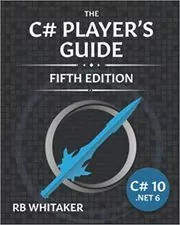
The C# Player's Guide
For beginners who enjoy challenges and a sense of progression, Whitaker turns fundamentals into an active learning path. The exercises help reveal gaps in understanding, though the game-inspired framing won't appeal to every reader.
What it's about
R. B. Whitaker introduces C# through a game-inspired approach with practical challenges and playful examples. This fifth edition covers C# 10 and .NET 6, guiding beginners from their first programs toward broader programming skills through building software as they learn.
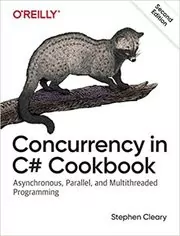
For working C# developers choosing between asynchronous and parallel approaches, Cleary offers focused recipes that explain practical differences. Its problem-based organization supports immediate consultation, though readers need language fundamentals and should check library-version details.
What it's about
Stephen Cleary organizes concurrent programming in C# around practical recipes with code and explanations. The cookbook explores asynchronous operations, parallel processing, multithreading, and related libraries, showing how different approaches address responsiveness, scalability, and coordination in applications.

For beginners who learn through pictures, exercises, and repeated experimentation, Stellman and Greene offer an approachable introduction. Its playful presentation encourages participation, though readers wanting a compact reference may prefer a more conventional layout.
What it's about
Andrew Stellman and Jennifer Greene teach C# and .NET Core through a visual, activity-based introduction. Puzzles, exercises, and projects connect language concepts with building applications, interfaces, and games, giving beginners repeated opportunities to practice object-oriented programming and related skills.
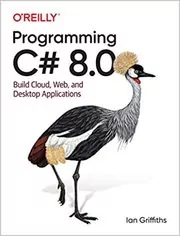
For experienced programmers moving into C# 8, Griffiths supplies more detail and explanation than a quick-start tutorial. The language-focused approach supports careful study, though it doesn't cover features introduced in later versions of C#.
What it's about
Ian Griffiths introduces C# 8.0 to experienced programmers, combining language fundamentals with extensive code examples. The guide explores generics, LINQ, asynchronous programming, nullable references, and other features, connecting the language with techniques for cloud, web, and desktop applications.
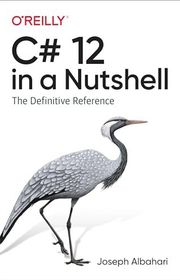
C# 12 in a Nutshell
For developers who already program and need broad coverage through C# 12, Albahari offers a substantial language and framework reference. Its depth supports selective study, though the density makes it a demanding first programming book.
What it's about
Joseph Albahari surveys C# 12 and the core libraries of .NET 8. The book covers language features, LINQ, concurrency, and runtime facilities, helping developers look up details and connect individual features to everyday programming tasks.

For learners working specifically with C# 10 and .NET 6, Price connects language study with application development. Its broad route gives projects a purpose, though web and data examples depend on the versions covered here.
What it's about
Mark Price introduces C# 10 and version 6 of Microsoft's development platform through practical programming projects. Topics include object oriented code, testing, LINQ, databases with Entity Framework Core, and building websites and services with Blazor and Microsoft's web framework.
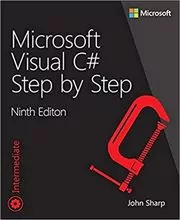
Microsoft Visual C# Step by Step
For beginners who want lessons organized around guided Visual Studio exercises, Sharp provides a clear sequence. The tool-based approach makes practice explicit, though this edition's Visual Studio 2017 environment differs substantially from newer installations.
What it's about
John Sharp teaches Visual C# fundamentals through exercises and code examples using Visual Studio 2017. The guide develops programming skills for building applications, connecting language basics with object-oriented design and practical work in the development environment covered by this edition.
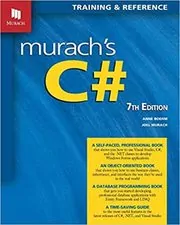
Murach's C#
For beginners whose goal is Windows Forms development, Murach's paired explanations and examples support steady practice. The desktop emphasis gives fundamentals a concrete setting, though it is a narrower fit for readers targeting cross-platform services.
What it's about
Anne Boehm and Joel Murach teach C# through developing Windows Forms applications. The seventh edition connects language fundamentals with object-oriented and database programming, presenting explanations and examples that support both introductory learning and later reference while building desktop software.
Sources
- 1
10 Best C# and .NET Books for 2026 | ComputingForGeeks
computingforgeeks.com
- 2
So You Want to Learn C#? (2026 Edition) | Patrick T Coakley
patricktcoakley.com
- 3
C Sharp Books
goodreads.com
- 4
Best C# Books [2026] | Beginner to Advanced | JobRoadmaps
jobroadmaps.com
- 5
Top 8 C# Books for Beginners & Experts: A 2023 (Professional)
educba.com
- 6
What are the best books for you on C# and .NET?
reddit.com
- 7
The C# Player’s Guide: Still Worth Reading in 2025?
reddit.com
- 8
5 Best C# Books for Building Games and Beyond (2023) | Books on Code
booksoncode.com


Edited by
Software engineer whose passion for tracking book recommendations from podcasts inspired the creation of MRB.
Lead investor at 3one4 Capital whose startup expertise and love for books helped shape MRB and its growth.
Comments
Did we miss something? Have feedback?
Help us improve this page by sharing your thoughts