
11 Best .NET Books
The best .NET books, ranked by how many expert sources recommend each one, with notes to help beginners and experienced C# developers choose where to start.
Our take
.NET gives developers a runtime, libraries, and tools for building web services, desktop software, and other applications. C# is one of its main languages, but learning the syntax is only part of the work. These books help with the next decisions too: organizing dependencies, writing asynchronous code, and understanding why an application uses more memory than expected.
The starting points differ. The C# Player's Guide teaches through challenges, while Head First C#: A Learner's Guide to Real-World Programming with C# and .NET Core uses a visual approach. C# in Depth suits readers who already program and want clearer explanations of language behavior. The memory and concurrency books address narrower problems, and ASP.NET Core in Action concentrates on web development. Check the edition before following setup instructions, since several books target earlier .NET releases. Start with a beginner book if C# is new to you, or choose the specialist that matches a problem in your current project.
11 books · 9 sources · Last updated
As an Amazon Associate, we earn from qualifying purchases (at no extra cost to you).
How to choose from this list
Skip to the full rankingIf you're new to C#: The C# Player's Guide → C# in Depth
If you want a desk reference: C# 12 in a Nutshell
If you want to build web applications: ASP.NET Core in Action
If you need to understand the runtime: CLR via C# → Pro .NET Memory Management
If you want to untangle application dependencies: Dependency Injection in .NET
The 11 books, ranked
Ranked by how many expert sources name each book. Ties go to the book more people recommend.

C# in Depth
For developers who already write C# and want to understand its language features more deeply. Skeet explains the reasoning behind the syntax, but the fourth edition stops before newer language releases.
What it's about
Jon Skeet examines the evolution and deeper features of C# for developers who already know the language. This fourth edition explores concepts including asynchronous functions, tuples, and interpolated strings, using examples to explain how C# 6 and 7 features work.
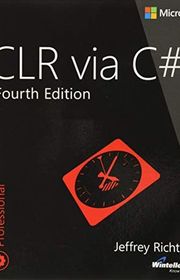
CLR via C#
For working C# developers who want to understand the runtime beneath their code. It connects types, garbage collection, and threading in one place, but its .NET Framework focus requires checking which details still apply.
What it's about
Jeffrey Richter explains how the common language runtime executes managed applications. Through C# examples, he explores types, assemblies, garbage collection, exceptions, and threading, giving developers a foundation for reasoning about reliability and performance.
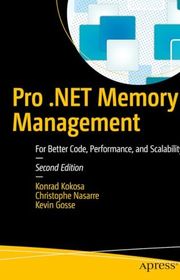
Pro .NET Memory Management
For experienced .NET developers investigating allocation costs, garbage collection, or memory pressure. It goes further into memory behavior than the general language books here, but the detail demands time and a concrete problem to explore.
What it's about
Konrad Kokosa examines memory management across .NET, including garbage collection, allocation behavior, diagnostics and performance techniques. Detailed explanations connect runtime internals with coding choices, helping developers investigate memory problems and understand their effects on application scalability.
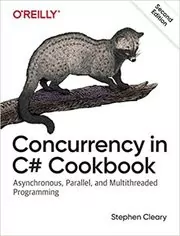
For C# developers tackling async code, parallel work, or coordination problems. Its short recipes are easier to consult during a task than a runtime textbook, but they assume you already understand the language.
What it's about
Stephen Cleary organizes concurrent programming in C# around practical recipes with code and explanations. The cookbook explores asynchronous operations, parallel processing, multithreading, and related libraries, showing how different approaches address responsiveness, scalability, and coordination in applications.
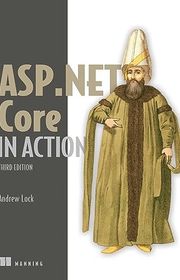
ASP.NET Core in Action
For C# developers ready to build web applications and APIs. It explains the request pipeline and application structure more fully than the general introductions here, but its third edition targets ASP.NET Core 7.
What it's about
Andrew Lock teaches web development with ASP.NET Core through examples and annotated code. The third edition covers minimal APIs, Razor Pages, authentication, data access, and testing, showing how these pieces fit into a working application.
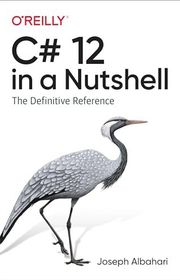
C# 12 in a Nutshell
For intermediate C# developers who want a reference beside their editor. Its coverage of the language and core libraries is broader than the specialist books here, but its density makes it a demanding first tutorial.
What it's about
Joseph Albahari surveys C# 12 and the core libraries of .NET 8. The book covers language features, LINQ, concurrency, and runtime facilities, helping developers look up details and connect individual features to everyday programming tasks.
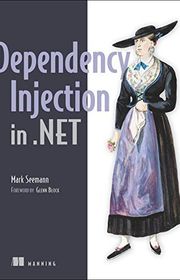
Dependency Injection in .NET
For C# developers trying to untangle dependencies and make applications easier to test. Its patterns explain the design decisions behind injection, but the container examples reflect an older generation of .NET tooling.
What it's about
Mark Seemann explains dependency injection through .NET examples, showing how to separate object creation from behavior and organize dependencies. The book discusses design patterns, common mistakes and container use, connecting testability and maintainability with decisions about application structure.

For programmers who want one guided route from C# fundamentals to databases and web applications. Its breadth helps connect the pieces of .NET development, but the examples target .NET 6 and need version checks.
What it's about
Mark Price introduces C# 10 and version 6 of Microsoft's development platform through practical programming projects. Topics include object oriented code, testing, LINQ, databases with Entity Framework Core, and building websites and services with Blazor and Microsoft's web framework.
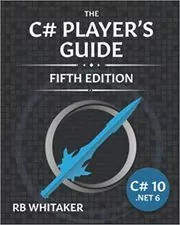
The C# Player's Guide
For first-time programmers who want frequent challenges and a playful tone. It offers a more exercise-driven route into C# than the reference books here, but the game framing will not suit every learner.
What it's about
R. B. Whitaker introduces C# through a game-inspired approach with practical challenges and playful examples. This fifth edition covers C# 10 and .NET 6, guiding beginners from their first programs toward broader programming skills through building software as they learn.

For beginners who learn through pictures, puzzles, and projects. Its visual approach offers more guided practice than the reference books here, though readers who prefer concise explanations may find the busy pages distracting.
What it's about
Andrew Stellman and Jennifer Greene teach C# and .NET Core through a visual, activity-based introduction. Puzzles, exercises, and projects connect language concepts with building applications, interfaces, and games, giving beginners repeated opportunities to practice object-oriented programming and related skills.

For developers who want a substantial reference spanning C# and several application frameworks. It covers more ground than a focused language tutorial, but its .NET Core 3 examples need care when used with newer tools.
What it's about
Andrew Troelsen and Phil Japikse provide a foundation in C# 8 and .NET Core 3. The guide combines object-oriented programming, collections, reflection, and advanced language topics with coverage of web applications, services, data access, and desktop development in the associated frameworks.
Sources
- 1
Best C# and .NET Books for 2026
computingforgeeks.com
- 2
Best C# Books
jobroadmaps.com
- 3
What .NET/C# books have helped you the most or would you recommend?
reddit.com
- 4
Best .NET books for a experienced developer
reddit.com
- 5
Dotnet Books
goodreads.com
- 6
awesome-dotnet-resources/docs/books.md at main · Mwaseemzakir/awesome-dotnet-resources
github.com
- 7
100 Best .Net Books of All Time
shortform.com
- 8
.Net Books
educba.com
- 9
Ultimate .NET Reference Texts
dev.to






Edited by
Software engineer whose passion for tracking book recommendations from podcasts inspired the creation of MRB.
Lead investor at 3one4 Capital whose startup expertise and love for books helped shape MRB and its growth.
Comments
Spotted a missing book, a wrong order or a mistake? Tell us and we'll fix this page.
We're a reading guide, not the author or publisher, so we can't send books or pass on messages.