
12 Best MySQL Books
The best MySQL books, ranked by how many expert sources recommend each one, with notes to help you choose SQL lessons, development guides, and administration.
Our take
MySQL books serve several kinds of reader. Learning to write queries is different from designing an application database, and both differ from keeping a server fast and dependable. Some books teach a sequence of skills; others are references for a particular problem. The version covered also matters, especially for software examples and operational advice.
Murach’s MySQL offers structured study, while Learning SQL concentrates on the query language. Learning MySQL extends into administration, and MySQL Cookbook provides task-based solutions. For performance work, High Performance MySQL takes a broad systems view, while Efficient MySQL Performance focuses closely on measuring and improving query response. The PHP books show the database inside a wider web application, with less room for MySQL alone.
Start with SQL and a small database you can practice on, then choose development or administration material to match your work. Check the edition against the MySQL version you use before relying on detailed commands or settings.
12 books · 8 sources · Last updated
As an Amazon Associate, we earn from qualifying purchases (at no extra cost to you).
How to choose from this list
Skip to the full rankingIf you want structured MySQL lessons: Murach's MySQL
If you want to focus on querying: Learning SQL
If you want projects from the basics: MySQL Crash Course
If you need recipes for specific tasks: MySQL Cookbook
If you need to improve performance: Efficient MySQL Performance → High Performance MySQL
If you maintain stored programs: MySQL Stored Procedure Programming
The 12 books, ranked
Ranked by how many expert sources name each book. Ties go to the book more people recommend.

For experienced users who want to connect performance with reliable operation. Its broad systems perspective goes beyond individual query tricks, though this third edition predates newer MySQL behavior and should be supplemented with current documentation.
What it's about
Baron Schwartz, Peter Zaitsev, and Vadim Tkachenko examine MySQL performance in this third edition. Coverage connects architecture, benchmarking, and profiling with optimization, replication, scalability, and backup strategies, emphasizing dependable systems alongside faster queries and server operation.

For readers who want a path from basic queries into running a database. Its combination of development and operational topics gives useful breadth, though those seeking only SQL practice may find the administration material more than they need.
What it's about
Vinicius Grippa and Sergey Kuzmichev introduce MySQL from installation through production use. Their second edition covers queries, database design, monitoring, security, and recovery, alongside high availability, load balancing, and deployment choices for managing reliable database systems.

Murach's MySQL
For learners who want structured lessons in SQL, schema design, and MySQL tools. Its paired explanations and examples support systematic study, though the breadth requires more commitment than a short introduction and edition-specific features need checking.
What it's about
Joel Murach teaches SQL and database design using MySQL 8.0 in this third edition. Examples cover queries, functions, views, transactions, procedures, triggers, and security, while guidance on MySQL Workbench and administration connects programming skills with managing a database.

For developers and administrators who already have a task to solve. Its recipe format makes recurring problems easy to look up, though reading selectively works better than treating it as a sequential beginner course, and this edition is older.
What it's about
Paul DuBois's third edition collects practical recipes for MySQL developers and administrators. Solutions cover querying, dates, summaries, stored routines, data transfer, transactions, web integration, and security, providing reusable approaches to common database tasks and programming problems.
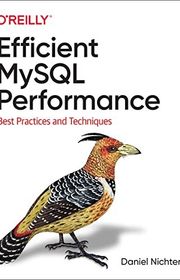
Efficient MySQL Performance
For developers who know SQL and need a disciplined way to investigate slow queries. Its focus on response time connects measurement with indexing and data access, though it assumes an existing application and some database experience.
What it's about
Daniel Nichter explains MySQL performance through query response time, execution plans, indexing, data access, and operational metrics. Examples connect database behavior with application choices, helping developers investigate bottlenecks and evaluate changes rather than rely on isolated tuning rules.
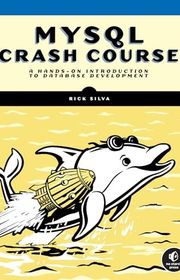
MySQL Crash Course
For beginners who want to move from basic database objects into concrete projects. Its exercises make development tasks tangible, though it is a starting course rather than a substitute for deeper administration or performance references.
What it's about
Rick Silva introduces MySQL database development through tables, queries, data types, joins, routines, and application connections. Exercises and projects build on the fundamentals, including databases for weather information, voter data, and salary access through views.

MySQL Stored Procedure Programming
Building High-Performance Web Applications in MySQL
For developers maintaining or learning database-side programs in MySQL. Its focused treatment of procedures, functions, and triggers goes deeper than general introductions, though the older version context makes checking current syntax and behavior essential.
What it's about
Guy Harrison and Steven Feuerstein explain MySQL stored procedures, functions, and triggers. Tutorials and examples develop stored-programming fundamentals, including SQL integration, conditional logic, error handling, and techniques for building and maintaining programs that execute within the database.

For readers outside database work who need to understand how information should be organized. Its accessible explanations make design decisions less intimidating, though it offers less technical depth than the larger programming and administration guides.
What it's about
Andrew Comeau explains MySQL and database design for readers outside the technology profession. Starting with basic concepts and organizing information, the guide develops an understanding of installation choices and the tools used to store and protect data.

PHP and MySQL Web Development
For readers who want PHP and MySQL taught through complete web applications. Its project-oriented approach connects several development tasks, though the fifth edition’s PHP 7 and MySQL 5.7 examples require revision for current environments.
What it's about
Luke Welling and Laura Thomson teach database-driven web development using PHP and MySQL. Their fifth edition covers PHP 7 and MySQL 5.7, combining language fundamentals with security, debugging, authentication, and practical projects that integrate the technologies.

Learn SQL (using MySQL) in One Day and Learn It Well
SQL for Beginners with Hands-on Project
For beginners wanting a compact introduction followed by a practical project. Its limited scope makes an approachable first pass, though the one-day promise should not be mistaken for the time needed to develop reliable querying skills.
What it's about
Jamie Chan and LCF Publishing introduce SQL using MySQL through explanations and a concluding practical project. Lessons cover creating databases, retrieving and combining data, aggregate functions, views, triggers, and stored programs, connecting individual concepts with hands-on work.

For aspiring web developers who want to connect a database with a complete application stack. Its integrated projects show MySQL in context, though the database shares space with several languages and older library examples need updating.
What it's about
Robin Nixon teaches the technologies behind interactive, database-driven websites, combining PHP and MySQL with JavaScript, jQuery, CSS, and HTML5. Practical lessons cover sessions, security, Ajax, and mobile layouts before bringing the components together in a social networking application.

For learners who want a sustained foundation in SQL rather than server administration. Its focused lessons and exercises help develop querying skills, though MySQL-specific deployment, operations, and performance need a separate reference.
What it's about
Alan Beaulieu teaches SQL through self-contained lessons, annotated examples, and practice exercises. The guide explains retrieving and manipulating data, creating database objects, writing subqueries, and using functions and conditional logic in database applications and reporting.
Sources
- 1
9 Best MySQL and MariaDB Books for 2026
computingforgeeks.com
- 2
15 Best MySQL Books For Developers & DBAs
whatpixel.com
- 3
Mysql Books
goodreads.com
- 4
10 Essential MySQL Books You Should Read in 2023
educba.com
- 5
The 9 Best MySQL Books for 2023 Based on Real User Reviews
solutionsreview.com
- 6
Good SQL book for self taught database developers?
reddit.com
- 7
Best book for a DBA who's never touched MySQL, but wants to learn more?
reddit.com
- 8
MySQL Books
mysql.com





Edited by
Software engineer whose passion for tracking book recommendations from podcasts inspired the creation of MRB.
Lead investor at 3one4 Capital whose startup expertise and love for books helped shape MRB and its growth.
Comments
Spotted a missing book, a wrong order or a mistake? Tell us and we'll fix this page.
We're a reading guide, not the author or publisher, so we can't send books or pass on messages.