
10 Best Biotechnology Books
The best biotechnology books, ranked by how many expert sources recommend each one, with notes for readers exploring the science, industry, and ethical questions.
Our take
Biotechnology uses biological knowledge to develop products and processes, but its story also involves money, institutions, patients, and choices about how research should be used. These books concentrate on the people and organizations behind medical biotechnology. They offer industry histories, reported accounts of drug development, and explanations of technologies whose possibilities raise difficult ethical questions.
Genentech traces the beginnings of a company central to the industry's growth. The Billion Dollar Molecule and The Antidote follow Vertex at different stages, while Science Lessons looks at management from inside Amgen. For the human consequences of research, The Immortal Life of Henrietta Lacks puts consent and family experience at the center. The Code Breaker and A Crack in Creation approach gene editing through biography and researchers' perspectives; Regenesis explores wider synthetic-biology ambitions. Start with Genentech for industry history, or The Immortal Life of Henrietta Lacks for the relationship between scientific progress and the people affected.
10 books · 6 sources · Last updated
As an Amazon Associate, we earn from qualifying purchases (at no extra cost to you).
How to choose from this list
Skip to the full rankingIf you want the industry's early history: Genentech → The Billion Dollar Molecule
If you want a company's longer development story: The Billion Dollar Molecule → The Antidote
If management is your focus: Science Lessons
If you want gene editing through people and ideas: The Code Breaker → A Crack in Creation
If you want research ethics and lived experience: The Immortal Life of Henrietta Lacks
If you want a focused drug-development case: Her-2
The 10 books, ranked
Ranked by how many expert sources name each book. Ties go to the book more people recommend.

For readers who want to understand how biotechnology became a commercial industry. Hughes uses interviews to connect scientific work with finance and institutional decisions, though the focus on one company's beginnings limits the wider industry picture.
What it's about
Sally Smith Hughes reconstructs Genentech's early history through interviews with participants in the biotechnology industry. She follows the company's creation and growth while examining how scientific research interacted with venture capital, legal interests, regulation, and commercial ambition.
Also recommended by
2 people Patrick Collison recommended this book
Patrick Collison
"Enjoyed [this book]." - Patrick Collison
Patrick Collison's recommendation of this book  Trung Phan recommended this book
Trung Phan
"About the Biotech industry." - Trung Phan
Trung Phan's recommendation of this book

For readers who want an inside account of a young biotech company balancing laboratory work and investor expectations. Werth makes scientific uncertainty central to the business story, though the early Vertex setting captures a particular era.
What it's about
Barry Werth follows the founding and early scientific struggles of Vertex, a pharmaceutical startup pursuing new approaches to drug development. His reporting connects laboratory research with entrepreneurial ambition, financial pressure, and the risks of seeking a successful medicine.
Also recommended by
1 person- Patrick Collison recommended this book
Patrick Collison
"Lots about entrepreneurship, science, pharmacology, risk, importance of work ethic, management practices, fundraising, and the impressive depth of US capital markets." - Patrick Collison
Patrick Collison's recommendation of this book

For readers who want drug development placed within the longer history of cancer. Mukherjee connects research with patients and clinical experience, though the extensive historical narrative is broader than biotechnology and isn't a technical methods guide.
What it's about
Siddhartha Mukherjee recounts the history of cancer through patients, researchers, and changing ideas about the disease. Combining medical history with clinical experiences, he traces efforts to understand and treat cancer alongside the human consequences of that struggle.
Also recommended by
4 people Peter Attia recommended this book
Peter Attia
One of Peter Attia's answers to "any books you feel would make your reading list?"
Peter Attia's recommendation of this book  Bill Gates recommended this book
Bill Gates
"I loved [this] brilliant book about cancer." - Bill Gates
Bill Gates's recommendation of this book  Laura R Walker recommended this book
Laura R Walker
"For friends who have faced or are facing cancer, I often give them [this book]." - Laura R Walker
Laura R Walker's recommendation of this book  Cathie Wood recommended this book
Cathie Wood
"Fantastic book...a must read!" - Cathie Wood
Cathie Wood's recommendation of this book

For readers who want a focused case of a treatment moving from discovery toward clinical use. Bazell connects researchers, patients, and corporate decisions, though the close view of one drug doesn't represent every development pathway.
What it's about
Robert Bazell traces the development of Herceptin through scientific discoveries, clinical trials, and the experiences of patients. The account examines how research, fundraising, corporate decisions, politics, and patient activism shaped the drug’s path from laboratory to treatment.

For readers curious about the ambitions behind synthetic biology. Church and Regis connect genetic engineering with possible applications across several fields, though many proposals are speculative and should be read as possibilities rather than established capabilities.
What it's about
George Church and Ed Regis explore the possibilities of synthetic biology and large-scale changes to genomes. They explain the science behind proposals for engineered organisms, renewable energy, improved health, longer lives, and the revival of extinct species.

For managers and entrepreneurs interested in leading a science-based company. Binder connects Amgen's development with decisions about people, products, and finance, though an executive's retrospective offers a selective view of the organization's history.
What it's about
Gordon Binder recounts Amgen’s growth from a financially precarious biotechnology company to a major drug developer. Drawing on successes and setbacks during his leadership, he connects the history of its products with practical lessons about management and scientific decision-making.

For readers who want an extended look at the pressures surrounding drug development. Werth connects scientific uncertainty with corporate competition and regulation, though its company-specific detail is easier to place after The Billion Dollar Molecule.
What it's about
Barry Werth returns to pharmaceutical company Vertex to follow its development over twenty-five years. Inside reporting examines scientific uncertainty, business competition, regulatory pressures, and the company’s effort to bring new medicines through a demanding development process.

The Immortal Life of Henrietta Lacks
For readers interested in the human consequences of biological research. Skloot connects a widely used cell line with family history, consent, and unequal power, though the investigative narrative offers less detail on the laboratory techniques themselves.
What it's about
Rebecca Skloot investigates the life of Henrietta Lacks, whose cells were taken without her knowledge and became important tools in medical research. Her reporting connects scientific advances with the experiences of Lacks's family and questions of consent, race, and justice.
Also recommended by
1 person A.J. Jacobs recommended this book
A.J. Jacobs
"Great writer." - A.J. Jacobs
A.J. Jacobs's recommendation of this book

For readers who want gene editing explained by researchers involved in its development. The first-person perspective connects scientific discovery with ethical responsibility, though it offers participants' account rather than a detached history of every competing contribution.
What it's about
Jennifer Doudna and Samuel Sternberg recount the development of CRISPR gene editing and examine the responsibilities that accompany it. Their account connects scientific discovery with questions about potential applications, heritable changes, and the ethical consequences of altering genetic code.
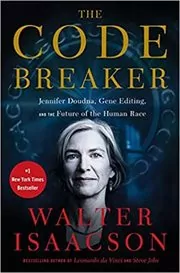
The Code Breaker
Jennifer Doudna, Gene Editing, and the Future of the Human Race
For readers who prefer scientific ideas introduced through biography and relationships. Isaacson uses Jennifer Doudna's career to explore gene editing and scientific competition, though the broad narrative provides less technical depth than a specialist treatment.
What it's about
This biography of Jennifer Doudna follows the race to develop CRISPR gene editing and the science behind it. Isaacson pairs lab drama with the huge ethical questions that come with rewriting the code of life.
Sources





Edited by
Software engineer whose passion for tracking book recommendations from podcasts inspired the creation of MRB.
Lead investor at 3one4 Capital whose startup expertise and love for books helped shape MRB and its growth.
Comments
Spotted a missing book, a wrong order or a mistake? Tell us and we'll fix this page.
We're a reading guide, not the author or publisher, so we can't send books or pass on messages.