
19 Best Biostatistics Books
The best biostatistics books, ranked by how many expert sources recommend each one, with notes for students, clinicians and researchers finding where to start.
Our take
Biostatistics helps researchers describe biological data, compare groups and judge how much confidence to place in a result. The books here serve different needs: understanding a journal article, completing a first methods course, designing a trial or building models for complex outcomes. Choosing the right level matters more than finding the largest collection of techniques.
Intuitive Biostatistics emphasizes interpretation without extensive derivations, while Medical Statistics Made Easy offers a shorter orientation to common methods. Basic Biostatistics, Fundamentals of Biostatistics and Principles of Biostatistics provide more structured foundations with examples and exercises. Essentials of Biostatistics in Public Health keeps population-health applications in view. For specialized work, Fundamentals of Clinical Trials addresses trial decisions, Survival Analysis concentrates on time-to-event data, and Regression Modeling Strategies develops more advanced modeling judgment. R for Data Science supports the practical work of preparing and exploring data.
Start with an interpretation-focused book if you mainly read research, or choose a full introductory textbook before moving to specialized methods.
19 books · 10 sources · Last updated
As an Amazon Associate, we earn from qualifying purchases (at no extra cost to you).
How to choose from this list
Skip to the full rankingIf you mainly want to understand research papers: Medical Statistics Made Easy → Intuitive Biostatistics
If you're taking a first methods course: Basic Biostatistics → Fundamentals of Biostatistics
If your focus is public health: Essentials of Biostatistics in Public Health
If you're planning or assessing trials: Fundamentals of Clinical Trials
If you're moving into specialized analysis: Survival Analysis → Regression Modeling Strategies
If you need a practical R workflow: R for Data Science
The 19 books, ranked
Ranked by how many expert sources name each book. Ties go to the book more people recommend.

Fundamentals of Biostatistics
For students and researchers who want methods developed through worked medical examples. Its step-by-step calculations support a substantial course of study, but the breadth and computational detail make it a larger commitment than an interpretation-first guide.
What it's about
Bernard Rosner presents statistical methods for research involving human subjects. Worked examples drawn from medical studies develop each concept step by step, connecting techniques and computations with the practical problems researchers face when analyzing and interpreting health data.
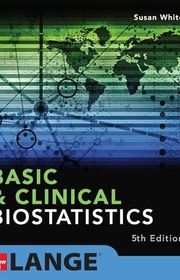
Basic & Clinical Biostatistics
For medical learners who want statistical methods organized around clinical research questions. Its published-study problems connect design with interpretation, but it is a broad introductory course rather than a specialist reference for complex modeling.
What it's about
Susan White introduces biostatistics and epidemiology as used in medical research and clinical literature. Published-study problems and exercises develop understanding of study design, common analytical methods and interpretation, with attention to the questions investigators ask of their data.

For health-science students who want a conventional, wide-ranging statistics course. Its progression from probability through inference and regression builds a reusable foundation, but readers seeking a brief guide to interpreting papers may find it extensive.
What it's about
Wayne Daniel and Chad Cross explain statistical concepts and methods used to analyze health-science data. Coverage of probability, sampling, estimation, hypothesis testing, analysis of variance, regression, and correlation connects mathematical tools with their practical application and interpretation in healthcare research.

For readers who need to understand statistical claims without starting with mathematical derivations. Its emphasis on reasoning and common mistakes supports critical reading, but it does not replace a technical course in performing analyses.
What it's about
Harvey Motulsky emphasizes statistical thinking and interpretation rather than mathematical derivations or computation. His conversational introduction helps students and scientists make sense of research results, understand common analytical mistakes, and evaluate the reasoning behind claims based on biomedical data.
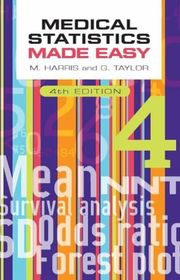
Medical Statistics Made Easy
For clinicians and students who need a concise explanation of methods encountered in papers. Its consistent entries and worked examples support quick orientation, but the brief overview cannot supply the depth needed for independent advanced analysis.
What it's about
Michael Harris and Gordon Taylor explain common statistical methods used in medical research through short, consistently organized entries. Worked examples show methods in context, and ratings indicate their relative difficulty and frequency, helping readers navigate unfamiliar analyses in published studies.

Principles of Biostatistics
For students seeking a structured introduction supported by data sets and exercises. Its health-science examples connect methods with research questions, but the conventional textbook progression rewards sustained practice rather than quick, isolated consultation.
What it's about
Marcello Pagano and Kimberlee Gauvreau introduce biostatistical methods for students in biological and health sciences. Examples, data sets, and exercises connect statistical concepts with research questions, building skills in analyzing evidence and interpreting findings from scientific studies.
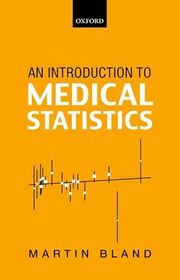
An Introduction to Medical Statistics
For readers who want statistical ideas taught through real medical studies. Its attention to both correct and incorrect use supports critical appraisal, but the serious introductory treatment still requires working through examples and exercises.
What it's about
Martin Bland introduces methods encountered in medical studies and explains how to interpret and analyze their results. Real research examples illustrate appropriate and inappropriate uses of statistics, while exercises and case studies develop practical understanding of medical evidence.

For public-health students who want a steady introduction to common statistical methods. Its examples connect calculations with population-health questions, but the broad foundation offers less depth on specialized modeling than the advanced references here.
What it's about
B. Burt Gerstman introduces statistical methods using the types of data encountered in public health and biomedical work. Explanations and examples progress from measurement and descriptive statistics to probability, confidence intervals, hypothesis testing, regression, and comparisons between groups.

Biostatistics For Dummies
For beginners who want plain-language orientation before committing to a formal course. Its range connects statistical vocabulary with research tasks, but the accessible survey provides less depth and mathematical development than the main textbooks here.
What it's about
John Pezzullo introduces biostatistics in accessible language, linking basic statistical reasoning with biological data and clinical research. Coverage includes probability, sampling, inference, statistical software, and trial design, helping readers understand how studies are planned and their results analyzed.

Essential Medical Statistics
For health researchers who want a broad practical foundation in statistical analysis. Its medical emphasis keeps methods connected with research problems, but the substantial scope requires more sustained study than a compact guide to reading results.
What it's about
Betty Kirkwood and Jonathan Sterne explain statistical methods used in medical research, connecting foundational concepts with applied analysis. The text develops approaches to describing data, estimation, testing and modeling, helping readers understand the reasoning behind choices made when analyzing health studies.

Essentials of Biostatistics in Public Health
For public-health learners who want statistical concepts connected directly with health research. Its examples and exercises emphasize application and interpretation, but readers seeking extensive mathematical derivations or advanced modeling will need a deeper reference.
What it's about
Lisa Sullivan introduces the application and interpretation of biostatistics in public health. Examples and exercises connect statistical concepts with health research, guiding students through describing data, estimating quantities, testing hypotheses, and understanding relationships between risk factors and outcomes.
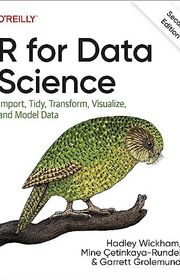
R for Data Science
For readers who understand their statistical question but need a practical data workflow in R. Its exercises connect importing, cleaning and visualization, but it teaches general data skills rather than clinical study design or specialist biostatistical methods.
What it's about
Hadley Wickham and coauthors introduce a workflow for working with data in R and the tidyverse. Examples and exercises cover importing, tidying, transforming and visualizing data, with guidance on communicating results and managing the practical stages of analysis.
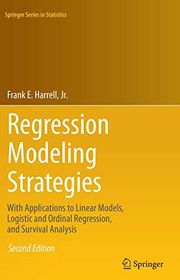
Regression Modeling Strategies
For analysts who know multiple regression and need better strategies for real research data. Its case studies connect model building, missing data and validation, but the graduate-level treatment assumes substantial statistical preparation and comfort with R.
What it's about
Frank Harrell develops strategies for building, validating and interpreting regression models using substantial data-analysis case studies. Topics include missing data, nonlinear relationships and prediction, with applications to linear, logistic, ordinal and survival models supported by R functions.
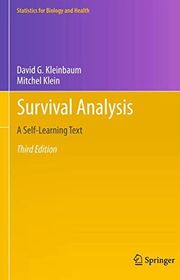
Survival Analysis
For researchers ready to analyze time-to-event outcomes rather than only standard group comparisons. Its self-learning format provides organized explanations and practice, but the specialized methods assume an introductory statistical foundation and require software work.
What it's about
David Kleinbaum and Mitchel Klein introduce methods for analyzing survival and event-history data. Structured explanations, tests and exercises support independent study, while a computer appendix shows how to apply the methods using statistical software, including R, SAS, Stata and SPSS.

For health-science readers who want the reasoning behind tests explained with humor and little algebra. Its informal approach makes unfamiliar analyses less forbidding, but those planning their own advanced models will need more technical treatment.
What it's about
Geoffrey Norman and David Streiner explain the statistical tests readers encounter in health-sciences literature with humor and minimal algebra. Their emphasis on concepts helps students and practitioners interpret analyses, understand research methods, and recognize the reasoning behind statistical choices.

Biostatistics for the Biological and Health Sciences
For students who learn best through biological and medical applications. Its examples connect data collection, analysis and interpretation across the health sciences, but the introductory breadth leaves specialized research methods for more advanced follow-up.
What it's about
Marc Triola, Mario Triola, and Jason Roy introduce statistics through applications in biology, medicine, and health. Real-world examples connect statistical concepts with collecting, analyzing, and interpreting data, providing a foundation for students learning to evaluate quantitative evidence in these fields.

Jekel's Epidemiology, Biostatistics, Preventive Medicine, and Public Health
For medical students who want biostatistics placed alongside study design, prevention and public health. Its integrated perspective explains how the subjects connect, but the wide remit gives statistics less space than a dedicated methods textbook.
What it's about
This textbook brings epidemiology, biostatistics, preventive medicine, and public health into a single introduction. Chapters connect study design and analysis with risk assessment, disease prevention, community health, and healthcare systems, showing how these disciplines inform clinical and population-level decisions.

For readers interested in why association alone cannot settle causal questions. Its account of models, interventions and counterfactuals broadens statistical thinking, but it is a conceptual companion rather than a practical introductory biostatistics textbook.
What it's about
Judea Pearl and Dana Mackenzie explain the development of causal reasoning beyond statistical correlation. Examples show how models can address interventions and hypothetical alternatives, tracing the ideas behind a scientific approach to questions of cause and effect.
Also recommended by
3 people Naval Ravikant recommended this book
Naval Ravikant
Naval Ravikant tweeted about this book.
Naval Ravikant's recommendation of this book  Keith Rabois recommended this book
Keith Rabois
"[One of] two indispensable books of 2018." - Keith Rabois
Keith Rabois's recommendation of this book  Ryan Shea recommended this book
Ryan Shea
Ryan Shea recommended this book on his website.
Ryan Shea's recommendation of this book

Fundamentals of Clinical Trials
For researchers who want statistical decisions connected with the full life of a clinical trial. Its coverage links design, conduct and interpretation, but it assumes a focused interest in trials rather than providing general statistical training.
What it's about
Lawrence Friedman and his coauthors explain the principles of designing, conducting, and interpreting clinical trials. Examples from published studies illuminate randomization, sample size, monitoring, and regulatory considerations, providing a foundation for researchers and readers assessing the strengths and implications of trial results.
Sources
- 1
10 Best Biostatistics Books To Read [Updated]
findcareerinfo.com
- 2
The Complete Biostatistics Roadmap, or How to Become a Great Biostatistician (with Books and Resources)
biostatistics.ca
- 3
Library of medical statistics
statsyup.org
- 4
Biostatistics Books
goodreads.com
- 5
Biostatistics books
reddit.com
- 6
Statistics & Data Science Resources: Statistics & Biostatistics E-Books
libguides.mssm.edu
- 7
Books for OMS1 & OMS2: Biostatistics
libguides.tu.edu
- 8
PLFSOM Textbooks: Biostat. & Epi.
elpaso-ttuhsc.libguides.com
- 9
Best textbook for biostatistics or medical statistics
reddit.com
- 10
Getting Started with Research Statistics
library.neco.edu


Edited by
Software engineer whose passion for tracking book recommendations from podcasts inspired the creation of MRB.
Lead investor at 3one4 Capital whose startup expertise and love for books helped shape MRB and its growth.
Comments
Spotted a missing book, a wrong order or a mistake? Tell us and we'll fix this page.
We're a reading guide, not the author or publisher, so we can't send books or pass on messages.