
7 Best Astrophysics Books
The best astrophysics books, ranked by how many expert sources recommend each, with notes on popular introductions, observing guides, and mathematical study.
Our take
Astrophysics asks how the universe works by connecting observations with physical explanations. Books on the subject can introduce stars and galaxies without equations, explore a focused cosmological question, or develop the mathematics used in university study. Practical observing guides and histories add useful perspectives, but they serve different purposes from a textbook about the physics itself.
Astrophysics for People in a Hurry offers a short orientation, while Cosmos places scientific ideas within a wider story about discovery and humanity. A Brief History of Time concentrates on time, black holes, and cosmology; The End of Everything (Astrophysically Speaking) approaches the subject through possible cosmic futures. For formal study, An Introduction to Modern Astrophysics assumes a stronger foundation in mathematics and physics. NightWatch helps turn curiosity into observing, and The Glass Universe follows the people behind important stellar measurements. Start with Tyson for a brief introduction or Sagan for a broader narrative, then choose a more focused or technical direction.
7 books · 8 sources · Last updated
As an Amazon Associate, we earn from qualifying purchases (at no extra cost to you).
How to choose from this list
Skip to the full rankingIf you want a brief introduction: Astrophysics for People in a Hurry
If you prefer a broad story of discovery: Cosmos
If you're interested in time and cosmic futures: A Brief History of Time → The End of Everything (Astrophysically Speaking)
If you're ready for mathematical study: An Introduction to Modern Astrophysics
If you want to start observing: NightWatch
If you want the history of stellar measurement: The Glass Universe
The 7 books, ranked
Ranked by how many expert sources name each book. Ties go to the book more people recommend.

Astrophysics for People in a Hurry
For curious readers who want a brief orientation before committing to a longer book. The short chapters introduce useful ideas and vocabulary, though the compression can make unfamiliar concepts pass quickly without enough worked explanation to settle them.
What it's about
Neil deGrasse Tyson introduces central ideas in astrophysics through short chapters intended for busy readers. Topics range from the Big Bang and quantum mechanics to black holes, planets and the search for life elsewhere in the universe.
Also recommended by
2 people Vinod Khosla recommended this book
Vinod Khosla
"Great, very quick overview of astrophysics." - Vinod Khosla
Vinod Khosla's recommendation of this book  Richard Dawkins recommended this book
Richard Dawkins
"Lovely book. Last chapter worthy of Carl Sagan himself." - Richard Dawkins
Richard Dawkins's recommendation of this book
Cosmos
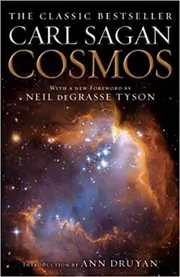
For readers who want astronomy connected with history, scientific curiosity, and human responsibility. Its narrative range gives the subject a larger cultural setting, though some scientific details have changed and it offers little mathematical training.
What it's about
Cosmos takes readers from the birth of stars and planets to the rise of life on Earth. Sagan blends astronomy, history, and philosophy into an accessible story about how we came to understand the universe and our small place within it.
Also recommended by
2 people Richard Branson recommended this book
Richard Branson
Richard Branson recommended this book on his "70 must-read books" blog post.
Richard Branson's recommendation of this book  Bill Nye recommended this book
Bill Nye
"The story of my other hero, Carl Sagan. The other guy who inspired me to do what I do now." - Bill Nye
Bill Nye's recommendation of this book

A Brief History of Time
For readers who want a conceptual introduction to time, black holes, and the universe's origins. Its compact argument connects major questions clearly, though the later chapters demand concentration and reflect an earlier stage of cosmological research.
What it's about
Stephen Hawking introduces questions about the universe's beginning, its possible fate, and the nature of time. He explains black holes, relativity, and quantum ideas for general readers, connecting familiar physical concepts with the puzzles of cosmology.
Also recommended by
2 people- Richard Branson recommended this book
Richard Branson
Richard Branson recommended this book on his "70 must-read books" blog post.
Richard Branson's recommendation of this book  James Clear recommended this book
James Clear
"[One of] the 10 best nonfiction books of all-time." - James Clear
James Clear's recommendation of this book

The End of Everything
For readers who want cosmology organized around possible futures of the universe. Its conversational treatment makes speculative scenarios easier to compare, though the focus is narrower than a general astronomy survey and several questions remain unresolved.
What it's about
Katie Mack explores five possible endings for the universe: the Big Crunch, Heat Death, Big Rip, Vacuum Decay, and Bounce. Her account uses these scenarios to explain cosmology and the physics behind competing visions of cosmic extinction.

An Introduction to Modern Astrophysics
For students ready to connect astronomy with undergraduate physics and mathematics. Its broad textbook treatment provides the formal development missing from popular accounts, though the scale, equations, and problems require sustained study rather than casual reading.
What it's about
Bradley Carroll and Dale Ostlie survey astrophysics through the physical principles governing stars, planetary systems, galaxies, and cosmology. Mathematical explanations, worked examples, and problems connect astronomical observations with mechanics, radiation, stellar structure, and the evolution of cosmic systems.

For beginners who want to take their interest outside and recognize objects in the sky. Its charts and equipment guidance make observing approachable, though the emphasis is practical astronomy rather than the mathematical physics behind celestial objects.
What it's about
Terence Dickinson introduces practical stargazing with charts for finding objects in the night sky. The guide covers choosing telescopes and binoculars, observing from either hemisphere, and techniques for photographing celestial objects.

The Glass Universe
How the Ladies of the Harvard Observatory Took the Measure of the Stars
For readers interested in the people and observational work behind discoveries about stars. Its historical narrative reveals how classification and measurement developed, though it provides less systematic explanation of astrophysical theory than a science introduction or textbook.
What it's about
Dava Sobel tells the history of women who studied photographic glass plates at Harvard College Observatory. Their work on stellar classification, composition, and distance transformed astronomy, while their personal stories reveal the obstacles surrounding women's participation in science.
Sources
- 1
Astrophysics Books
goodreads.com
- 2
Looking for astronomy and cosmology books
reddit.com
- 3
Recs for easy books about astrophysics?
reddit.com
- 4
Best Astrophysics Books for Beginners in 2026
telescopeguides.com
- 5
Astronomy Fundamentals Resource List
cosgrovescosmos.com
- 6
Best space and astronomy books 2026
space.com
- 7
40 best space and astronomy books
skyatnightmagazine.com
- 8
UNIST Observational Astrophysics Group - Resources
astrojykim.com








Edited by
Software engineer whose passion for tracking book recommendations from podcasts inspired the creation of MRB.
Lead investor at 3one4 Capital whose startup expertise and love for books helped shape MRB and its growth.
Comments
Spotted a missing book, a wrong order or a mistake? Tell us and we'll fix this page.
We're a reading guide, not the author or publisher, so we can't send books or pass on messages.