
10 Best Astronomy Books
The best astronomy books, ranked by how many expert sources recommend each one, with notes on who each book suits and where to start exploring the sky.
Our take
Astronomy books can take you in two different directions: outside to observe the sky, or deeper into the ideas that explain it. A practical guide helps you find targets and choose equipment. A popular science book explains stars, galaxies, black holes, and the universe’s history. Both can deepen your interest, but they serve different needs.
If you want to begin observing, start with NightWatch or Turn Left at Orion. The Backyard Astronomer's Guide provides a broader reference as your interests grow. For reading indoors, Cosmos connects the science with human history, while Astrophysics for People in a Hurry offers a shorter overview. A Brief History of Time, Black Hole Survival Guide, and The End of Everything focus more closely on cosmology and extreme physics. Older classics remain rewarding, but use newer editions for practical observing information. Choose your starting point by whether you want to recognize tonight’s sky or understand the questions behind it.
10 books · 8 sources · Last updated
As an Amazon Associate, we earn from qualifying purchases (at no extra cost to you).
How to choose from this list
Skip to the full rankingIf you’re new to the science: Astrophysics for People in a Hurry → Cosmos
If you want to start observing: NightWatch → Turn Left at Orion
If you want equipment and technique guidance: The Backyard Astronomer's Guide
If you want black holes and cosmology: A Brief History of Time → Black Hole Survival Guide → The End of Everything
If you want the human perspective: The Human Cosmos → Pale Blue Dot
The 10 books, ranked
Ranked by how many expert sources name each book. Ties go to the book more people recommend.
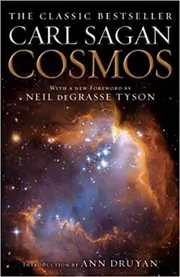
Cosmos
For beginners who want astronomy connected with scientific history and humanity’s place in nature. Sagan’s broad narrative supplies context that shorter surveys lack, though its scientific account reflects the era in which it was written.
What it's about
Cosmos takes readers from the birth of stars and planets to the rise of life on Earth. Sagan blends astronomy, history, and philosophy into an accessible story about how we came to understand the universe and our small place within it.
Also recommended by
2 people Richard Branson recommended this book
Richard Branson
Richard Branson recommended this book on his "70 must-read books" blog post.
Richard Branson's recommendation of this book  Bill Nye recommended this book
Bill Nye
"The story of my other hero, Carl Sagan. The other guy who inspired me to do what I do now." - Bill Nye
Bill Nye's recommendation of this book
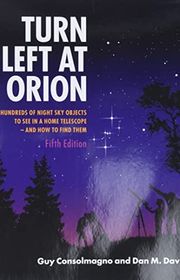
Turn Left at Orion
For beginners with binoculars or a small telescope who want specific objects to find. Its finder instructions and eyepiece sketches support real observing, though they require choosing targets suited to your location, season, and equipment.
What it's about
This observing guide explains how to locate and view a range of night-sky objects with modest equipment. Charts, sketches, and practical directions help beginners recognize what they can actually expect to see through a telescope.

A Brief History of Time
For readers who want a compact introduction to cosmology’s large questions. It connects black holes, time, and the early universe without advanced mathematics, though the concepts still demand slow reading and some scientific details have changed.
What it's about
Stephen Hawking introduces questions about the universe's beginning, its possible fate, and the nature of time. He explains black holes, relativity, and quantum ideas for general readers, connecting familiar physical concepts with the puzzles of cosmology.
Also recommended by
2 people- Richard Branson recommended this book
Richard Branson
Richard Branson recommended this book on his "70 must-read books" blog post.
Richard Branson's recommendation of this book  James Clear recommended this book
James Clear
"[One of] the 10 best nonfiction books of all-time." - James Clear
James Clear's recommendation of this book
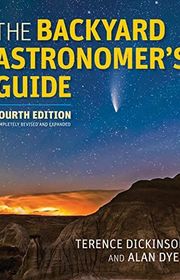
The Backyard Astronomer's Guide
For observers who want a broad reference covering equipment, techniques, and astrophotography. Its range makes it useful beyond the first sessions, though the large format is less convenient outdoors than a smaller field guide.
What it's about
Dickinson and Dyer explain how to get started in amateur astronomy, choose and use observing equipment, and explore celestial targets. Photographs, charts, and practical guidance extend from naked-eye observing to telescopes and astronomical photography.

Astrophysics for People in a Hurry
For busy beginners who want a brief orientation before choosing a deeper subject. The short chapters introduce vocabulary and scale efficiently, though their compression can leave difficult ideas needing more explanation elsewhere.
What it's about
Neil deGrasse Tyson introduces central ideas in astrophysics through short chapters intended for busy readers. Topics range from the Big Bang and quantum mechanics to black holes, planets and the search for life elsewhere in the universe.
Also recommended by
2 people Vinod Khosla recommended this book
Vinod Khosla
"Great, very quick overview of astrophysics." - Vinod Khosla
Vinod Khosla's recommendation of this book  Richard Dawkins recommended this book
Richard Dawkins
"Lovely book. Last chapter worthy of Carl Sagan himself." - Richard Dawkins
Richard Dawkins's recommendation of this book

For newcomers who want to identify objects and start observing. Its charts and equipment guidance turn interest into practical sessions outdoors, though an older edition’s date-specific tables and equipment advice need checking.
What it's about
Terence Dickinson introduces practical stargazing with charts for finding objects in the night sky. The guide covers choosing telescopes and binoculars, observing from either hemisphere, and techniques for photographing celestial objects.
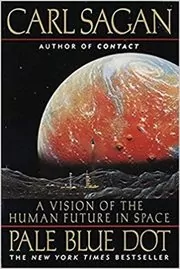
For readers who want space exploration connected with questions about humanity’s future. Its planetary perspective extends the concerns of Cosmos, though the mission history and predictions should be read in their 1990s context.
What it's about
Pale Blue Dot looks outward from the famous photograph of Earth as a tiny speck in space. Sagan recounts the story of planetary exploration and argues that seeing our world from afar changes how we think about war, ecology, and our shared future.

The End of Everything
For readers who already know the basics and want to explore the universe’s possible futures. Comparing different endings makes uncertainty in cosmology concrete, though some physics requires patient rereading and the scenarios remain unsettled.
What it's about
Katie Mack explores five possible endings for the universe: the Big Crunch, Heat Death, Big Rip, Vacuum Decay, and Bounce. Her account uses these scenarios to explain cosmology and the physics behind competing visions of cosmic extinction.

Black Hole Survival Guide
For curious readers who want one cosmic subject explored imaginatively rather than a general survey. The imagined encounter and artwork make black holes less abstract, though the format offers less systematic coverage than a textbook.
What it's about
Janna Levin imagines an encounter with a black hole to introduce these extreme cosmic objects. With artwork by Lia Halloran, she explains their physical behavior and influence on galaxies in an accessible exploration for nonspecialist readers.

For readers interested in how the sky has shaped human cultures and experience. The historical and cultural focus offers an alternative to physics-led accounts, though it teaches less about observing techniques or mathematical astronomy.
What it's about
Jo Marchant traces humanity's relationship with the night sky across cultures and centuries. From ancient monuments and celestial navigation to modern physics, she explores how observing the heavens shaped art, religion, science, and everyday experience.
Sources
- 1
Best space and astronomy books 2026 | Space
space.com
- 2
Best Astronomy & Space Books for Adults in 2026 - TelescopeGuides
telescopeguides.com
- 3
Astronomy/Cosmology Suggested Reading
reddit.com
- 4
Books – Astronomy Ireland
astronomy.ie
- 5
what are some good astronomy books that i should read?
reddit.com
- 6
40 best space and astronomy books | BBC Sky at Night Magazine
skyatnightmagazine.com
- 7
Best astronomy books: modern hits and classic titles | Live Science
livescience.com
- 8
Astronomy Books
goodreads.com







Edited by
Software engineer whose passion for tracking book recommendations from podcasts inspired the creation of MRB.
Lead investor at 3one4 Capital whose startup expertise and love for books helped shape MRB and its growth.
Comments
Did we miss something? Have feedback?
Help us improve this page by sharing your thoughts