
Subjective Cosmology Cycle Books in Order
Part ofGreg Egan Books in OrderThis page maps the Subjective Cosmology books by Greg Egan in order, with summaries, background on the linked themes, and tips on where to begin.
Last updated:
As an Amazon Associate, we earn from qualifying purchases (at no extra cost to you).
Subjective Cosmology Cycle books in publication order
3 books
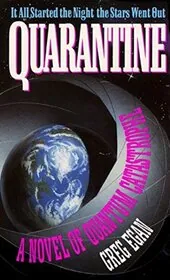
Quarantine
by Greg Egan
1992
Private investigator Nick Stavrianos is hired to find a missing woman in a future where the Solar System has been sealed inside the Bubble. His case leads into quantum manipulation, neural mods, and a reality that may depend on human observation.
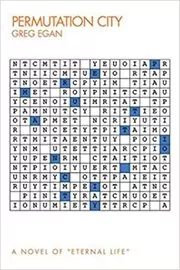
Permutation City
by Greg Egan
1994
Paul Durham sells digital copies of human minds the promise of continued life in virtual reality. As the project grows into a whole new world, the novel digs into identity, immortality, and whether reality needs hardware at all.
Recommended by
2 people Tobi Lütke recommended this book
Tobi Lütke
"The quality of the science in this book is exceptional." - Tobi Lütke
Tobi Lütke's recommendation of this book  Naval Ravikant recommended this book
Naval Ravikant
"[The author]'s very dry but full of great ideas." - Naval Ravikant
Naval Ravikant's recommendation of this book
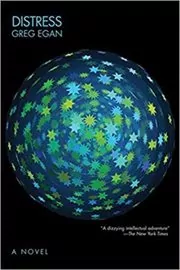
Distress
by Greg Egan
1995
Science journalist Andrew Worth heads to a floating enclave where physicists may be close to a Theory of Everything. Assassins, fringe movements, and a spreading mental plague turn the search for truth into a near-future thriller.
Recommended by
1 person- Naval Ravikant recommended this book
Naval Ravikant
Naval Ravikant mentioned this book on "The Tim Ferriss Show" podcast.
Naval Ravikant's recommendation of this book
Subjective Cosmology Cycle books in chronological order
Series background & context
Subjective Cosmology is best understood as a reader's label, not an official Greg Egan series. Egan has said that Quarantine, Permutation City, and Distress were not conceived or published as a formal trilogy. Still, the grouping makes sense, because all three books ask the same unnerving question: what if the reality we trust is only a local, human-scale picture of something much stranger?
Think of it as a shelf label, not a saga.
In Quarantine, that question arrives as a near-future detective story. The Solar System has been sealed inside the Bubble, and private investigator Nick Stavrianos is pulled into a case involving missing people, neural mods, and quantum manipulation. The book moves fast, but underneath the chase there is a deeper shock: observation, consciousness, and physical law may be bound together in ways nobody can safely control.
Permutation City turns inward. Paul Durham sells digital copies of human minds a version of immortality, building a virtual refuge for people who can afford to keep running after their bodies fail. Maria Deluca and the strange life evolving inside the Autoverse widen the scale, but the heart of the book is still personal. If a mind can be copied, sped up, edited, or moved, which version is you, and how much does the answer matter?
Distress brings the focus back to the physical world, but not to anything simple. Science journalist Andrew Worth heads to a floating conference center where a Theory of Everything may be within reach. Around that scientific breakthrough swirl cults, political splinter groups, assassination threats, exotic biotechnology, and the terrifying mental condition that gives the novel its title. It is probably the most openly political of the three books, and the most interested in how ideas about truth spill into public life.
What links these novels is not plot continuity. You do not need to read them in order to follow the characters, because each book stands alone. What carries across is the feeling that reality can crack open at any moment, and that the crack will expose both a bigger cosmos and a more fragile human self. Egan keeps asking what happens when science does not merely add new gadgets, but rewrites the terms on which identity, freedom, and knowledge rest.
So if you come to this page expecting a traditional sequence, adjust your expectations a little. These are companion books in spirit, not episodes in one ongoing story. Read them for the shared mood, the recurring intellectual nerve, and the way each one turns a different scientific idea into a very human kind of vertigo.






Edited by
Software engineer whose passion for tracking book recommendations from podcasts inspired the creation of MRB.
Lead investor at 3one4 Capital whose startup expertise and love for books helped shape MRB and its growth.
Comments
Did we miss something? Have feedback?
Help us improve this page by sharing your thoughts