
Orthogonal Books in Order
Part ofGreg Egan Books in OrderThis page covers the Orthogonal books by Greg Egan in order, with short summaries, trilogy background, and help deciding where to start.
Last updated:
As an Amazon Associate, we earn from qualifying purchases (at no extra cost to you).
Orthogonal books in publication order
3 books
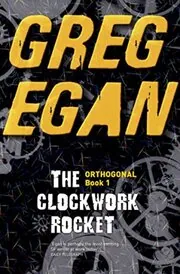
The Clockwork Rocket
by Greg Egan
2011
Yalda grows up in an alien civilization whose physics, biology, and family structures are nothing like ours. When incoming Hurtlers threaten the world, she helps launch a generation-spanning plan to find the knowledge needed to survive.
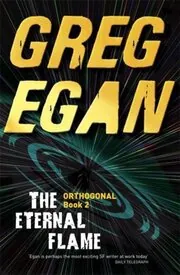
The Eternal Flame
by Greg Egan
2012
Aboard the generation ship Peerless, Tamara and Carlo face fuel shortages, crowding, and the limits of their mission. As the voyage deepens, scientific discovery and social strain become equally dangerous.
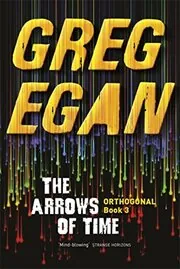
The Arrows of Time
by Greg Egan
2013
The final Orthogonal novel follows the returning ship Peerless as its crew tries to use everything they have learned to save home. Reverse time, hard choices, and alien physics push the trilogy toward its biggest questions.
Orthogonal books in chronological order
Series background & context
Orthogonal is Greg Egan's most sustained attempt to build an alien universe from first principles. In these books, the basic structure of spacetime is different from ours, so light, heat, motion, and even reproduction work in unfamiliar ways. That sounds forbidding on paper, but the trilogy stays anchored in people trying to understand their world before it destroys them.
The story begins in The Clockwork Rocket with Yalda, who grows from curious child to serious thinker in a society that feels both strange and lived-in. Her civilization has no sun like ours, and its science is still catching up with the deeper rules of its universe. When she realizes that devastating Hurtlers are on the way, the series finds its long game: knowledge is the only real defense, but building that knowledge may take more time than anyone alive has.
So they build a ship.
Peerless is meant to cross the void, find more advanced civilizations, and bring home the science needed to save the world. That plan gives the trilogy its scale, but also its human tension. A mission measured in generations has to deal with ordinary things too: politics, ego, family ties, dwindling resources, and the fact that people on the same side rarely want the same future.
The Eternal Flame shifts much of the action onto Peerless, where Tamara and Carlo become central figures as the mission runs into problems its founders did not fully foresee. Fuel, crowding, biology, and social strain all matter. So does discovery. The further the travelers push into their universe, the more they learn that the laws of nature open strange doors, including possibilities that look like impossible propulsion, matter traveling with opposite arrows of time, and messages that complicate any easy picture of cause and effect.
The Arrows of Time brings those ideas home. The return journey, the threat facing Yalda's people, and the consequences of reversing direction through this universe all converge into a finale that feels both gigantic and intimate. Egan never treats the science as window dressing. The equations are part of the pressure the characters live under, the same way weather or war might be in a different kind of saga.
This is not a casual trilogy, but it is a rewarding one. The tone is hard science fiction through and through, yet the emotional core is easy to recognize: curiosity under pressure, communities arguing over risk, and people trying to hand a future to descendants they will never meet. If that mix sounds exciting rather than intimidating, start with The Clockwork Rocket and keep going in order.











Edited by
Software engineer whose passion for tracking book recommendations from podcasts inspired the creation of MRB.
Lead investor at 3one4 Capital whose startup expertise and love for books helped shape MRB and its growth.
Comments
Did we miss something? Have feedback?
Help us improve this page by sharing your thoughts