
Greg Egan Books in Order
Explore Greg Egan books in order, with quick summaries, notes on Orthogonal and related works, and clear suggestions for where to start reading.
Last updated:
As an Amazon Associate, we earn from qualifying purchases (at no extra cost to you).
Greg Egan books in publication order
38 books

An Unusual Angle
by Greg Egan
1983
Egan's debut novel follows a high school student who develops an extraordinary ability to create films inside his own mind. It starts with a playful, odd premise, then turns it toward stranger consequences.

Axiomatic
by Greg Egan
1990
This early collection is full of body mods, copied selves, engineered emotions, and warped realities. It is probably the quickest way to see Egan's recurring obsessions with consciousness, choice, and the unintended consequences of powerful ideas.
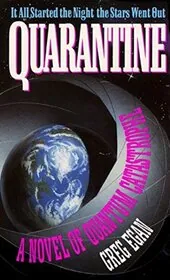
Quarantine
by Greg Egan
1992
Private investigator Nick Stavrianos is hired to find a missing woman in a future where the Solar System has been sealed inside the Bubble. His case leads into quantum manipulation, neural mods, and a reality that may depend on human observation.
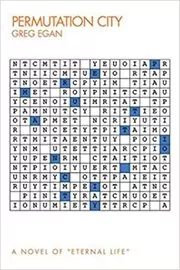
Permutation City
by Greg Egan
1994
Paul Durham sells digital copies of human minds the promise of continued life in virtual reality. As the project grows into a whole new world, the novel digs into identity, immortality, and whether reality needs hardware at all.
Recommended by
2 people Tobi Lütke recommended this book
Tobi Lütke
"The quality of the science in this book is exceptional." - Tobi Lütke
Tobi Lütke's recommendation of this book  Naval Ravikant recommended this book
Naval Ravikant
"[The author]'s very dry but full of great ideas." - Naval Ravikant
Naval Ravikant's recommendation of this book
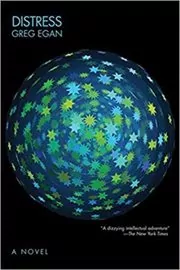
Distress
by Greg Egan
1995
Science journalist Andrew Worth heads to a floating enclave where physicists may be close to a Theory of Everything. Assassins, fringe movements, and a spreading mental plague turn the search for truth into a near-future thriller.
Recommended by
1 person- Naval Ravikant recommended this book
Naval Ravikant
Naval Ravikant mentioned this book on "The Tim Ferriss Show" podcast.
Naval Ravikant's recommendation of this book

Luminous
by Greg Egan
1995
This collection gathers some of Egan's sharpest short fiction about broken mathematics, copied minds, altered bodies, and dangerous new technologies. It is a strong snapshot of the ideas and tensions that made his reputation.

Our Lady Of Chernobyl
by Greg Egan
1995
This small collection gathers four early stories, including the title piece, and shows Egan moving toward the hard science fiction style he became known for. Expect bleak futures, sharp thought experiments, and a darker edge.

TAP
by Greg Egan
1995
A man learns TAP, a powerful new language that seems to change what thought itself can do. The story combines culture-war panic with a classic Egan question: what happens when a tool rewires the mind that uses it?
Diaspora
by Greg Egan
1997
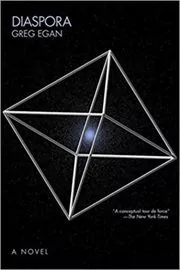
In a far-future civilization of fleshers, robots, and software citizens, orphan Yatima is drawn into a crisis that opens onto galaxy-scale exploration. It is a huge, idea-heavy novel about posthuman life, survival, and what minds become when bodies are optional.
Recommended by
1 person- Naval Ravikant recommended this book
Naval Ravikant
Naval Ravikant tweeted about this book.
Naval Ravikant's recommendation of this book
Blood Sisters
by Greg Egan
1998
Two identical twin sisters are diagnosed with the same rare fatal illness, but only one survives. The aftermath drives the survivor into a grim investigation that mixes biotech, grief, and revenge.
Teranesia
by Greg Egan
1999
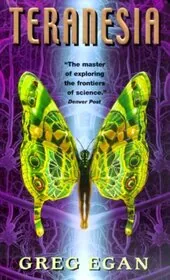
After a childhood on an isolated Indonesian island marked by strange evolutionary change, Prabir grows up into a world still haunted by what he witnessed. Genetics, politics, and personal identity collide as the mystery of Teranesia deepens.

Oracle
by Greg Egan
2000
In an alternate twentieth century, a brilliant scientist and a mysterious visitor use branching histories to test the limits of mathematics and computation. It is an ambitious story about possible worlds, impossible machines, and grief that will not stay local.
Schild's Ladder
by Greg Egan
2002
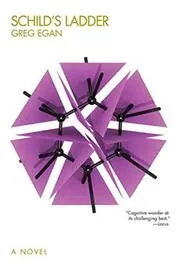
Centuries after an experiment creates a runaway region of new vacuum, posthuman investigators travel beside the expanding frontier to understand it. The novel mixes catastrophe, deep physics, and fierce debate over whether the unknown should be stopped or embraced.

Glory
by Greg Egan
2007
Two humans inhabit alien bodies to mediate a local conflict and investigate the vanished culture of the Niah. Diplomacy and archaeology gradually open into a story about mathematics, history, and cosmic perspective.

Dark Integers and Other Stories
by Greg Egan
2008
This compact collection ranges from broken arithmetic to posthuman exploration and first contact. The mood shifts from abstract math to intimate emotion, but the fascination with reality's hidden rules never lets up.
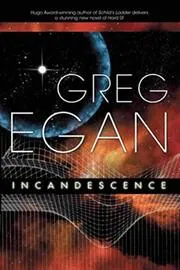
Incandescence
by Greg Egan
2008
A pre-industrial species living deep inside a dense cosmic environment slowly works out the truth of gravity and motion. Their story runs alongside a far-future investigation, making scientific discovery itself the central drama.

Crystal Nights and Other Stories
by Greg Egan
2009
This collection brings together stories of AI, virtual beings, social engineering, and mathematical weirdness, including the standout title piece. It is brisk, unsettling, and full of classic Egan puzzles about what counts as real or alive.

Oceanic
by Greg Egan
2009
Built around the Hugo-winning title novella, this collection moves between faith, science, first contact, and far-future speculation. It shows how well Egan can balance huge ideas with quieter emotional stakes.
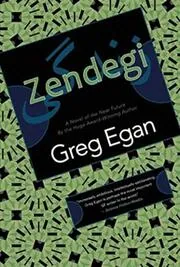
Zendegi
by Greg Egan
2010
Set in a near-future Iran shaped by political upheaval and rapid tech change, this follows journalist Martin Seymour as virtual worlds edge toward digital copies of real minds. It is one of Egan's more grounded, human-scale novels.
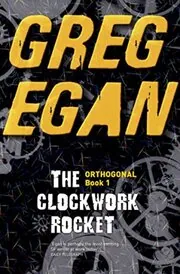
The Clockwork Rocket
by Greg Egan
2011
Yalda grows up in an alien civilization whose physics, biology, and family structures are nothing like ours. When incoming Hurtlers threaten the world, she helps launch a generation-spanning plan to find the knowledge needed to survive.
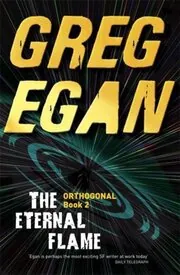
The Eternal Flame
by Greg Egan
2012
Aboard the generation ship Peerless, Tamara and Carlo face fuel shortages, crowding, and the limits of their mission. As the voyage deepens, scientific discovery and social strain become equally dangerous.

Wang's Carpets
by Greg Egan
2012
Researchers study alien life forms that look like vast carpets, only to discover they behave like living computation. It is a short, idea-rich story about intelligence, pattern, and how strange minds might be built.
The Arrows of Time
by Greg Egan
2013
The final Orthogonal novel follows the returning ship Peerless as its crew tries to use everything they have learned to save home. Reverse time, hard choices, and alien physics push the trilogy toward its biggest questions.

The Four Thousand, the Eight Hundred
by Greg Egan
2016
On twin asteroid colonies with unequal lives and shrinking options, a desperate plan becomes the only path to freedom. Egan uses a tight space setting to turn a moral dilemma into a tense, human novella.
Dichronauts
by Greg Egan
2017
Seth and Theo live in a world with two directions of time and a brutally narrow habitable zone. Their expedition to the edge of survival uncovers a planet-sized danger, turning very strange physics into a tense journey of discovery.

Uncanny Valley
by Greg Egan
2017
In a future where the rich can rebuild themselves with curated memories and replacement bodies, a young man confronts what survival really means. It is an unusually emotional Egan story about identity, family, and the price of choosing a better self.
Phoresis
by Greg Egan
2018
On the twin worlds of Tvibura and Tviburi, a young woman commits herself to a project that may take generations to matter. It is a patient, thoughtful novella about survival, engineering, and building a future you might never live to see.

The Nearest
by Greg Egan
2018
What starts as a family murder investigation becomes something stranger when Kate realizes the people around her may not be what they seem. Egan turns domestic tragedy into a disorienting puzzle about perception, geometry, and trust.

Perihelion Summer
by Greg Egan
2019
A wandering black hole system shifts Earth's orbit and turns climate into immediate disaster. Matt and his friends try to survive on a self-sustaining boat, making this one of Egan's most grounded stories of adaptation and mutual aid.

The Best of Greg Egan
by Greg Egan
2019
Selected by the author, this retrospective offers twenty stories spanning roughly three decades of his work. It is a strong one-volume sampler, from early identity shocks to later tales of cosmic scale and stranger physics.
Zeitgeber
by Greg Egan
2019
A new disease knocks human circadian clocks out of sync, letting every body drift to its own rhythm. As rumors of sabotage spread and a possible cure appears, Egan turns a medical crisis into a sharp story about time, labor, and social order.

Dispersion
by Greg Egan
2020
On a world divided into six mutually invisible, usually intangible fractions, a new disease starts breaking the old boundaries. The novella mixes strange geometry with social suspicion as people struggle to understand a crisis that rewrites reality.

Instantiation
by Greg Egan
2020
Eleven stories from the 2010s explore software beings, artificial intelligence, odd mathematics, and the social fallout of new tech. If you want later-period Egan in shorter bursts, this collection is a great place to look.

The Book of All Skies
by Greg Egan
2021
Del lives in a world where crossing certain hoops carries you to a new sky instead of back home. A stolen ancient map, a chase into the unknown, and a hidden planetary truth drive this inventive adventure.

Scale
by Greg Egan
2022
In a society where humans exist at seven different body scales, detective Sam Mujrif investigates a missing woman from a much larger caste. The case opens into a tense story about inequality, engineering, and radically different physics.

Phoresis and Other Journeys
by Greg Egan
2023
This volume collects the novellas The Four Thousand, the Eight Hundred, Dispersion, and Phoresis. Together they make a neat sampler of Egan at novella length, with strange worlds, survival problems, and carefully worked-out science.

Sleep and the Soul
by Greg Egan
2023
This collection gathers ten recent stories, mixing alternate history, near-future biotech, social breakdown, and mind-bending speculation. It shows Egan still stretching into new corners while keeping his focus on how ideas change lived experience.

Morphotrophic
by Greg Egan
2024
In this alternate biology, living cytes are not locked inside one body, and swapping them can change health, lifespan, and even species boundaries. Marla's sudden collapse pulls her into a struggle over who gets to control life itself.
Where to start with Greg Egan
If you want the classic near-future mind-benders: Quarantine → Permutation City → Distress
If you want posthuman ideas on the biggest scale: Diaspora → Schild's Ladder
If you want a full trilogy in a truly alien universe: The Clockwork Rocket → The Eternal Flame → The Arrows of Time
If you want short fiction first: Axiomatic → Luminous → Oceanic
Greg Egan sub-series and character series
Subjective Cosmology Cycle books in order
Explore this seriesSubjective Cosmology Cycle books in chronological order
Greg Egan collections, short stories, and related book types
Short Stories/Novellas
Short Story Collections
Standalone Greg Egan books
Author bio
Greg Egan was born in Perth, Western Australia, on August 20, 1961. He studied mathematics at the University of Western Australia, then spent years working as a computer programmer, often in jobs supporting medical research. That mix of math, code, and real-world science sits right at the center of his fiction.
He published his first novel, An Unusual Angle, in 1983. His earliest work leaned more toward horror and fantasy, but by the early 1990s he had shifted decisively into hard science fiction. In a later interview, he said he had been writing full-time since 1992.
That change shaped the rest of his career.
Books like Quarantine, Permutation City, and Distress helped define the version of Egan many readers know best: near-future stories where a scientific idea is never just background decoration. Quantum theory, uploaded minds, and theories of everything become engines for suspense, argument, and moral pressure. He likes to start with a question that sounds abstract, then show what it would do to a person's job, body, grief, or sense of self.
Then he kept going bigger.
Diaspora and Schild's Ladder push his work out to posthuman and cosmic scales, but they never lose interest in how minds cope with change. Later books like Zendegi show another side of him, more grounded, more political, and more tied to contemporary life, while the Orthogonal trilogy, beginning with The Clockwork Rocket, rebuilds physics from the ground up in a truly alien universe. If readers come back again and again, it is often because Egan can make the hardest idea in the room feel like the thing the characters have to survive.
His short fiction matters just as much. Collections like Axiomatic, Luminous, and Oceanic are packed with stories about artificial consciousness, biotech, religion, identity, and reality going sideways. The novella Oceanic won the Hugo Award, and Permutation City won the John W. Campbell Memorial Award. He has also picked up multiple Seiun Awards, which tells you how widely his work has traveled.
For all that, he has always kept a low profile.
Egan is famously private. He does not make a circuit of conventions and signings, and he has said there are no genuine photos of him on the web. That reserve can make him seem distant, but it also fits the work: the books do the talking, and they say plenty.
Outside fiction, he has written science notes and essays for readers who want to follow the machinery behind the stories. He has also spoken about political causes, including support for refugees in Australian detention centers. Even there, the pattern is familiar: clear thinking, impatience with cant, and a refusal to look away from the human cost of systems.
Public details about his day-to-day life remain limited, but he has long been associated with Perth and still maintains an active author site. New novels and collections have continued to appear well into the 2020s, which is a good sign that he is still chasing the next hard question. With Greg Egan, that question is usually stranger, and more human, than it first appears.


Edited by
Software engineer whose passion for tracking book recommendations from podcasts inspired the creation of MRB.
Lead investor at 3one4 Capital whose startup expertise and love for books helped shape MRB and its growth.
Comments
Did we miss something? Have feedback?
Help us improve this page by sharing your thoughts