
9 Best UML Books
The best UML books, ranked by how many expert sources recommend each one, with notes on who they suit, from first diagrams to object-oriented design.
Our take
UML helps teams represent software structure and behavior, but learning notation is different from learning to design a system. These books serve both purposes in different proportions. Some give you enough vocabulary to read and sketch diagrams; others connect models with requirements, object responsibilities, and implementation. They suit students, developers, and analysts who want clearer ways to discuss designs without assuming that more diagrams automatically produce better software.
UML Distilled offers a concise starting point. Learning UML 2.0 and UML @ Classroom provide more space for guided study, while Applying UML and Patterns puts modeling inside a larger design process. For consultation after the basics, consider The Unified Modeling Language User Guide or UML 2.0 in a Nutshell. The Elements of UML™ 2.0 Style concentrates on clarity and consistency. Start with a short introduction, then choose a design text or reference according to the work you actually need to do.
9 books · 6 sources · Last updated
As an Amazon Associate, we earn from qualifying purchases (at no extra cost to you).
How to choose from this list
Skip to the full rankingIf you want a concise first introduction: UML Distilled
If you prefer structured study: Learning UML 2.0 → UML @ Classroom
If you want object-oriented design practice: Applying UML and Patterns
If you need a desk reference: The Unified Modeling Language User Guide → UML 2.0 in a Nutshell
If you want clearer team diagrams: The Elements of UML™ 2.0 Style
If you want examples connected to Java: UML for Java Programmers
The 9 books, ranked
Ranked by how many expert sources name each book. Ties go to the book more people recommend.
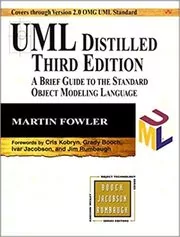
For developers who want enough notation to read and sketch useful diagrams without studying the whole standard. Fowler's concise approach makes a manageable first book, though specialized features and detailed language semantics need a fuller reference.
What it's about
Fowler introduces the essential concepts and diagram types of UML without attempting to cover every detail of the notation. The guide explains how to use modeling in object-oriented development, with practical advice on diagrams, development processes, and UML 2.
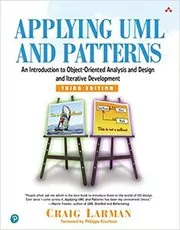
Applying UML and Patterns
An Introduction to Object-Oriented Analysis and Design and Iterative Development
For students who want diagrams connected to object-oriented design decisions. Larman's iterative case study goes beyond notation into assigning responsibilities and applying patterns, though its textbook length is excessive if you only need a quick diagram reference.
What it's about
Craig Larman teaches object-oriented analysis and design through successive iterations of a shared case study. The book connects requirements, UML diagrams, responsibility assignment, and design patterns with iterative development, helping readers translate models into software.
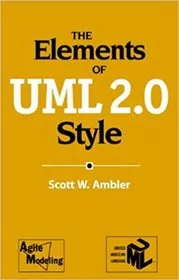
The Elements of UML™ 2.0 Style
For teams that can already draw UML but want diagrams to communicate more consistently. Ambler focuses on readable style rather than reteaching every concept, though the compact conventions work best alongside a fuller introduction or reference.
What it's about
Scott Ambler presents conventions for creating clear, consistent UML diagrams. The guide covers diagram types ranging from classes and use cases to activities, sequences, components, and deployment, helping teams make their models easier to read and maintain.
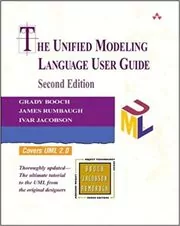
The Unified Modeling Language User Guide
For readers already comfortable with object-oriented concepts who want a fuller explanation of UML. Its examples support more detailed study than UML Distilled, though it is not a substitute for learning basic software design first.
What it's about
The creators of UML introduce its core concepts and notation through an example-driven tutorial. The guide progresses from basic structural and behavioral modeling to more complex designs, showing how diagrams can document and communicate software systems.
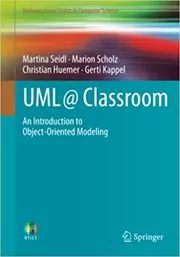
For students who prefer a structured introduction to modeling with examples. Its explanation of notation and meaning offers more classroom support than a pocket reference, though learning the diagrams still needs practice with actual design problems.
What it's about
Martina Seidl and her coauthors introduce object-oriented modeling through UML diagrams. Examples explain use cases, classes, states, sequences, and activities, combining notation and meaning with guidance on applying models at different stages of software development.
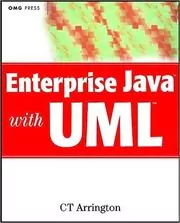
Enterprise Java with UML
For developers examining UML within older enterprise Java application development. Arrington connects models with implementation choices, though the historical Java platform context needs substantial translation before applying examples to a current project.
What it's about
C. T. Arrington explains how UML can guide the development of enterprise Java systems. The book follows modeling through the development cycle, showing how teams can communicate designs, evaluate technology choices, and track decisions before implementing their applications.
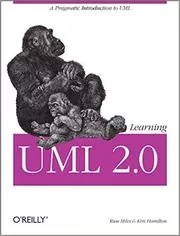
For readers who want a practical introduction connecting requirements, structure, behavior, and deployment. Miles and Hamilton emphasize using diagrams within a project, though the UML 2.0 edition should not be treated as the latest complete language specification.
What it's about
Russ Miles and Kim Hamilton introduce UML through practical examples of software modeling. The guide explains how to capture requirements, represent system components and relationships, describe behavior, and model deployment so teams can communicate project designs.
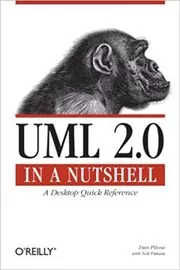
For developers and analysts who need a compact desk reference once the main concepts are familiar. Pilone and Pitman combine syntax with practical context, though a quick reference gives less sustained instruction than a project-based textbook.
What it's about
Dan Pilone and Neil Pitman provide a reference to UML syntax, meaning, and practical use. Examples explain how to interpret and create diagrams, with coverage of modeling practices and the Object Constraint Language for developers, architects, and analysts.
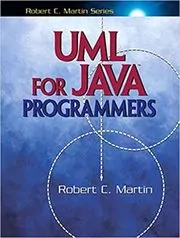
UML for Java Programmers
For Java programmers who want to connect diagrams with code they can recognize. Martin's pragmatic focus makes modeling feel less detached from development, though the older examples and narrower language perspective limit its value as a current general reference.
What it's about
Martin connects UML modeling with practical Java development, explaining how diagrams relate to code. Class, object, sequence, collaboration, and state diagrams support examples and a client-server case study, with guidance on when modeling helps and how to use it effectively.
Sources
Edited by
Software engineer whose passion for tracking book recommendations from podcasts inspired the creation of MRB.
Lead investor at 3one4 Capital whose startup expertise and love for books helped shape MRB and its growth.
Comments
Spotted a missing book, a wrong order or a mistake? Tell us and we'll fix this page.
We're a reading guide, not the author or publisher, so we can't send books or pass on messages.