
7 Best Thermodynamics Books
The best thermodynamics books, ranked by expert source recommendations, with notes to help beginners, physics students, and engineers choose where to start.
Our take
Thermodynamics explains how energy moves, which processes are possible, and why heat cannot always be converted into useful work. Books approach these questions differently depending on their audience. Engineering texts emphasize properties, energy balances, and devices such as turbines and refrigerators. Physics texts develop the underlying structure and connect macroscopic behavior with statistical descriptions of matter.
For a compact conceptual introduction, try The Laws of Thermodynamics. Engineering students can choose among Engineering Thermodynamics, Thermodynamics: An Engineering Approach, and Fundamentals of Engineering Thermodynamics, ideally matching the text and edition used in their course. Chemical-engineering students have a more specialized route in Introduction to Chemical Engineering Thermodynamics. An Introduction to Thermal Physics offers a physics pathway with applications and problems, while Thermodynamics and an Introduction to Thermostatistics suits readers ready for a more formal framework. Start with the short introduction for orientation, then choose one main textbook suited to your course and mathematical background.
7 books · 7 sources · Last updated
As an Amazon Associate, we earn from qualifying purchases (at no extra cost to you).
How to choose from this list
Skip to the full rankingIf you want a short conceptual introduction: The Laws of Thermodynamics
If you are beginning engineering thermodynamics: Thermodynamics → Fundamentals of Engineering Thermodynamics
If you want engineering problem practice: Engineering Thermodynamics
If you study chemical engineering: Introduction to Chemical Engineering Thermodynamics
If you want the physics pathway: An Introduction to Thermal Physics → Thermodynamics and an Introduction to Thermostatistics
The 7 books, ranked
Ranked by how many expert sources name each book. Ties go to the book more people recommend.

For beginning engineering students who learn through physical examples and applications. Its accessible explanations connect energy and entropy with real devices, though the large textbook format demands sustained study and practice rather than casual reading.
What it's about
Çengel and Michael Boles develop engineering thermodynamics from energy balances and substance properties through entropy and exergy. Applications include power and refrigeration cycles, air conditioning, chemical reactions, equilibrium and compressible flow, supported by practical examples.

Fundamentals of Engineering Thermodynamics
For engineering students who want a systematic framework for modeling systems and checking assumptions. The problem-solving emphasis supports careful analysis, though it works best alongside exercises and a course rather than as a quick reference.
What it's about
Moran and his coauthors introduce thermodynamic principles through engineering models, examples and problem-solving exercises. The text develops energy balances, the second law and property evaluation before applying these tools to power, refrigeration and reacting systems.

For curious readers who want a compact explanation of what the thermodynamic laws mean. The conceptual focus offers perspective before tackling a textbook, though the compressed discussion can be demanding and provides little engineering problem practice.
What it's about
Peter Atkins explains the four laws of thermodynamics and their significance for physical processes. Everyday examples introduce temperature, heat, energy conservation, entropy, free energy, and absolute zero, connecting fundamental principles with phenomena throughout the universe.
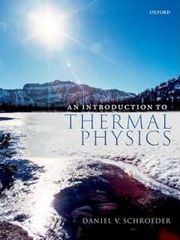
An Introduction to Thermal Physics
For physics students ready to connect energy and entropy with microscopic behavior. The applications and worked examples make statistical ideas approachable, though introductory physics and calculus are prerequisites and engineering design receives less emphasis.
What it's about
Daniel Schroeder introduces thermodynamics and statistical mechanics through energy, entropy, and the behavior of matter. Worked examples and problems connect these ideas with engines, phase changes, chemical processes, quantum systems, and phenomena across the natural sciences.
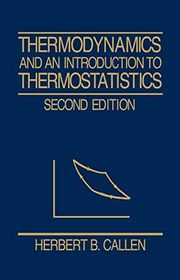
Thermodynamics and an Introduction to Thermostatistics
For students who want a formal framework for equilibrium thermodynamics before connecting it with statistical physics. The postulate-based approach clarifies relationships among thermodynamic quantities, though the abstraction suits mathematically confident readers better than absolute beginners.
What it's about
Herbert Callen develops equilibrium thermodynamics through postulates and thermodynamic potentials, then connects macroscopic principles with thermostatistics. The treatment examines the structure of the theory, phase transitions, and statistical foundations for students seeking a systematic physical understanding.

Engineering Thermodynamics
For engineering students who want worked problems alongside a broad treatment of thermodynamic principles. The emphasis on solving engineering questions supports coursework and exam preparation, though readers seeking a short conceptual introduction will find it substantial.
What it's about
Nag develops the principles of engineering thermodynamics through explanations and worked problems. Topics connect heat, work and energy laws with entropy, substance properties, power and refrigeration cycles, and the analysis of practical engineering processes.

Introduction to Chemical Engineering Thermodynamics
For chemical-engineering students who need thermodynamics connected to processes, mixtures, and equilibrium. The discipline-specific approach is more relevant to that coursework than a general mechanical-engineering text, though it assumes comfort with mathematical analysis.
What it's about
Smith, Van Ness, Abbott and Swihart develop thermodynamic principles from a chemical-engineering perspective. Explanations alternate with property correlations and applications, using realistic problems and examples to connect theoretical concepts with the analysis of chemical processes.
Sources
- 1
The 13 Best Books for Thermodynamics
celsiuselements.com
- 2
100 Best Thermodynamics Books of All Time
shortform.com
- 3
Thermodynamics Books
goodreads.com
- 4
Thermodynamics - Mechanical Engineering - Purdue University
engineering.purdue.edu
- 5
Thermodynamics | Mechanical Department | IITG
iitg.ac.in
- 6
Recomendations for learning thermodynamics?
reddit.com
- 7
The 4 Best Thermodynamic Textbooks On The Market
engineeringness.com










Edited by
Software engineer whose passion for tracking book recommendations from podcasts inspired the creation of MRB.
Lead investor at 3one4 Capital whose startup expertise and love for books helped shape MRB and its growth.
Comments
Spotted a missing book, a wrong order or a mistake? Tell us and we'll fix this page.
We're a reading guide, not the author or publisher, so we can't send books or pass on messages.