
12 Best Physical Chemistry Books
The best physical chemistry books, ranked by how many expert sources recommend each one, with notes for beginners, course students, and advanced readers.
Our take
Physical chemistry uses mathematics and physics to explain chemical behavior, from molecular energy levels to reaction rates and equilibrium. The right book depends partly on your calculus background and partly on the order your course takes. A text that begins with quantum mechanics asks different questions at the outset from one that starts with thermodynamics.
Physical Chemistry: A Molecular Approach develops the molecular picture first, while Atkins' Physical Chemistry offers a broad course reference in focused sections. Elements of Physical Chemistry provides a shorter introduction. The books by Levine, Ball, and Silbey offer alternative explanations of the core material, and Schaum's Outline of Physical Chemistry is useful when your main need is calculation practice. Specialist quantum and statistical mechanics books let you study one area in greater depth.
Start with the book assigned for your course, then choose a second explanation or problem collection for the topics that remain unclear.
12 books · 9 sources · Last updated
As an Amazon Associate, we earn from qualifying purchases (at no extra cost to you).
How to choose from this list
Skip to the full rankingIf you need a shorter introduction: Elements of Physical Chemistry → Atkins' Physical Chemistry
If you want a molecular starting point: Physical Chemistry
If you need worked calculation practice: Schaum's Outline of Physical Chemistry
If you want detailed derivations with Levine: Physical Chemistry → Quantum Chemistry
If you want deeper quantum theory: Molecular Quantum Mechanics
If you want advanced statistical mechanics: Statistical Mechanics
The 12 books, ranked
Ranked by how many expert sources name each book. Ties go to the book more people recommend.

Atkins' Physical Chemistry
For undergraduates wanting a broad reference that can follow a conventional physical chemistry course. The focused sections help with targeted review, though compressed explanations sometimes need slower rereading or additional worked examples to become clear.
What it's about
Peter Atkins, Julio de Paula, and James Keeler present an undergraduate physical chemistry textbook organized into focused topics. This eleventh edition develops chemical principles through mathematics, worked explanations, conceptual checklists, and expanded support for mathematical techniques.

For students who want molecular behavior to explain the larger thermodynamic picture. McQuarrie and Simon build from quantum mechanics and provide mathematical interludes, though the substantial length and quantum-first order may differ from your course.
What it's about
Donald McQuarrie and John Simon begin with quantum mechanics and molecular behavior before developing thermodynamics and kinetics. Their textbook builds explanations of macroscopic chemical phenomena from an atomic and molecular perspective, supported by worked examples and problems.

Physical Chemistry
For students who want detailed mathematical development alongside the standard physical chemistry topics. Levine offers a substantial reference for revisiting derivations, though the density makes it less inviting as a first encounter without calculus preparation.
What it's about
Ira Levine develops physical chemistry through thermodynamics, equilibrium, reaction kinetics, and quantum mechanics. The textbook also examines molecular structure, spectroscopy, statistical mechanics, and solids and liquids, connecting these topics in a detailed treatment of the subject's foundations.
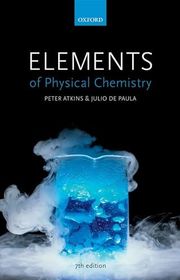
Elements of Physical Chemistry
For students who need a shorter route through introductory physical chemistry before a full textbook. Atkins and de Paula provide mathematical support in focused sections, though the reduced scope leaves less room for advanced topics.
What it's about
Peter Atkins and Julio de Paula introduce molecular structure, energy, reactions, and material behavior through physical and mathematical principles. Short topic sections, worked explanations, and mathematical support help connect chemical questions with the calculations used to answer them.

Physical Chemistry
For students comfortable with calculus and physics who want theory connected to applications. Silbey and his coauthors provide a broad undergraduate treatment, though the level assumes more preparation than a gentle conceptual introduction.
What it's about
Robert Silbey, Robert Alberty, and Moungi Bawendi present physical chemistry for students with backgrounds in calculus and physics. The textbook combines theoretical explanations with practical applications and problems, including coverage of statistical mechanics, nanoscience, and oscillating chemical reactions.
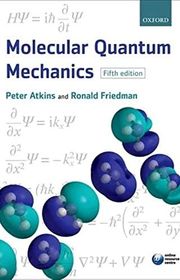
Molecular Quantum Mechanics
For students who want to go beyond a general course’s quantum chapters into molecular structure and spectroscopy. Atkins and Friedman connect theory with chemical applications, though the specialist mathematics requires more preparation than an introductory overview.
What it's about
Peter Atkins and Ronald Friedman develop quantum principles and models of atomic, molecular, and electronic structure. Their treatment extends into spectroscopy, molecular properties, and computational methods, using mathematical explanations and worked examples to support the theoretical development.

Physical Chemistry
For students who want a more direct introduction to the core calculus-based material. Ball keeps the course foundations in view, though readers seeking extensive advanced applications or a specialist treatment will need additional books.
What it's about
David Ball presents calculus-based physical chemistry with an emphasis on core topics and clear explanations. Designed for science and engineering students, the textbook combines a traditional course organization with a review of calculus applications relevant to the subject.

Physical Chemistry: Quanta, Matter, and Change
For students wanting a molecular starting point with material divided into short, connected topics. The organization supports selective study, though its quantum-first sequence may require jumping between sections when following a thermodynamics-first course.
What it's about
Peter Atkins, Julio de Paula, and Ronald Friedman connect molecular properties with macroscopic behavior through quantum theory, statistical mechanics, and thermodynamics. The second edition organizes the course into short topics grouped into larger sections, with roadmaps showing their connections.
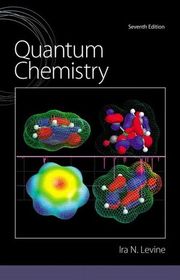
Quantum Chemistry
For students who need the mathematics explained alongside quantum chemistry rather than assumed throughout. Levine develops the necessary tools in detail, though that thoroughness makes the book a substantial commitment rather than a quick supplement.
What it's about
Ira Levine introduces quantum mechanics, atomic structure, and molecular electronic structure together with the mathematics needed to study them. The seventh edition also examines computational approaches and the capabilities and limitations of methods for calculating molecular properties.

Schaum's Outline of Physical Chemistry
For students who understand lectures but need more practice carrying out calculations. The solved-problem format makes gaps in technique easier to locate, though it works better beside a main textbook than as a complete conceptual course.
What it's about
Clyde Metz provides a topic-by-topic physical chemistry review supported by solved problems, explanations, and practice exercises. Coverage includes gases, kinetic-molecular theory, transport phenomena, and thermodynamics, offering students a structured supplement to lectures and a main course textbook.
Statistical Mechanics
For advanced undergraduates or beginning graduate students ready to study statistical mechanics separately. McQuarrie provides a concentrated treatment with substantial problems, though the mathematical demands and narrow scope make it unsuitable as a first chemistry textbook.
What it's about
Donald McQuarrie develops statistical mechanics as a framework for understanding the properties of systems containing many particles. Aimed at advanced undergraduate and early graduate study, the textbook combines theoretical development with end-of-chapter problems for sustained practice.

For students concentrating on thermodynamics and kinetics who want the mathematical reasoning developed carefully. Cooksy connects the theoretical steps, though this volume covers only part of physical chemistry and needs a separate quantum treatment.
What it's about
Andrew Cooksy explains thermodynamics, statistical mechanics, and kinetics through careful mathematical derivations and connected theoretical reasoning. Exercises draw on molecular physics and physical organic chemistry, with additional applications in biochemistry and chemical engineering for physical chemistry students.
Sources
- 1
Chemistry and Chemical Engineering: Physical chemistry
guides.library.stanford.edu
- 2
What Is The Best Physical Chemistry Textbook?
chemistryhall.com
- 3
Resources for learning Chemistry
chemistry.stackexchange.com
- 4
Physical Chemistry Books
goodreads.com
- 5
Great chemistry book(s) for physical chemistry
reddit.com
- 6
Books for Physical Chemistry
reddit.com
- 7
Best Physical Chemistry Textbook: Top Reviews of 2020
geometryofmolecules.com
- 8
The Best Physical Chemistry Textbooks of 2026
conqueryourexam.com
- 9
16 Best Physical Chemistry Books for Undergraduates
gauravtiwari.org


Edited by
Software engineer whose passion for tracking book recommendations from podcasts inspired the creation of MRB.
Lead investor at 3one4 Capital whose startup expertise and love for books helped shape MRB and its growth.
Comments
Spotted a missing book, a wrong order or a mistake? Tell us and we'll fix this page.
We're a reading guide, not the author or publisher, so we can't send books or pass on messages.