
13 Best Spring Framework Books
The best Spring Framework books, ranked by expert-source recommendations, with notes on prerequisites, framework versions, application guides and references.
Our take
Spring books cover several layers of Java development. Some explain the application context and dependency injection, others use Boot to build services quickly, and specialist titles focus on security or distributed systems. You will get more from them if you already understand Java and basic web development. Many existing links point to older editions, so match examples to your project’s versions and current documentation.
Spring Start Here concentrates on fundamentals before the wider tour in Spring in Action. Spring Boot: Up and Running develops applications in Java and Kotlin, while Learning Spring Boot 3.0 follows a newer platform than the earlier Boot-specific titles. Spring Microservices in Action and Cloud Native Spring in Action move toward connected services and deployment. Spring Security in Action provides focused study, with particular care needed around the linked edition’s configuration examples.
Begin with Spring Start Here if the framework still feels opaque, then choose a Boot project or specialist topic matched to the application you are building.
13 books · 8 sources · Last updated
As an Amazon Associate, we earn from qualifying purchases (at no extra cost to you).
How to choose from this list
Skip to the full rankingIf you are new to Spring and know Java: Spring Start Here → Spring in Action
If you want to build a Boot application: Spring Boot: Up and Running → Learning Spring Boot 3.0
If you want to study application security: Spring Security in Action
If you want distributed application and deployment skills: Spring Microservices in Action → Cloud Native Spring in Action
If you maintain Spring 5 applications: Pro Spring 5: An In-Depth Guide to the Spring Framework and Its Tools → Spring 5 Recipes: A Problem-Solution Approach
If you want historical design context: Professional Java Development with the Spring Framework
The 13 books, ranked
Ranked by how many expert sources name each book. Ties go to the book more people recommend.

Spring in Action
For Java developers who want a broad application-driven introduction to Spring. Its projects connect several parts of the ecosystem more directly than a narrow reference, but this linked Spring 5 edition needs adaptation to newer dependencies and APIs.
What it's about
Craig Walls introduces Spring 5 through practical application development, covering core framework features alongside Spring Boot configuration. This edition extends the guide into reactive programming, WebFlux, and microservices, showing how Spring supports several approaches to building Java software.

Spring Security in Action
For developers who want to understand authentication and authorization through practical examples. Its focused security coverage goes deeper than general introductions, but the linked first edition predates substantial configuration changes and must be checked against current security documentation.
What it's about
Laurentiu Spilca teaches application security through practical Spring examples, starting with users, passwords, authentication, and access controls. Later chapters cover OAuth2, protected endpoints, authorization servers, reactive applications, and testing security configurations against common web threats.

Spring Boot in Action
For readers who want to understand Boot’s conventions and reduced configuration. Its focused application examples explain the motivation more directly than a large framework reference, but the early Boot generation makes tooling and configuration details historical.
What it's about
Craig Walls explains how Spring Boot simplifies building Java applications through automatic configuration and established conventions. Practical examples cover configuration changes, testing, the command-line interface, Actuator monitoring, and deployment, connecting application development with reduced setup work.

Spring Microservices in Action
For developers who already build applications and want to connect services into a distributed system. Its configuration, resilience and tracing examples extend beyond basic web development, but the added operational complexity and older dependency versions require careful adaptation.
What it's about
John Carnell and Illary Huaylupo Sánchez demonstrate building Java microservices with Spring Boot and Spring Cloud. Examples cover configuration, service discovery, routing, resilience, security, messaging, distributed tracing, containers, and deployment, connecting individual services into a working system.
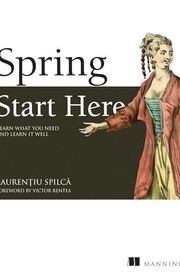
Spring Start Here
For Java developers who want to understand the framework before adding more abstractions. Its deliberate focus on the context, beans and application fundamentals gives clearer early orientation than a broad reference, but the original edition uses older framework versions.
What it's about
Laurentiu Spilca introduces Spring through its core concepts, including the application context, dependency injection, configuration and aspects. Practical examples then connect these foundations with web applications and persistence, helping Java developers understand what the framework is doing.

Cloud Native Java
Designing Resilient Systems with Spring Boot, Spring Cloud, and Cloud Foundry
For experienced Java developers interested in connecting application development with operations. Its treatment of services, testing and delivery gives a wider production perspective, but the older Spring Cloud and Cloud Foundry stack limits direct use of the examples.
What it's about
Josh Long and Kenny Bastani show how to build cloud applications with Spring Boot, Spring Cloud, and Cloud Foundry. They cover services, data integration, observability, testing, and continuous delivery while explaining approaches to modernizing existing Java systems.
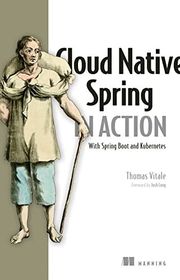
Cloud Native Spring in Action
For developers ready to connect Spring applications with containers and deployment workflows. Its hands-on cloud-native project goes further into operations than the introductory books, but the toolchain adds substantial prerequisites and published dependency versions need updating.
What it's about
Thomas Vitale develops cloud-native applications using Spring Boot, Spring Cloud, Docker and Kubernetes. The book connects application design with testing, packaging, deployment and operational concerns, guiding readers through building and delivering a service-based system.
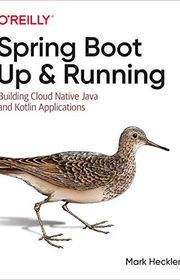
Spring Boot: Up and Running
For Java and Kotlin developers who want an application-focused Boot introduction. Its practical progression connects development with testing and deployment more directly than a framework catalog, but the older Boot generation requires adapting configuration and dependencies.
What it's about
Mark Heckler introduces Spring Boot through Java and Kotlin applications. The guide explains Boot’s conventions and architecture while developing practical work with web services, data, testing and deployment, showing how the framework supports application development with less manual setup.

Getting started with Spring Framework
For Java developers who want hands-on coverage of core and web features. Its examples provide a broader starting course than a specialist security book, but this Spring 5 edition requires version-aware reading and comparison with current documentation.
What it's about
J. Sharma and Ashish Sarin introduce Spring 5 through hands-on Java examples. This edition covers dependency injection, aspects, database integration, messaging, web applications, REST services, and reactive development with WebFlux, Reactor, and Spring Data MongoDB.
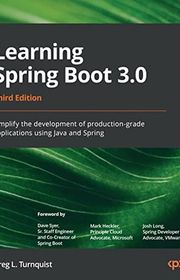
Learning Spring Boot 3.0
For developers who want a Boot 3 project extending from setup to deployment. Its coverage of security, testing and native images offers a newer platform than the Boot 2 volume, but it remains version-specific and still needs current documentation.
What it's about
Greg Turnquist builds a Spring Boot 3 application and develops its security, testing, packaging and deployment. This third edition also explores Docker, GraalVM native images and reactive programming, connecting application construction with several production-oriented development options.

Professional Java Development with the Spring Framework
For readers interested in the design thinking behind Spring’s early enterprise approach. Its complete application connects dependency injection with architectural choices, but the old framework generation makes it historical background rather than a current implementation guide.
What it's about
Rod Johnson and his coauthors explain Spring’s design and its role in enterprise Java development. A complete sample application illustrates dependency injection, aspect-oriented programming, data access, transactions, remoting, security, and web application development.

For experienced developers working with Spring 5 who want detailed framework explanations. Its coverage supports deeper reference work than an introductory project book, but the dense text and older platform need comparison with current APIs and conventions.
What it's about
Iuliana Cosmina and her coauthors explain Spring 5 for experienced Java developers. Examples cover dependency injection, configuration, aspect-oriented programming, persistence, transactions, testing, and web services, connecting framework fundamentals with practical enterprise application development.

For developers maintaining Spring 5 applications who need solutions to specific problems. Its recipe structure is quicker to consult than a linear course, but the version-specific examples are a poor basis for copying unchanged into newer projects.
What it's about
Marten Deinum and his coauthors provide reusable solutions to Spring 5 development problems. Code recipes cover core configuration, web and REST applications, security, transactions, messaging, batch processing, and integration with enterprise services and data stores.
Sources
- 1
Best Spring Boot Books for 2026
computingforgeeks.com
- 2
Resources for Learning Spring
github.com
- 3
Awesome Spring
github.com
- 4
Best Spring Framework Books For Java Programmers
whatpixel.com
- 5
12 Best Spring Books in 2026 | Learn the Spring Framework
hackr.io
- 6
6 Best Spring Framework Books for Java Developers in 2026
java67.com
- 7
Spring Framework Books
goodreads.com
- 8
Bombed a Spring Boot interview… now I’m on a mission to actually master Spring. Which 3 books should I start with?
reddit.com


Edited by
Software engineer whose passion for tracking book recommendations from podcasts inspired the creation of MRB.
Lead investor at 3one4 Capital whose startup expertise and love for books helped shape MRB and its growth.
Comments
Spotted a missing book, a wrong order or a mistake? Tell us and we'll fix this page.
We're a reading guide, not the author or publisher, so we can't send books or pass on messages.