
7 Best Solid State Physics Books
The best solid state physics books, ranked by how many expert sources recommend each one, with notes on prerequisites, mathematical depth, and reader fit.
Our take
Solid-state physics connects the structure of matter with properties such as electrical conduction, heat capacity, and magnetism. Most textbooks assume some quantum mechanics, thermal physics, and university mathematics. They differ in how quickly they move from physical intuition to detailed models, and in whether they emphasize crystalline materials, electronic structure, or the wider field of condensed matter.
The Oxford Solid State Basics offers a focused introduction before the larger treatments. Kittel′s Introduction to Solid State Physics covers a broad range in a compact style, while Ashcroft and Mermin's Solid State Physics gives more room to theoretical development. Elementary Solid State Physics provides another undergraduate route, and The Electronic Structure and Chemistry of Solids approaches the subject for chemists. For deeper theoretical study, Principles of the Theory of Solids and Condensed Matter Physics extend the shelf. Start with Simon if you want a guided first pass, then use a fuller textbook alongside your course or chosen topic.
7 books · 8 sources · Last updated
As an Amazon Associate, we earn from qualifying purchases (at no extra cost to you).
How to choose from this list
Skip to the full rankingIf you're taking your first solid-state course: The Oxford Solid State Basics → Kittel′s Introduction to Solid State Physics
If you want detailed theoretical development: Solid State Physics → Principles of the Theory of Solids
If you prefer another undergraduate introduction: Elementary Solid State Physics
If you're approaching solids through chemistry: The Electronic Structure and Chemistry of Solids
If you want broader graduate coverage: Condensed Matter Physics
The 7 books, ranked
Ranked by how many expert sources name each book. Ties go to the book more people recommend.

Kittel′s Introduction to Solid State Physics
For upper undergraduate readers who want broad coverage of standard solid-state topics, Kittel provides a compact reference with many physical examples. Its range makes it useful beside a course, though the compressed explanations can require additional derivations or lecture support.
What it's about
Charles Kittel introduces the physics of solids, emphasizing physical ideas alongside undergraduate mathematics. Crystal structures, phonons, energy bands, semiconductors, superconductivity, and magnetism form the core, with the Global Edition offering expanded problems for practice.

Solid State Physics
For readers with quantum and statistical mechanics who want detailed reasoning, Ashcroft and Mermin develop core models more fully than a short survey. The explanations reward sustained study, though the length and older treatment make it a substantial first commitment.
What it's about
Neil Ashcroft and David Mermin introduce solid-state physics through descriptive accounts of crystalline matter and detailed theoretical explanations. The textbook develops a working understanding of the phenomena found in solids while establishing the fundamental concepts behind their behavior.
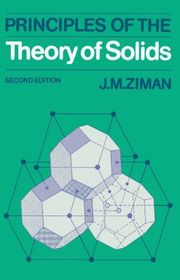
Principles of the Theory of Solids
For readers ready to organize solid-state ideas into a more theoretical framework, Ziman provides a concise synthesis of underlying principles. Its conceptual connections reward prior knowledge, though the mathematical compression and historical coverage make it a demanding introductory choice.
What it's about
J. M. Ziman develops a theoretical account of solids through lattice structure, electron behavior, excitations, and physical properties. The treatment connects models and mathematical principles, giving readers a framework for understanding the behavior of crystalline materials.

The Oxford Solid State Basics
For students beginning solid-state physics after introductory quantum and thermal physics, Simon builds intuition through a focused sequence of models. Its accessible explanations make a useful first pass, though the deliberately limited scope needs expanding for advanced study.
What it's about
Steven Simon develops solid-state physics from heat capacity and electron models toward crystals, diffraction, and band structure. Simple one-dimensional examples build the underlying ideas before applications to semiconductors, magnetism, electron interactions, and the Hubbard model.
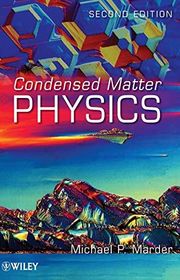
Condensed Matter Physics
For graduate students wanting a wider view than a traditional crystalline-solids text, Marder connects standard solid-state topics with soft condensed matter and other systems. The breadth supports advanced coursework, though its size and mathematical demands require a strong foundation.
What it's about
Michael Marder develops the physics of condensed matter from atomic structure and collective behavior to electronic, mechanical, and thermal properties. The textbook combines solid-state foundations with broader material systems, connecting theoretical models with experimentally observed phenomena.

For undergraduates who want a conventional introduction connecting crystal structure with material properties, Omar offers a coherent alternative to the denser classics. Its explanatory approach supports foundational study, though the older coverage needs supplementing for newer research topics.
What it's about
M. Ali Omar introduces solid-state physics through crystal structure, interatomic forces, and diffraction. The treatment connects microscopic concepts such as electrons, phonons, and energy bands with the electrical, thermal, optical, and magnetic behavior of materials.

The Electronic Structure and Chemistry of Solids
For chemists who want electronic structure connected with bonding and materials behavior, Cox offers a different entry point from the physics textbooks. The disciplinary bridge is useful, though it does not replace a broad course in solid-state physics.
What it's about
P. A. Cox explains electronic structures and solid-state properties in language suited to chemists. The treatment moves into topics including metal-insulator transitions, low-dimensional materials, molecular metals, and surfaces, connecting chemical perspectives with the behavior of solids.
Sources
- 1
David Tong: Solid State Physics, Recommended Books and Resources
damtp.cam.ac.uk
- 2
Recommended literature
uebungen.physik.uni-heidelberg.de
- 3
Solid State Physics Books
goodreads.com
- 4
Physics 152B, Spring 2024: Books
courses.physics.ucsd.edu
- 5
Electrical, Optical, and Magnetic Properties of Materials: Readings
ocw.mit.edu
- 6
Physics for Solid-State Applications: Readings
ocw.mit.edu
- 7
Hi, I need to learn Solid State Physics basics, suggest me a good book
reddit.com
- 8
Physics 617 Bibliography
people.tamu.edu








Edited by
Software engineer whose passion for tracking book recommendations from podcasts inspired the creation of MRB.
Lead investor at 3one4 Capital whose startup expertise and love for books helped shape MRB and its growth.
Comments
Spotted a missing book, a wrong order or a mistake? Tell us and we'll fix this page.
We're a reading guide, not the author or publisher, so we can't send books or pass on messages.