
10 Best Particle Physics Books
The best particle physics books, ranked by how many expert sources recommend each one, with notes for curious beginners and students ready for calculations.
Our take
Particle physics investigates the constituents of matter and the interactions between them. The subject links abstract mathematical models with experiments that test their predictions. These books serve two rather different purposes: helping a curious reader understand the ideas, or teaching a physics student how to calculate. A popular introduction can make the subject clearer, but it does not replace the quantum mechanics and relativity needed for technical study.
For an initial overview, Frank Close’s Particle Physics is concise, while Introducing Particle Physics and Particle Physics Brick by Brick use visual explanations. The Particle at the End of the Universe follows the Higgs discovery and the work of experimental science. Students can begin with Introduction to Elementary Particles or Modern Particle Physics, then move toward the more demanding Quantum Field Theory and the Standard Model. Choose a conceptual book if your goal is orientation; choose a textbook and work its problems if you want to understand the calculations.
10 books · 8 sources · Last updated
As an Amazon Associate, we earn from qualifying purchases (at no extra cost to you).
How to choose from this list
Skip to the full rankingIf you want a concise overview: Particle Physics
If you prefer visual explanations: Introducing Particle Physics → Particle Physics Brick by Brick
If you want the story of the Higgs discovery: The Particle at the End of the Universe
If you are ready for undergraduate calculations: Introduction to Elementary Particles → Modern Particle Physics
If you want to study quantum field theory: Quantum Field Theory and the Standard Model
The 10 books, ranked
Ranked by how many expert sources name each book. Ties go to the book more people recommend.

Introduction to Elementary Particles
For physics undergraduates who want a first quantitative route into particles and their interactions. Its worked examples connect intuition with calculation, though quantum mechanics, relativity and mathematical practice are needed to benefit from the later chapters.
What it's about
David Griffiths introduces elementary particle physics for undergraduate readers, balancing mathematical calculations with intuitive explanations. A historical introduction leads into the theories and models of the field, while problems give students practice applying the quantitative methods used to understand particles.
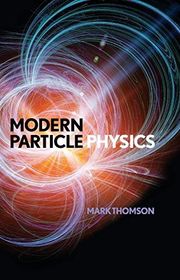
Modern Particle Physics
For physics students who want theory and experiments developed together. Its attention to measurable quantities makes it especially useful for an experimental direction, though the technical level still requires prior quantum mechanics and special relativity.
What it's about
Thomson introduces particle physics through the relationship between theoretical ideas and experimental measurements. The textbook develops the Standard Model, particle interactions and methods of calculation, with examples and problems showing how predictions connect to observable results.

Quantum Field Theory and the Standard Model
For advanced physics students who want to learn field theory and then apply it to the Standard Model. Its detailed progression supports serious study, though the calculations and length demand much more preparation than an undergraduate overview.
What it's about
Beginning with radiation and relativistic fields, Schwartz builds the tools of quantum electrodynamics and renormalization before developing the Standard Model. Advanced discussions extend the framework to effective theories, heavy-quark physics and jets.

For students who want to work carefully through particle interactions with substantial mathematical detail. Its self-contained development rewards calculation, though the older coverage predates major experimental discoveries and needs to be read alongside a later account.
What it's about
Francis Halzen and Alan Martin introduce modern particle physics through elementary particles and their interactions. The self-contained textbook develops the background needed to understand theoretical and experimental advances, beginning with symmetries, quarks and antiparticles.

For readers who want a concise explanation of the particles inside matter and how they were discovered. Its limited length provides a manageable overview, though that same brevity leaves many technical questions for a second book.
What it's about
Frank Close introduces the particles found within atoms, including quarks, electrons, and neutrinos. His account explains how discoveries were made and how their results altered physicists’ understanding of matter and the universe.
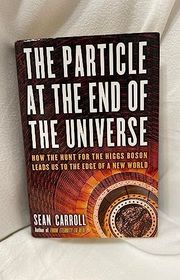
The Particle at the End of the Universe
For readers who want to understand why the Higgs search mattered and how large experiments make discoveries. Its narrative gives the science a human setting, though it offers less systematic coverage than a general particle-physics textbook.
What it's about
Carroll explains the Higgs boson and recounts the search that led to its discovery at the Large Hadron Collider. The account connects the underlying physics with the technology, collaboration and experimental challenges involved in testing ideas about matter.

For visual learners who want a compact orientation before taking on a longer book. Its illustrated format makes the historical development approachable, though the compressed presentation leaves little room for detailed explanations or calculations.
What it's about
Tom Whyntie and illustrator Oliver Pugh explore particle physics in a graphic guide. The history of atomic theory leads toward the Higgs boson, dark matter and speculative ideas, showing how experiments investigate nature's smallest constituents.

Concepts of Elementary Particle Physics
For students ready to connect the Standard Model’s theoretical framework with experimental evidence. Its integrated approach gives calculations a physical purpose, though the field-theory background makes it a substantial step beyond popular introductions.
What it's about
Michael Peskin explains the Standard Model through its theoretical foundations and experimental development. Relativity, quantum field theory and detectors lead into strong and weak interactions, quarks, neutrinos and the Higgs boson, connecting calculations with observations.

For curious readers who want an informal introduction without working through a textbook. The mix of scientific history and conceptual explanation makes the subject inviting, though the simplified treatment cannot provide the precision of mathematical derivations.
What it's about
Tim James introduces quantum and particle physics without relying on complex mathematics. Alongside explanations of quantum phenomena and field theory, he recounts stories of the scientists behind the discoveries and explores how their work led to modern particle physics.

Particle Physics Brick by Brick
Atomic and Subatomic Physics Explained... in LEGO
For readers who understand new ideas most easily through visual models. The brick-based representations make particle relationships memorable, though the analogy has limits and should be treated as a learning aid rather than a literal picture.
What it's about
Ben Still uses colored LEGO bricks to explain atomic and subatomic physics. Visual models introduce particles and their interactions, tracing the building blocks of the universe from the Big Bang to the Higgs boson.
Sources
- 1
Particle Physics Books
goodreads.com
- 2
Particle Physics Books
sites.ualberta.ca
- 3
Part II Particle and Nuclear Physics
hep.phy.cam.ac.uk
- 4
Books for particle physics and the Standard Model
physics.stackexchange.com
- 5
Best literature for self study of basics in particle physics?
reddit.com
- 6
Recommended Books
indico.cern.ch
- 7
What are some good books for someone trying to learn more about particle physics?
reddit.com
- 8
Particle physics made easy: Sources & Further Reading
easyparticles.org






Edited by
Software engineer whose passion for tracking book recommendations from podcasts inspired the creation of MRB.
Lead investor at 3one4 Capital whose startup expertise and love for books helped shape MRB and its growth.
Comments
Spotted a missing book, a wrong order or a mistake? Tell us and we'll fix this page.
We're a reading guide, not the author or publisher, so we can't send books or pass on messages.