
10 Best Mathematical Physics Books
The best mathematical physics books, ranked by expert-source recommendations, with notes on prerequisites, methods courses, references and geometry.
Our take
Mathematical physics ranges from learning the calculations used in undergraduate courses to studying the geometric structures behind advanced theories. The right book depends on your background and purpose. A readable methods course helps build fluency, a large reference helps recover a technique, and a specialist text develops a narrower subject with greater conceptual depth.
Mathematical Methods in the Physical Sciences offers an approachable working foundation, while Mathematical Methods for Physics and Engineering supplies a broader course and reference. Mathematical Methods for Physicists is useful when you already know the basics and need extensive coverage. For graduate study, Mathematics for Physics connects methods with more advanced ideas. Geometry, Topology and Physics and Mathematical Methods of Classical Mechanics move toward geometric thinking, while Advanced General Relativity assumes a specialist direction and substantial preparation.
Begin with Boas or Mathematical Tools for Physics if you are building methods skills, then choose a broader reference or specialist topic as your courses require.
10 books · 8 sources · Last updated
As an Amazon Associate, we earn from qualifying purchases (at no extra cost to you).
How to choose from this list
Skip to the full rankingIf you are building undergraduate methods skills: Mathematical Methods in the Physical Sciences → Mathematical Tools for Physics
If you want a broad course and reference: Mathematical Methods for Physics and Engineering → Mathematical Methods for Physicists
If you are preparing for graduate theory: Mathematics for Physics → Geometry, Topology and Physics
If you want geometric classical mechanics: Mathematical Methods of Classical Mechanics
If you want deeper classical analytical methods: Methods of Mathematical Physics: Vol. 1 → Methods of Theoretical Physics: Part 1 & 2
If you already study relativistic geometry: Geometry, Topology and Physics → Advanced General Relativity
The 10 books, ranked
Ranked by how many expert sources name each book. Ties go to the book more people recommend.

Geometry, Topology and Physics
For physicists ready to connect topology and differential geometry with field theory. Its physical motivation provides a useful bridge beyond calculus-based methods, but the rapid introduction of concepts offers less mathematical rigor than dedicated texts in each subject.
What it's about
Mikio Nakahara introduces differential geometry and topology as tools for theoretical physics. The text connects mathematical techniques with gauge theories, anomalies, and bosonic string theory, showing how geometric ideas help describe and analyze physical systems.
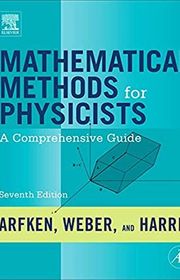
Mathematical Methods for Physicists
For advanced undergraduates and graduate students who need a broad methods reference. Its extensive coverage is convenient when returning to unfamiliar tools, but the compressed explanations make it harder to learn from without a prior course or supporting text.
What it's about
George Arfken, Hans Weber and Frank Harris survey mathematical methods used in physics. The seventh edition covers a wide range of analytical tools, connecting equations, special functions and other methods with worked examples and problems for advanced study.

Mathematical Methods in the Physical Sciences
For undergraduates who want an approachable working foundation for physics courses. Its explanations and practice problems make it easier to learn from than the large references, but advanced topics require more specialized texts and deeper mathematical study.
What it's about
Mary Boas introduces mathematical techniques used in advanced physical science courses. Topics include complex numbers, matrices, vector analysis, Fourier series, differential equations, integral transforms, and probability, with problems designed to develop practical analytical and computational skills.
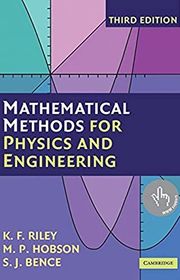
Mathematical Methods for Physics and Engineering
For students who want a broad course text that can remain useful as a reference. Its examples and exercises support sustained study across many methods, but the size makes a planned sequence more effective than reading without specific goals.
What it's about
Riley, Hobson and Bence develop mathematics used across physics and engineering. Their comprehensive course connects explanations, worked examples and exercises across topics including calculus, linear algebra, differential equations and transforms, supporting undergraduate study and later reference needs.

Mathematical Methods of Classical Mechanics
For readers who want classical mechanics developed through geometry and dynamical systems. Its conceptual structure offers more than a collection of calculation techniques, but the concise treatment assumes comfort with proofs, analysis and advanced mechanics.
What it's about
Vladimir Arnold develops classical mechanics through the geometry of manifolds, phase spaces, and dynamical systems. The text treats Newtonian, Lagrangian, and Hamiltonian mechanics, including oscillations, rigid bodies, perturbation methods, averaging, and adiabatic invariance.
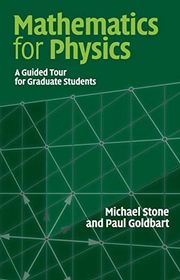
Mathematics for Physics
For graduate students who want mathematical techniques connected with theoretical physics. Its guided exposition and selected examples offer more continuity than an encyclopedic reference, but the pace assumes solid undergraduate mathematics and is demanding for first-time learners.
What it's about
Michael Stone and Paul Goldbart guide graduate students through mathematical ideas used in physics. The book connects analytical methods and more abstract structures with physical examples, helping readers develop the tools and mathematical perspective needed for advanced theoretical work.

Advanced General Relativity
For readers already studying relativity who want spinors and gravitational radiation in greater depth. Its focused mathematical treatment goes well beyond the general methods books, but it assumes substantial background and is unsuitable as an introduction to physics mathematics.
What it's about
John Stewart develops advanced general relativity through differential geometry, two-component spinors, and the Newman-Penrose formalism. He examines gravitational radiation, the behavior of fields far from isolated sources, and characteristic initial value problems, with exercises supporting the mathematical treatment.
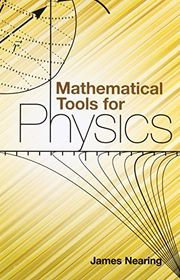
Mathematical Tools for Physics
For undergraduates who want to understand their calculations rather than collect formulas. Its intuitive explanations and practical problems give a focused alternative to the largest references, but more advanced geometric and theoretical topics require other books.
What it's about
James Nearing develops mathematical tools for undergraduate physics through explanation and problem solving. Topics include series, complex algebra, differential equations, Fourier analysis, vector spaces and multivariable calculus, with attention to understanding and checking the meaning of calculations.

For readers who want classical mathematical methods developed as connected ideas. Its treatment of variations, eigenvalues and integral equations offers more depth than a quick reference, but the older notation and demanding exposition require patient study.
What it's about
Richard Courant and David Hilbert connect mathematical methods with physical intuition in the first volume of their mathematical physics text. Topics include linear transformations, function expansions, integral equations, the calculus of variations, and vibration and eigenvalue problems.

For advanced students who want a substantial reference on mathematical treatments of physical fields. Morse and Feshbach develop methods beyond short formula summaries, but the dense two-part work and older presentation make it difficult as a first course.
What it's about
Philip Morse and Herman Feshbach present mathematical methods for analyzing physical fields and their equations. The two-part work covers variational principles, complex functions, differential equations, boundary conditions, eigenfunctions, Green's functions, and integral equations for problems in theoretical physics.
Sources
- 1
Mathematical Physics Book Recommendation
mathoverflow.net
- 2
books and reviews in mathematical physics
ncatlab.org
- 3
Mathematical Physics Books
goodreads.com
- 4
Mathematical Physics book confusion
reddit.com
- 5
Math methods book for grad school in theoretical physics
reddit.com
- 6
Best books for mathematical background?
physics.stackexchange.com
- 7
100 Best Mathematical Physics Books of All Time
shortform.com
- 8
Mathematical methods for physicists
phys.uconn.edu






Edited by
Software engineer whose passion for tracking book recommendations from podcasts inspired the creation of MRB.
Lead investor at 3one4 Capital whose startup expertise and love for books helped shape MRB and its growth.
Comments
Spotted a missing book, a wrong order or a mistake? Tell us and we'll fix this page.
We're a reading guide, not the author or publisher, so we can't send books or pass on messages.