
13 Best Quantum Physics Books
The best quantum physics books, ranked by how many expert sources recommend each one, with notes on concepts, interpretations, math, and where to start.
Our take
Quantum physics describes matter and energy at scales where familiar expectations can fail. Reading about it can mean learning the calculations, understanding why the predictions are surprising, or exploring disagreements about what the theory says is real. These books offer all three routes, alongside biographies and histories that show how the ideas developed.
How to Teach Quantum Physics to Your Dog provides an approachable conceptual start. Beyond Weird examines common explanations more closely, while Something Deeply Hidden and Helgoland argue for different interpretations. Neither perspective should be mistaken for a settled experimental verdict. For readers ready to calculate, Quantum Mechanics: The Theoretical Minimum builds a bridge toward formal study, and Introduction to Quantum Mechanics demands the mathematical work of an undergraduate course. Start with Orzel for a friendly overview, or Feynman’s QED if you want to concentrate on how a specific quantum theory makes predictions.
13 books · 8 sources · Last updated
As an Amazon Associate, we earn from qualifying purchases (at no extra cost to you).
How to choose from this list
Skip to the full rankingIf you're new to quantum physics: How to Teach Quantum Physics to Your Dog → Beyond Weird
If you want light and matter explained conceptually: QED
If you want to compare interpretations: Something Deeply Hidden → Helgoland
If you want to learn the mathematics: Quantum Mechanics → Introduction to Quantum Mechanics
If you prefer scientific biography: The Strangest Man
If you want the history of the debates: What Is Real? → The Ghost in the Atom
The 13 books, ranked
Ranked by how many expert sources name each book. Ties go to the book more people recommend.

For readers who want a sustained argument for the many-worlds interpretation. Its willingness to confront foundational questions gives the ideas direction, though it advocates a particular position rather than neutrally surveying every interpretation.
What it's about
Sean Carroll explains quantum mechanics and argues for the many-worlds interpretation as a way to understand its puzzles. He explores the implications for reality and considers how quantum foundations might illuminate gravity and the emergence of spacetime.
Also recommended by
2 people Joe Rogan recommended this book
Joe Rogan
"Really excellent and really perplexing at the same time." - Joe Rogan
Joe Rogan's recommendation of this book  Ezra Klein recommended this book
Ezra Klein
"Great if you like feeling very confused about the nature of reality, which I guess I do." - Ezra Klein
Ezra Klein's recommendation of this book

For readers who want a physicist to explain an actual predictive framework without advanced equations. Its diagrams and cumulative examples reward concentration, though its focus on light and matter is narrower than a general quantum survey.
What it's about
Richard Feynman introduces quantum electrodynamics, the theory describing how light and matter interact. Using diagrams, visual reasoning, and everyday language, he explains its central ideas for readers without relying on advanced mathematics.
Also recommended by
1 person Larry Page recommended this book
Larry Page
Larry Page mentioned this book in an Entrepreneur.com article.
Larry Page's recommendation of this book

For readers who want the history of disagreements about what quantum theory means. Its attention to neglected approaches broadens the familiar story, though it is an argued historical account rather than a neutral catalog or mathematical course.
What it's about
Adam Becker recounts the disputes over what quantum mechanics says about reality. Following figures such as David Bohm, Hugh Everett, and John Bell, he examines competing interpretations and the professional pressures surrounding attempts to question established scientific views.
Also recommended by
1 person Brian Cox recommended this book
Brian Cox
"Terrific." - Brian Cox
Brian Cox's recommendation of this book

For general readers who want to question the usual slogans about quantum weirdness. Its attention to what explanations actually mean rewards careful thought, though the conceptual discussion can remain demanding without worked mathematical examples.
What it's about
Philip Ball examines what quantum physics implies about reality and why familiar explanations can be misleading. His accessible account explores the theory’s counterintuitive foundations, competing interpretations, and the challenge of connecting quantum principles with the everyday world we experience.

How to Teach Quantum Physics to Your Dog
For newcomers who want quantum ideas explained through playful everyday questions. The conversational format makes an unfamiliar subject approachable, though the humor and analogies do not replace the mathematics needed to solve quantum problems.
What it's about
Chad Orzel introduces quantum physics through imagined conversations with his dog, Emmy. Her questions about chasing animals and finding treats provide humorous starting points for explaining tunneling, teleportation, and other quantum ideas, including the limits of applying them to everyday life.
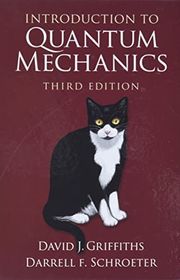
Introduction to Quantum Mechanics
For physics students who want to learn quantum mechanics by solving problems. Its structured undergraduate treatment develops practical calculation skills, though calculus, differential equations, and sustained exercise work are essential prerequisites rather than optional extras.
What it's about
David J. Griffiths and Darrell F. Schroeter introduce quantum mechanics through wave functions, the Schrödinger equation, formal principles, and applications. Worked explanations and exercises develop the mathematical methods used to calculate and interpret the behavior of quantum systems.
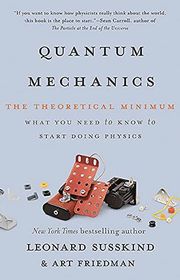
Quantum Mechanics: The Theoretical Minimum
For readers ready to move from popular explanations toward the mathematical structure of quantum mechanics. Its focused progression provides a bridge to formal study, though it requires algebraic effort and does not replace a full problem-based course.
What it's about
Leonard Susskind and Art Friedman develop the mathematical principles of quantum mechanics, including states, observables, measurement, and entanglement. Explanations and exercises introduce the tools needed to follow the theory beyond a purely verbal description of its puzzles.

For readers who want to hear contrasting physicists wrestle with interpretation. Its discussions make disagreement visible without requiring a full textbook, though the older conversations need supplementing for later theoretical and experimental developments.
What it's about
Paul Davies and Julian Brown introduce the puzzles of quantum physics and bring together discussions with leading physicists. Topics include measurement, Bell's theorem, quantum paradoxes, and competing interpretations of what the theory says about reality.
Also recommended by
1 person David Deutsch recommended this book
David Deutsch
David Deutsch recommended this book in his book "The Fabric of Reality."
David Deutsch's recommendation of this book
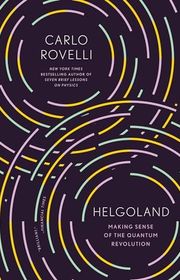
Helgoland: Making Sense of the Quantum Revolution
For readers who want a brief, reflective route into quantum interpretation. Its relational perspective offers a useful contrast to Carroll’s many-worlds argument, though it advances one interpretation and leaves much of the mathematics aside.
What it's about
Carlo Rovelli revisits the emergence of quantum mechanics and explores a relational interpretation of the theory. Historical episodes and philosophical reflections connect questions about observation, physical properties, and relationships with the challenge of understanding what the quantum world describes.

For readers who prefer entering physics through a scientist’s life. The biographical approach gives the theory a human setting, though it offers less direct instruction than a book organized around quantum concepts.
What it's about
Graham Farmelo traces physicist Paul Dirac's life alongside the development of quantum mechanics. Drawing on archival material, he examines Dirac's scientific achievements, reserved personality, relationships, and family life, connecting an unusual individual with a transformative period in physics.
Also recommended by
2 people Eric Weinstein recommended this book
Eric Weinstein
Eric Weinstein tweet about books that mattered enough to him.
Eric Weinstein's recommendation of this book  Jeff Dean recommended this book
Jeff Dean
"I too enjoyed [this book]." - Jeff Dean
Jeff Dean's recommendation of this book

Quantum Physics For Dummies
For students who want equations and worked problems alongside explanations. Its course-support format is more practical than a purely conceptual introduction, though the friendly title still assumes willingness to work with substantial mathematics.
What it's about
Steven Holzner introduces quantum physics through explanations, equations, and worked examples intended to accompany coursework. Topics include the Schrödinger equation, vector notation, spin, angular momentum, and scattering, connecting conceptual foundations with techniques for solving standard problems.

For readers interested in a historical popular account of the competing pictures behind quantum predictions. Its interpretive range invites comparison, though the older framework needs updating with more recent developments in the field.
What it's about
Nick Herbert introduces quantum physics for general readers while exploring the scientific and philosophical disputes about its meaning. His account connects the theory’s unfamiliar picture of the world with questions about metaphysics, interpretation, and the nature of reality.

For readers who want modern physics placed within a larger history of scientific work. Its interviews and narrative offer context beyond quantum foundations, though its wider particle-physics scope makes it less direct as a first quantum introduction.
What it's about
Robert Crease and Charles Mann trace twentieth-century physics through the scientists seeking a unified account of matter. Extensive interviews combine explanations of waves, particles, fields, and fundamental forces with personal stories behind the development of modern physical theory.
Sources
- 1
From Universe to Multiverse: 10 Best Books on Quantum Mechanics
interestingengineering.com
- 2
20 Best Quantum Physics Books
bestbookshub.com
- 3
Quantum Physics Books
goodreads.com
- 4
Reading List for Physics & Mathematics Majors
people.uncw.edu
- 5
David Kaiser's top 10 books about quantum theory
theguardian.com
- 6
Books on Quantum Mechanics
reddit.com
- 7
Quantum Mechanics: Recommended Books and Resources
damtp.cam.ac.uk
- 8
The Best Books on Quantum Theory
fivebooks.com











Edited by
Software engineer whose passion for tracking book recommendations from podcasts inspired the creation of MRB.
Lead investor at 3one4 Capital whose startup expertise and love for books helped shape MRB and its growth.
Comments
Spotted a missing book, a wrong order or a mistake? Tell us and we'll fix this page.
We're a reading guide, not the author or publisher, so we can't send books or pass on messages.