
7 Best Small Business Books
The best small business books, ranked by how many expert sources recommend each one, with notes on who each suits, from new owners to established operators.
Our take
Running a small business combines jobs that rarely fit neatly into one role: finding customers, organizing work, managing money, and deciding what the business should become. These books help owners think about different parts of that challenge. Some focus directly on operating a small company, while others offer broader lessons about personal effectiveness or organizations that last.
The E-Myth Revisited examines the difference between doing skilled work and building a business around it. Mind Your Business offers planning exercises for creative owners, and Profit First presents a particular approach to cash allocation. Company of One questions whether expansion should always be the goal, while Built to Sell considers how a business can become less dependent on its owner. The 7 Habits of Highly Effective People concerns personal effectiveness; Built to Last draws on larger companies. Start with Gerber for operating systems, or Griffo if you want to work through an early business plan.
7 books · 7 sources · Last updated
As an Amazon Associate, we earn from qualifying purchases (at no extra cost to you).
How to choose from this list
Skip to the full rankingIf you're planning a creative business: Mind Your Business → The E-Myth Revisited
If your business depends too heavily on you: The E-Myth Revisited → Built to Sell
If you want to examine cash allocation: Profit First
If you want to stay deliberately small: Company of One
If you want broader leadership perspectives: The 7 Habits of Highly Effective People → Built to Last
The 7 books, ranked
Ranked by how many expert sources name each book. Ties go to the book more people recommend.

The E-Myth Revisited
Why Most Small Businesses Don't Work and What to Do About It
For owners who feel trapped doing every task themselves, Gerber offers a useful way to think about systems and roles. The franchise-inspired model makes processes concrete, though highly bespoke work may need a more flexible interpretation.
What it's about
Michael Gerber argues that technical expertise does not automatically equip someone to run a small business. He distinguishes entrepreneurial, managerial, and technical responsibilities, outlining a systems-based approach designed to reduce a company’s dependence on its owner.
Also recommended by
7 people Tim Ferriss recommended this book
Tim Ferriss
"If you’re stuck in your own business, this book can help you get unstuck." - Tim Ferriss
Tim Ferriss's recommendation of this book  Dave Ramsey recommended this book
Dave Ramsey
Recommended on Dave Ramsey's website.
Dave Ramsey's recommendation of this book  Derek Sivers recommended this book
Derek Sivers
"Absolutely everyone who is an entrepreneur or wants to be one needs to read this book." - Derek Sivers
Derek Sivers's recommendation of this book  Dave Camarillo recommended this book
Dave Camarillo
"Was huge." - Dave Camarillo
Dave Camarillo's recommendation of this book  Tom Bilyeu recommended this book
Tom Bilyeu
Tom Bilyeu recommended this book on his website.
Tom Bilyeu's recommendation of this book  Michael Hyatt recommended this book
Michael Hyatt
Michael Hyatt recommended this book on his website.
Michael Hyatt's recommendation of this book +1
More recommendations
- Patrick Bet-David
Patrick Bet-David recommended this book on his website.
- Patrick Bet-David

Profit First
Transform Your Business from a Cash-Eating Monster to a Money-Making Machine
For owners who struggle to connect sales with available cash, Michalowicz offers a concrete allocation routine. The behavioral focus is distinctive, though its account structure needs adaptation to the business’s obligations and does not replace reliable bookkeeping.
What it's about
Mike Michalowicz presents a cash management system that assigns money to profit before operating expenses. He explains using separate accounts and allocation routines to shape spending habits, combining implementation steps with examples from small business finances.

For owners thinking about enduring values and long-term organizational habits, Collins and Jerry I. Porras offer a comparative historical perspective. The large-company examples require translation, and their retrospective patterns should not be treated as a formula for success.
What it's about
Jim Collins and Jerry Porras compare eighteen enduring companies with leading competitors, tracing their development from early beginnings. Their research identifies recurring organizational practices and offers managers and entrepreneurs a framework for building institutions that last.
Also recommended by
5 people Jeff Bezos recommended this book
Jeff Bezos
"My favorite business book." - Jeff Bezos
Jeff Bezos's recommendation of this book  Ev Williams recommended this book
Ev Williams
On the "books read" section of Ev Williams' GoodReads profile.
Ev Williams's recommendation of this book  Bill Gurley recommended this book
Bill Gurley
"[Suggests] that the very best companies set an audacious, very long-term goal that shines a light towards 'an envisioned future.'" - Bill Gurley
Bill Gurley's recommendation of this book  Jamie Dimon recommended this book
Jamie Dimon
On Jamie Dimon's list of favorite books.
Jamie Dimon's recommendation of this book  Patrick Bet-David recommended this book
Patrick Bet-David
Patrick Bet-David recommended this book on his website.
Patrick Bet-David's recommendation of this book

For owners who want a business that can operate without their constant involvement, Warrillow turns systems thinking toward transferability. The story format makes the ideas approachable, though its service-business example simplifies the complications of an actual sale.
What it's about
Through the story of an advertising agency owner seeking to sell his company, John Warrillow explains how to reduce a business’s dependence on its founder. He emphasizes teachable services, distinctive value, and repeatable revenue as foundations for a transferable company.
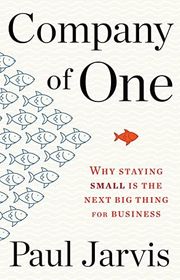
Company of One: Why Staying Small Is the Next Big Thing for Business
For owners who want more control over their work without automatically adding staff or scale, Jarvis makes deliberate smallness a serious option. Its emphasis on autonomy is useful, though businesses with heavy staffing or capital needs face different constraints.
What it's about
Paul Jarvis challenges the assumption that a successful business must continually grow. Drawing on examples and his own experience, he explores defining enough, serving customers, and building a sustainable working life through a business that stays small.

For owners who want to examine priorities, responsibility, and working relationships, Covey provides a broad personal framework. Its reach beyond business is useful, but it offers less direct help with pricing, bookkeeping, or daily operations.
What it's about
Stephen Covey presents seven habits for personal effectiveness, connecting individual responsibility with cooperation and continual renewal. His framework emphasizes principles such as integrity, fairness, and service in approaching relationships, decisions, and goals at work and home.
Also recommended by
12 people- Dave Ramsey recommended this book
Dave Ramsey
Recommended on Dave Ramsey's website.
Dave Ramsey's recommendation of this book  Daniel Pink recommended this book
Daniel Pink
Daniel Pink mentioned this book on "The Tim Ferriss Show" podcast.
Daniel Pink's recommendation of this book  Ken Block recommended this book
Ken Block
"[Also] helped me really be successful." - Ken Block
Ken Block's recommendation of this book  Dustin Moskovitz recommended this book
Dustin Moskovitz
"[I] was surprised at how familiar the topics felt." - Dustin Moskovitz
Dustin Moskovitz's recommendation of this book  Noah Kagan recommended this book
Noah Kagan
"Begin with the end in mind." - Noah Kagan
Noah Kagan's recommendation of this book  Kishore Biyani recommended this book
Kishore Biyani
"Immensely helpful and influential during my early years, it explained some of the basic mindsets required to succeed in any profession." - Kishore Biyani
Kishore Biyani's recommendation of this book +6
More recommendations
- Michael McCullough
"Helps you decide which action to actually take." - Michael McCullough
- Shay Carl
Shay Carl referenced this book on "The Tim Ferriss Show" podcast.
- Jenn Im
"Has changed my life in such a positive way." - Jenn Im
- Jim Kwik
"This personal development classic is a classic for a reason." - Jim Kwik
- Michael Hyatt
Michael Hyatt recommended this book on his website.
- Ben Greenfield
Most Recommended Books reached out to Ben Greenfield directly.
- Michael McCullough

For creative freelancers and aspiring studio owners who learn by writing things down, Griffo supplies a workbook rather than another management argument. Its planning exercises provide structure, though a creative-business perspective will not fit every industry equally well.
What it's about
Ilana Griffo provides a workbook for turning a creative pursuit into a business, drawing on her experience building a design studio. Planning exercises cover customers, branding, products, budgets, legal considerations, online marketing, and long-term growth.
Sources
- 1
The 21 Best Business Books for Entrepreneurs (2026)
scienceofpeople.com
- 2
16 books every small business owner should read
zapier.com
- 3
Best Books on Small Business Finance
danielsonservices.com
- 4
8 Best Small Business Books for Entrepreneurs Who Care to Succeed
candybar.co
- 5
Small Business Books
goodreads.com
- 6
The 15 best books for small business owners, ranked by reader data
entrepedia.co
- 7
What books should a first-time entrepreneur read before starting a business?
reddit.com


Edited by
Software engineer whose passion for tracking book recommendations from podcasts inspired the creation of MRB.
Lead investor at 3one4 Capital whose startup expertise and love for books helped shape MRB and its growth.
Comments
Spotted a missing book, a wrong order or a mistake? Tell us and we'll fix this page.
We're a reading guide, not the author or publisher, so we can't send books or pass on messages.