
21 Best Business Plan Books
The best business plan books, ranked by how many expert sources recommend each one, with notes for founders choosing a workbook, financial guide, or pitch format.
Our take
A business plan can be a working tool for the owner, a shared account of how a team intends to operate, or a document for someone considering funding. Those purposes overlap, but they do not require the same level of detail. The books here range from short frameworks and visual canvases to manuals with financial sections and complete sample plans.
The One Page Business Plan for the Creative Entrepreneur helps clarify direction, while Successful Business Plan and How to Write a Business Plan give a fuller document more structure. Business Model Generation is useful for examining how the pieces of a business fit together before writing at length. For presentation, Hit the Deck concentrates on a different format. The Plan-As-You-Go Business Plan emphasizes keeping planning connected with ongoing management. Start by identifying who will use your plan and what decision it needs to support, then choose the format and depth that purpose requires.
21 books · 14 sources · Last updated
As an Amazon Associate, we earn from qualifying purchases (at no extra cost to you).
How to choose from this list
Skip to the full rankingIf you need to clarify direction: The One Page Business Plan for the Creative Entrepreneur
If you want a complete written plan: Successful Business Plan → How to Write a Business Plan
If you need to examine the business model: Business Model Generation
If you are preparing a pitch: Hit the Deck
If you want an ongoing management tool: The Plan-As-You-Go Business Plan
If you are planning a creative practice: Mind Your Business
The 21 books, ranked
Ranked by how many expert sources name each book. Ties go to the book more people recommend.

For founders who want a substantial guide to developing and presenting a complete plan. Its worksheets connect research with strategy and financial sections, though the amount of material can be more than a simple internal plan needs.
What it's about
Rhonda Abrams guides entrepreneurs through researching, writing, and presenting a business plan. Worksheets, sample material, and practical advice connect business strategy with financial planning and the process of explaining a venture to investors or lenders.

The Secrets to Writing a Successful Business Plan
A Pro Shares A Step-by-Step Guide to Creating a Plan That Gets Results
For beginners who want each part of a business plan explained in sequence. Its mentoring perspective helps make the document’s purpose concrete, though general examples still need to be adapted to the venture and its intended audience.
What it's about
Hal Shelton guides entrepreneurs through writing each section of a business plan, with worksheets and examples from his mentoring and investing experience. He also discusses presenting plans to lenders and investors and adapting the process for nonprofit organizations.

Anatomy of a Business Plan
The Step-by-Step Guide to Building a Business and Securing Your Company's Future
For readers who want a document-centered guide with forms and examples. Its attention to marketing and financial support makes it useful for assembling a formal plan, though it requires more detail than a brief internal planning tool.
What it's about
Linda Pinson guides readers through the components of a business plan, from an executive summary and company description to marketing and financial documents. Sample plans, forms, and worksheets support the process of developing, presenting, and updating a plan.

The Lean Startup
How Today's Entrepreneurs Use Continuous Innovation to Create Radically Successful Businesses
For founders whose main uncertainty is whether their assumptions are sound. Its experimental approach can strengthen the thinking behind a plan, though it does not supply the detailed document structure or financial worksheets found in dedicated planning manuals.
What it's about
Eric Ries proposes developing businesses through repeated experiments, customer feedback, and validated learning. The book explains how entrepreneurs can test assumptions, measure progress, and adjust products and strategy under uncertainty rather than rely entirely on detailed initial plans.
Also recommended by
15 people Andrew Ng recommended this book
Andrew Ng
"Gives one specific tactic for innovating quickly." - Andrew Ng
Andrew Ng's recommendation of this book  Ben Horowitz recommended this book
Ben Horowitz
"Great." - Ben Horowitz
Ben Horowitz's recommendation of this book  Dustin Moskovitz recommended this book
Dustin Moskovitz
"At Asana, we've been lucky to benefit from [the author]'s advice firsthand; this book will enable him to help many more entrepreneurs answer the tough questions about their business." - Dustin Moskovitz
Dustin Moskovitz's recommendation of this book  Jason Calacanis recommended this book
Jason Calacanis
"You need to read [this book]." - Jason Calacanis
Jason Calacanis's recommendation of this book  Kevin Systrom recommended this book
Kevin Systrom
"The principles from [this book], I still apply today." - Kevin Systrom
Kevin Systrom's recommendation of this book  Marc Andreessen recommended this book
Marc Andreessen
"[The author] has created a science where previously there was only art. A must read for every serious entrepreneur—and every manager interested in innovation." - Marc Andreessen
Marc Andreessen's recommendation of this book +9
More recommendations
- Mark Cuban
One of the 7 books Mark Cuban credits his success to.
- Mike Maples, Jr.
"[I was] lucky enough to have a front-row seat at the birth of these ideas." - Mike Maples, Jr.
- Tim O’Reilly
"[This book] isn't just about how to create a more successful entrepreneurial business, it's about what we can learn from those businesses to improve virtually everything we do." - Tim O’Reilly
- Chris Dixon
Chris Dixon recommended this book on Twitter.
- Raoul Pal
Raoul Pal recommended this book on Twitter.
- Sheryl Sandberg
"Provides a great inside look at how the tech industry approaches building products and businesses." - Sheryl Sandberg
- Steve Blank
"A 'must have' for your shelf." - Steve Blank
- Marty Cagan
"Buy it." - Marty Cagan
- Patrick Bet-David
Patrick Bet-David recommended this book on his website.
- Mark Cuban

The One Page Business Plan for the Creative Entrepreneur
The Fastest, Easiest Way to Write a Business Plan
For creative entrepreneurs who need to clarify direction before assembling a long document. Its concise framework makes objectives and actions visible, though one page cannot hold all the financial evidence and detail a funder may require.
What it's about
Jim Horan presents a workbook for distilling a business plan onto a single page. Exercises and examples help entrepreneurs define their vision, mission, objectives, strategies, and action plans, using concise statements to connect business ambitions with practical steps.

Business Model Generation
A Handbook for Visionaries, Game Changers, and Challengers
For teams who want to see the relationships among customers, value, activities, and revenue. Its visual canvas supports discussion and redesign, though it describes a business model rather than providing a finished financing document or detailed forecasts.
What it's about
Alexander Osterwalder and Yves Pigneur introduce the Business Model Canvas for describing and designing businesses. This visual handbook combines model patterns, customer insights, prototyping, strategy, and a design process to help organizations rethink how they create and capture value.

The Complete Book of Business Plans
Simple Steps to Writing Powerful Business Plans
For readers who learn best by comparing complete examples. Its sample plans make the finished document easier to picture, though borrowing their structure without questioning the underlying assumptions can produce a polished but unconvincing plan.
What it's about
Joseph Covello and Brian Hazelgren explain how to assemble a business plan for a new or expanding company. Sample plans illustrate the process, while guidance on organization, financial planning, and presentation helps entrepreneurs prepare a document for potential funders.

The E-Myth Revisited
Why Most Small Businesses Don't Work and What to Do About It
For owners who want planning to address how the business will operate beyond their own daily effort. Its systems perspective clarifies roles and repeatable work, though the prescriptive framework needs adapting to different businesses and stages of growth.
What it's about
Michael Gerber argues that technical expertise does not automatically equip someone to run a small business. He distinguishes entrepreneurial, managerial, and technical responsibilities, outlining a systems-based approach designed to reduce a company’s dependence on its owner.
Also recommended by
7 people Tim Ferriss recommended this book
Tim Ferriss
"If you’re stuck in your own business, this book can help you get unstuck." - Tim Ferriss
Tim Ferriss's recommendation of this book  Dave Ramsey recommended this book
Dave Ramsey
Recommended on Dave Ramsey's website.
Dave Ramsey's recommendation of this book  Derek Sivers recommended this book
Derek Sivers
"Absolutely everyone who is an entrepreneur or wants to be one needs to read this book." - Derek Sivers
Derek Sivers's recommendation of this book  Dave Camarillo recommended this book
Dave Camarillo
"Was huge." - Dave Camarillo
Dave Camarillo's recommendation of this book  Tom Bilyeu recommended this book
Tom Bilyeu
Tom Bilyeu recommended this book on his website.
Tom Bilyeu's recommendation of this book  Michael Hyatt recommended this book
Michael Hyatt
Michael Hyatt recommended this book on his website.
Michael Hyatt's recommendation of this book +1
More recommendations
- Patrick Bet-David
Patrick Bet-David recommended this book on his website.
- Patrick Bet-David

The Art of the Start 2.0
The Time-Tested, Battle-Hardened Guide for Anyone Starting Anything
For readers who need to place planning within the wider work of launching a venture. Its practical range connects pitching, people, and positioning, though it is a startup guide rather than a detailed business-plan writing manual.
What it's about
Guy Kawasaki revises his guide to launching ventures with expanded discussion of social media, crowdfunding, and cloud computing. Advice on innovation, recruitment, financing, and branding helps entrepreneurs and organizational leaders turn ideas into products, services, and workable businesses.
Also recommended by
1 person Matt Mullenweg recommended this book
Matt Mullenweg
Matt Mullenweg recommended this book in the "Tools of Titans" book.
Matt Mullenweg's recommendation of this book

How to Write a Business Plan
For readers who want financial projections connected with the practical work of writing a plan. Its forms give estimates a clear structure, though the figures still depend on research and assumptions the book cannot supply for you.
What it's about
Mike McKeever guides readers through preparing a business plan with financial projections, marketing strategies, and staffing considerations. Instructions and forms cover testing an idea's viability, forecasting cash flow and profits, finding financing, and presenting the plan to potential backers.

For readers who want a practical explanation of how planning text and financial tables fit together. Its stepwise approach makes the document less abstract, though older software references and examples need to be separated from the enduring planning principles.
What it's about
Tim Berry explains how to build a business plan through manageable steps, combining text, tables, and charts. Practical examples cover market analysis, sales forecasts, expenses, profit and loss, cash flow, balance sheets, and implementation.

The Founder's Dilemmas
Anticipating and Avoiding the Pitfalls That Can Sink a Startup
For founders who need to plan relationships, ownership, and control before those choices become difficult to change. Its research-based perspective addresses decisions many templates miss, though it focuses on founder dilemmas rather than producing a complete business-plan document.
What it's about
Noam Wasserman examines the choices entrepreneurs face when building startup teams, drawing on years of research. He explores cofounder relationships, equity splits, hiring, investors, and leadership changes, showing how decisions about control and financial rewards can pull founders in different directions.

For creative freelancers who want to work through planning decisions on the page. Its workbook format connects branding, customers, and budgets with a creative practice, though it is less directly suited to complex financing proposals or larger operating businesses.
What it's about
Ilana Griffo provides a workbook for turning a creative pursuit into a business, drawing on her experience building a design studio. Planning exercises cover customers, branding, products, budgets, legal considerations, online marketing, and long-term growth.
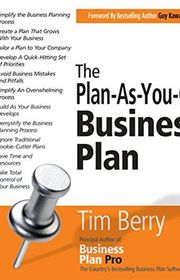
The Plan-As-You-Go Business Plan
For owners who want planning to remain useful after the document is written. Its flexible, regularly reviewed approach connects plans with management, though readers needing a formal financing submission must still assemble the required supporting detail.
What it's about
Tim Berry presents business planning as an ongoing process rather than a one-time document. The guide connects strategy, assumptions, milestones, and financial information with regular review, allowing owners to adapt the plan as their business develops.

For readers who want to question familiar assumptions about how businesses begin. Its emphasis on experience and practical development provides a useful counterpoint to templates, though it is not a substitute when a lender explicitly requires a plan.
What it's about
Carl Schramm challenges common stories about entrepreneurship, drawing on research and accounts of business founders. He examines how companies start and grow, emphasizing work experience, identifying unmet needs, and practical lessons beyond formal business planning.

Creating a Business Plan For Dummies
For beginners who want planning concepts and basic calculations introduced together. Its approachable structure helps connect an idea with budgets and forecasts, though the broad coverage provides less specialist depth than a financial-modeling or industry-specific reference.
What it's about
Veechi Curtis guides readers through evaluating a business idea, identifying competitive advantages, and preparing a plan. The book covers startup budgets, sales forecasts, expenses, cash flow, break-even calculations, risk scenarios, and presenting an elevator pitch.

For founders preparing a concise presentation for potential backers. Its pitch-deck emphasis encourages a clear argument, though slides cannot carry all the evidence, financial schedules, and operating detail expected in a full written plan.
What it's about
David Ronick explains how to develop a business idea and present it in a concise pitch deck. Step-by-step guidance and interviews with investors and entrepreneurs address planning, pitching, and revising proposals in response to feedback.

Starting a Business QuickStart Guide
For first-time owners who need the wider launch process explained before writing a plan. Its introductory scope helps connect customers, value, and operations, though readers needing a finished funding document will want a more specialized planning guide.
What it's about
Ken Colwell introduces the fundamentals of launching a small business, drawing on experience with entrepreneurs and new ventures. The guide follows the process from developing an initial concept to identifying customers, delivering value, and establishing a profitable operation.

The 1-Page Marketing Plan
Get New Customers, Make More Money, And Stand out From The Crowd
For owners whose weakest planning section is attracting and retaining customers. Its compact framework gives marketing decisions a clear sequence, though it covers one part of a business plan rather than its full operational and financial structure.
What it's about
Allan Dib presents a marketing framework organized into nine sections on a single page. The guide explains attracting new customers, generating more business from existing ones, differentiating an offer, setting prices, and applying direct response marketing within limited budgets.

Writing a Convincing Business Plan
For readers preparing a formal proposal for investors or financial institutions. Its attention to organization and supporting forecasts helps explain the case for funding, though the general framework must be adapted to the specific requirements of the intended recipient.
What it's about
Arthur DeThomas and his coauthors explain how to organize a business plan for investors and financial institutions. The guide covers business goals, market analysis, sales forecasts, operating and marketing plans, expenses, and the supporting material needed for a financing proposal.

Writing Winning Business Plans
How to Prepare a Business Plan that Investors Will Want to Read and Invest In
For founders who want to explain a venture from a potential investor’s perspective. Its attention to financials, competition, and presentation links the document with the funding conversation, though a persuasive plan cannot guarantee that an investor will commit.
What it's about
Garrett Sutton explains how to turn a business vision into a plan that potential investors can evaluate. Illustrative stories accompany discussions of financial information, competition, funding, elevator pitches, and using the finished plan to guide a new or existing venture.
Sources
- 1
20 Best Books on The Business Plan
biggerinvesting.com
- 2
20 Best Books on How to Write a Business Plan
profitableventure.com
- 3
Business Plan Books
goodreads.com
- 4
What is the best book to read about the making of a Business Plan?
reddit.com
- 5
7 Best Business Plan Books
mymoneybooks.com
- 6
The 5 Best Business Plan Books & Why You Shouldn’t Read Them
growthink.com
- 7
The 8 Best Business Plan Books in 2022
morebusiness.com
- 8
20 of the Best Business Books
seacoastbank.com
- 9
100 Best Business Planning Books of All Time (Updated for 2026)
shortform.com
- 10
7 Best Business Plan Books for Every Entrepreneurs Should Read
upmetrics.co
- 11
Business Planning - Entrepreneur's Reference Guide to Small Business Information - Research Guides at Library of Congress
guides.loc.gov
- 12
Business Planning Books
goodreads.com
- 13
Which book to read build structure in business? : r/Businessowners
reddit.com
- 14
Business Planning Books by Palo Alto Software
paloalto.com




Edited by
Software engineer whose passion for tracking book recommendations from podcasts inspired the creation of MRB.
Lead investor at 3one4 Capital whose startup expertise and love for books helped shape MRB and its growth.
Comments
Spotted a missing book, a wrong order or a mistake? Tell us and we'll fix this page.
We're a reading guide, not the author or publisher, so we can't send books or pass on messages.