
12 Best Ruby on Rails Books
The best Ruby on Rails books, ranked by expert-source recommendations, with notes for beginners, Ruby learners, and developers maintaining applications.
Our take
Ruby on Rails books can help with several different problems: building your first web application, understanding the Ruby behind framework conventions, or making an established codebase easier to change. Choosing for your current task matters because a language guide and an application tutorial ask you to practice quite different skills.
Ruby on Rails Tutorial and Agile Web Development with Rails 6 connect concepts through working applications. The Well-Grounded Rubyist and Eloquent Ruby spend more time on the language itself. Once you can build features, Practical Object-Oriented Design and Refactoring help you examine the structure of the code you already have. Several linked editions cover older Ruby or Rails releases, so check the version before treating their setup commands as instructions for a new project. Start with a guided application tutorial if web development is new, or with Metz if changing an existing application is your main concern.
12 books · 9 sources · Last updated
As an Amazon Associate, we earn from qualifying purchases (at no extra cost to you).
How to choose from this list
Skip to the full rankingIf you want a guided web project: Ruby on Rails Tutorial
If you need stronger Ruby foundations: The Well-Grounded Rubyist → Eloquent Ruby
If your code is hard to change: Practical Object-Oriented Design → Refactoring
If your methods need clearer structure: Confident Ruby
If you want to understand Ruby internals: Ruby Under a Microscope
The 12 books, ranked
Ranked by how many expert sources name each book. Ties go to the book more people recommend.

For developers whose Rails models are becoming difficult to change, Metz explains responsibilities, dependencies, and interfaces through focused Ruby examples. It offers stronger design reasoning than framework tutorials, but assumes you can already read Ruby.
What it's about
Sandi Metz uses Ruby examples to explain object-oriented design that accommodates change. Discussion of responsibilities, dependencies, interfaces, inheritance, composition, and testing helps programmers consider how design decisions affect the cost of maintaining and extending an application over time.

The Well-Grounded Rubyist
For learners who want to understand the Ruby beneath Rails conventions, this offers a deeper language foundation than application tutorials. Exercises support careful study, though its Ruby 2.5 coverage requires supplementing for later language changes.
What it's about
David A. Black and Joseph Leo III develop Ruby programming from first examples into reflection, threading, and recursion. This edition covers Ruby 2.5 and includes exercises alongside discussion of functional programming ideas, helping readers deepen their understanding of the language.

Eloquent Ruby
For programmers who can write Ruby but still think in another language, Olsen develops a feel for Ruby idioms and conventions. It complements Rails tutorials well, though language fluency takes priority over framework features.
What it's about
Russ Olsen explains the conventions and thinking behind expressive Ruby code. Starting with individual statements and methods, he progresses toward classes, metaprogramming, and project-level features, showing how language fluency can influence the way programmers organize and solve problems.
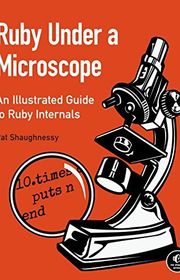
Ruby Under a Microscope: An Illustrated Guide to Ruby Internals
For curious Ruby developers, experiments and diagrams explain what happens beneath familiar language constructs. It goes deeper into implementation than the other language guides here, though its Ruby 1.8, 1.9, and 2.x coverage is historical.
What it's about
Pat Shaughnessy investigates Ruby internals through diagrams and experiments, covering parsing, execution, object representation, and garbage collection. The book also considers JRuby and Rubinius, connecting everyday Ruby code with the machinery that runs it.
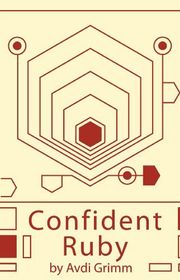
Confident Ruby: 32 Patterns for Joyful Coding
For Ruby developers whose methods drown in conditionals and nil checks, Grimm offers small patterns for making intent clearer. Its method-level focus provides manageable refactoring practice, though it covers less of application architecture than Metz.
What it's about
Avdi Grimm presents 32 patterns for structuring Ruby methods and handling uncertainty at the boundaries of code. Refactoring examples show ways to reduce repetitive conditionals and nil checks while giving each method a coherent purpose.

For beginners who learn by building, Hartl connects web fundamentals with increasingly substantial applications and testing. The detailed progression rewards steady practice, though this sixth edition teaches Rails 6 and needs version adjustments for newer projects.
What it's about
Michael Hartl teaches web development through three increasingly complex example applications. This sixth edition covers Rails 6 alongside Ruby, HTML, CSS, and SQL, explaining the techniques needed to build working websites through practical coding exercises.
Also recommended by
2 people David Heinemeier Hansson recommended this book
David Heinemeier Hansson
"Much celebrated." - DHH
David Heinemeier Hansson's recommendation of this book  Derek Sivers recommended this book
Derek Sivers
"Though I’ve worked my way through many Rails books, this is the one that finally made me 'get' it." - Derek Sivers
Derek Sivers's recommendation of this book
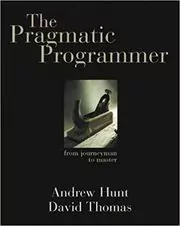
For Rails developers seeking better habits across their work, this broadens the discussion to requirements, communication, and maintainable software. Its advice travels across technologies, but it supplies little direct help with Rails APIs or configuration.
What it's about
Andrew Hunt and David Thomas present practical guidance on programming as a craft. They explore making informed choices, understanding requirements, communicating clearly, and producing software that others can maintain and build upon across different technologies.
Also recommended by
2 people Ev Williams recommended this book
Ev Williams
On the "books read" section of Ev Williams' GoodReads profile.
Ev Williams's recommendation of this book  Jeff Atwood recommended this book
Jeff Atwood
"Instead of worrying about code, the authors boiled down all the practical approaches that they've found to work in the real world into this one book." - Jeff Atwood
Jeff Atwood's recommendation of this book
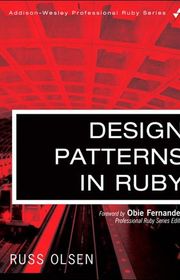
Design Patterns in Ruby
For developers familiar with object-oriented basics, Olsen shows how classic patterns change in a dynamic language. The Ruby-specific implementations make a useful bridge from Java or C++, though patterns still require judgment rather than automatic application.
What it's about
Russ Olsen revisits classic design patterns using Ruby's dynamic typing, closures, and mixins. He explains the problems patterns address, explores simpler Ruby implementations, and discusses additional patterns arising from Ruby practice, including convention over configuration.
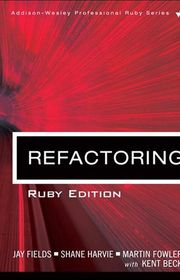
Refactoring: Ruby Edition
For Ruby developers changing working code, this supplies a broader refactoring vocabulary than a Rails-specific pitfalls guide. Stepwise transformations support careful maintenance, though the catalog format and older examples suit selective study more than beginner instruction.
What it's about
Jay Fields, Shane Harvie, Martin Fowler, and Kent Beck adapt refactoring techniques to Ruby examples and idioms. The book explains how to recognize design problems and improve existing code through small transformations that preserve its behavior.

Agile Web Development with Rails 6
For learners who want a sustained application project with reference material alongside it, this connects Rails features to incremental development. Its Rails 6 and Ruby 2.6 examples require care when following along with later versions.
What it's about
Sam Ruby, David B. Copeland, and Dave Thomas teach Rails 6 and Ruby 2.6 through tutorial and reference material. The guide explains application development step by step, including the framework's tools for processing incoming email and managing rich text.

For newcomers who prefer one concrete web project, the social news application gives Rails concepts a visible purpose. Its accessible progression includes Ruby basics, though the Rails 5 examples make it a version-specific learning route.
What it's about
Glenn Goodrich and Patrick Lenz introduce Rails 5 by building a social news application. Beginning with installation and Ruby fundamentals, the tutorial progresses through authentication, testing, debugging, and deployment, connecting framework concepts with features in a working web project.

For developers reviewing an existing Rails codebase, these problem-and-refactoring chapters make maintenance mistakes easier to recognize. The modular format suits targeted reading, though Rails 3 examples need interpretation before applying the advice to newer applications.
What it's about
Chad Pytel and Tammer Saleh identify common Rails 3 coding and design mistakes, explain their consequences, and provide refactoring examples. Modular chapters address problems affecting maintainability and performance, connecting alternative solutions with object-oriented principles and Rails development practices.
Sources
- 1
11 Books Every Ruby on Rails Developer Should Read
netguru.com
- 2
15 Best Books To Learn Ruby on Rails From Scratch
whatpixel.com
- 3
Best ruby programming books
goodreads.com
- 4
How to be a better Rails developer?
reddit.com
- 5
Which Ruby/Rails books do you recommend for an intermediate profile?
reddit.com
- 6
Ruby Bookmarks
github.com
- 7
Ruby Book List
rubylearning.dev
- 8
RubyOnRails.World
rubyonrails.world
- 9
Learn Ruby on Rails – Resources and Reading List
emarketjournal.com


Edited by
Software engineer whose passion for tracking book recommendations from podcasts inspired the creation of MRB.
Lead investor at 3one4 Capital whose startup expertise and love for books helped shape MRB and its growth.
Comments
Spotted a missing book, a wrong order or a mistake? Tell us and we'll fix this page.
We're a reading guide, not the author or publisher, so we can't send books or pass on messages.