
11 Best Ruby Books
The best Ruby books, ranked by how many expert sources recommend each one, with notes on reader fit, language versions, design, practice, and where to start.
Our take
Ruby books can teach basic programming, explain the language's object model, or help experienced developers make code easier to understand and change. Those are different stages of learning. A project-based introduction provides a reason to practice, while a design book becomes more useful once you have code of your own to revise. Rails examples can add context, but learning a web framework also introduces concepts beyond the Ruby language itself.
Several established books here describe older Ruby versions. Their explanations of objects, blocks, and design can remain useful, while installation steps, APIs, and newer language features need checking against current documentation. Head First Ruby uses visual activities, and The Well-Grounded Rubyist develops concepts more systematically. Practical Object-Oriented Design in Ruby concentrates on responsibilities and dependencies. Eloquent Ruby examines idioms, while Polished Ruby Programming addresses more advanced tradeoffs. Start with an introduction that matches your learning style, then move into design and idioms after writing and revising a few small programs.
11 books · 5 sources · Last updated
As an Amazon Associate, we earn from qualifying purchases (at no extra cost to you).
How to choose from this list
Skip to the full rankingIf you prefer visual lessons and activities: Head First Ruby
If you want a deeper language foundation: The Well-Grounded Rubyist
If you want to improve object-oriented design: Practical Object-Oriented Design in Ruby
If you want to understand Ruby idioms: Eloquent Ruby
If you're ready for advanced design tradeoffs: Polished Ruby Programming
If you learn through task-based examples: Ruby Cookbook
The 11 books, ranked
Ranked by how many expert sources name each book. Ties go to the book more people recommend.

Eloquent Ruby
For programmers who know the basics and want Ruby code to feel idiomatic. Its focused examples explain why common conventions work, though this first edition predates many modern language features and has a newer successor.
What it's about
Russ Olsen explains the conventions and thinking behind expressive Ruby code. Starting with individual statements and methods, he progresses toward classes, metaprogramming, and project-level features, showing how language fluency can influence the way programmers organize and solve problems.

For programmers who know Ruby syntax and want code that remains easier to change. Its concrete treatment of responsibilities and dependencies makes design choices visible, though readers need to apply the ideas to real code to benefit fully.
What it's about
Sandi Metz addresses the long-term maintainability of Ruby applications through practical object-oriented design examples. She examines how programmers organize responsibilities and relationships between objects, explaining practices intended to keep code manageable as requirements change and applications develop.

The Well-Grounded Rubyist
For programmers who want a sustained explanation of how Ruby behaves beyond isolated syntax examples. Its exercises connect basic features with deeper concepts, though this Ruby 2.5 edition omits later additions and changes.
What it's about
David A. Black and Joseph Leo III develop Ruby programming from first examples into reflection, threading, and recursion. This edition covers Ruby 2.5 and includes exercises alongside discussion of functional programming ideas, helping readers deepen their understanding of the language.

For newcomers who want programming concepts introduced before building larger examples. Its broad progression supports independent learning, though the Ruby 2.2 baseline means installation instructions and some surrounding technologies require updating.
What it's about
Peter Cooper introduces Ruby 2.2 through a progression from installation and basic programming to larger applications. Written for newcomers, the book develops understanding of the language while placing Ruby programming within a broader context of related development technologies.
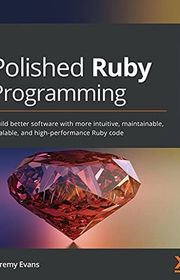
Polished Ruby Programming: Build better software with more intuitive, maintainable, scalable, and high-performance Ruby code
For experienced Ruby developers who want to examine design and implementation tradeoffs more closely. Its attention to maintainability and performance goes beyond introductory style advice, though its advanced material assumes confidence with Ruby's object model and core features.
What it's about
Jeremy Evans examines techniques for improving Ruby programs through clearer design, careful use of language features, and attention to performance. The book explores object models, abstractions, libraries, and implementation choices that affect software's maintainability and behavior.

For programmers who prefer solving a concrete task to following a course. The recipes explain both an approach and its rationale, though the Ruby 2.1 baseline requires checking APIs and libraries against your current environment.
What it's about
Lucas Carlson and Leonard Richardson provide more than three hundred fifty programming recipes revised for Ruby 2.1. Solutions range from data structures and objects to web development and concurrency, with explanations of how the code works and why it fits the problem.

For readers studying Ruby's earlier language design or maintaining legacy code. Its systematic explanation of the object model offers lasting conceptual value, though the coverage of Ruby 1.8 and 1.9 makes it unsuitable as a current reference.
What it's about
David Flanagan and Ruby creator Yukihiro Matsumoto explain Ruby versions 1.8 and 1.9. Starting with a language tour, they examine syntax, objects, methods, blocks, classes, and metaprogramming, with examples introducing the platform's core programming facilities.

For beginners who learn through visual explanations and frequent activities. Its varied presentation makes early programming concepts less abstract, though the busy layout and older Ruby examples may frustrate readers who prefer a concise modern reference.
What it's about
Jay McGavren teaches Ruby through hands-on activities and a visually rich learning format. The guide explores how the language handles programming details and supports concise code, using examples designed to help readers understand and practice new concepts.

For complete beginners who want a small project alongside basic programming lessons. Its flashcard-game progression gives new concepts an immediate use, though the limited scope calls for further practice and a broader language reference afterward.
What it's about
John Elder introduces Ruby programming from setting up a development environment to writing a math flashcard game. Lessons cover variables, conditionals, arrays, hashes, loops, and methods, with practice exercises that let beginners apply the concepts as they progress.

For readers who want a brief survey before committing to a longer course. Its compact coverage can establish basic vocabulary, though the title's time promise should not be confused with enough practice to become a capable programmer.
What it's about
Robert Dwight introduces Ruby through explanations and practical examples for beginning programmers. The guide covers installation, statements, variables, objects, classes, loops, methods, exceptions, and input and output, giving readers an initial route into writing programs with the language.

For programmers working with older Ruby who want a compact syntax reminder. Its quick-consult format is convenient beside code, though the Ruby 2.2 coverage cannot serve as a complete reference for current language features.
What it's about
Michael Fitzgerald provides a compact reference to Ruby 2.2 for programmers seeking syntax and method details. Entries cover operators, variables, regular expressions, classes, exception handling, and core methods, organizing frequently needed language information for quick consultation while coding.
Sources






Edited by
Software engineer whose passion for tracking book recommendations from podcasts inspired the creation of MRB.
Lead investor at 3one4 Capital whose startup expertise and love for books helped shape MRB and its growth.
Comments
Spotted a missing book, a wrong order or a mistake? Tell us and we'll fix this page.
We're a reading guide, not the author or publisher, so we can't send books or pass on messages.