
14 Best Quantum Mechanics Books
The best quantum mechanics books, ranked by expert source recommendations, with notes to help you choose popular explanations, mathematical courses, and advanced texts.
Our take
Quantum mechanics books can serve very different purposes. Popular accounts introduce unfamiliar phenomena and the questions they raise about reality. Textbooks teach the mathematical framework and calculations needed to solve physical problems. Neither route replaces the other, and a book described as introductory may still assume calculus, linear algebra, and earlier physics courses.
For a conceptual beginning, try QED, Beyond Weird, or How to Teach Quantum Physics to Your Dog. Something Deeply Hidden argues for many worlds, while Quantum Reality compares interpretations more critically. Susskind and Friedman’s Quantum Mechanics offers a bridge into mathematical reasoning. For university study, Griffiths’s Introduction to Quantum Mechanics emphasizes accessible problem solving, Shankar’s Principles of Quantum Mechanics develops a broader formal framework, and Zettili provides extensive worked practice. Modern Quantum Mechanics is better suited to a later course. The field-theory and quantum-gravity books require considerably more preparation. Start by deciding whether you want to understand the ideas, learn the calculations, or pursue a specialist question.
14 books · 10 sources · Last updated
As an Amazon Associate, we earn from qualifying purchases (at no extra cost to you).
How to choose from this list
Skip to the full rankingIf you want conceptual explanations: QED → Beyond Weird
If you are ready to work with equations: Quantum Mechanics (Susskind and Friedman)
If you want a university course: Introduction to Quantum Mechanics → Principles of Quantum Mechanics
If you want extensive worked practice: Quantum Mechanics (Zettili)
If you are ready for graduate study: Modern Quantum Mechanics
If you want to compare interpretations: Something Deeply Hidden → Quantum Reality
The 14 books, ranked
Ranked by how many expert sources name each book. Ties go to the book more people recommend.

Introduction to Quantum Mechanics
For undergraduates who want an approachable course built around examples and problem solving. The clear development makes standard applications manageable, though readers seeking deeper emphasis on formal foundations may want a second viewpoint alongside it.
What it's about
Griffiths and Schroeter develop quantum mechanics through explanations, examples and problems. This edition adds a treatment of symmetries, computational exercises and solid-state applications, alongside a consolidated discussion of potentials that change with time.

Principles of Quantum Mechanics
For readers who want mathematical foundations developed alongside the physical theory. The opening preparation and systematic framework support independent study, though the length and density require more patience than a compact introductory course.
What it's about
R. Shankar develops quantum mechanics from its mathematical foundations and physical postulates. Intended for advanced students, the textbook reviews classical mechanics and examines quantum theory through detailed derivations, exercises, and treatments of methods including path integrals.
Also recommended by
1 person Eric Weinstein recommended this book
Eric Weinstein
Eric Weinstein tweet about books that mattered enough to him.
Eric Weinstein's recommendation of this book
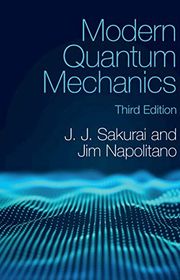
Modern Quantum Mechanics
For students who have completed an introductory course and want a graduate-level treatment emphasizing operators and symmetry. The connection with experimental questions gives the formalism purpose, though the problem difficulty and limited solutions favor guided study.
What it's about
Sakurai and Napolitano present quantum mechanics through state vectors, operators, dynamics, and symmetry. The graduate text develops angular momentum, approximation techniques, scattering, and related applications, connecting formal methods with experimental phenomena and providing problems for deeper study.

For students who learn by working through many examples and exercises. The extensive practice supports calculations more directly than conceptual popular books, though the substantial textbook format requires mathematical preparation and a sustained study plan.
What it's about
Zettili combines quantum-mechanical theory with worked examples and extensive practice problems. Topics progress from experimental foundations and mathematical tools to Schrödinger equations, angular momentum, identical particles, approximation methods and scattering, emphasizing applications alongside formal development.

For readers who want an accessible case for the many-worlds interpretation and its implications. Carroll makes an abstract position vivid, though the book advocates one interpretation rather than providing an evenly weighted survey of alternatives.
What it's about
Sean Carroll explains quantum mechanics and argues for the many-worlds interpretation as a way to understand its puzzles. He explores the implications for reality and considers how quantum foundations might illuminate gravity and the emergence of spacetime.
Also recommended by
2 people Joe Rogan recommended this book
Joe Rogan
"Really excellent and really perplexing at the same time." - Joe Rogan
Joe Rogan's recommendation of this book  Ezra Klein recommended this book
Ezra Klein
"Great if you like feeling very confused about the nature of reality, which I guess I do." - Ezra Klein
Ezra Klein's recommendation of this book

For readers ready to move from popular explanations into equations and the structure of quantum reasoning. The relatively compact development provides a useful bridge, though it expects mathematical engagement and is less comprehensive than a university textbook.
What it's about
Leonard Susskind and Art Friedman introduce quantum mechanics through its underlying ideas and mathematics. Developed for readers ready to work with equations, the book explains how physicists describe quantum systems and reason about their unfamiliar behavior.
Also recommended by
1 person- Eric Weinstein recommended this book
Eric Weinstein
Eric Weinstein tweet about books that mattered enough to him.
Eric Weinstein's recommendation of this book

For readers who want familiar quantum slogans questioned rather than repeated. The careful conceptual discussion helps distinguish a successful theory from claims about reality, though the information-centered framing is itself a particular interpretive perspective.
What it's about
Philip Ball examines what quantum physics implies about reality and why familiar explanations can be misleading. His accessible account explores the theory’s counterintuitive foundations, competing interpretations, and the challenge of connecting quantum principles with the everyday world we experience.

For curious readers who want light-matter interactions explained through visual reasoning. Feynman gives the unfamiliar rules an unusually concrete presentation, though the accessible account does not teach the calculations of a full electrodynamics course.
What it's about
Richard Feynman introduces quantum electrodynamics, the theory describing how light and matter interact. Using diagrams, visual reasoning, and everyday language, he explains its central ideas for readers without relying on advanced mathematics.
Also recommended by
1 person Larry Page recommended this book
Larry Page
Larry Page mentioned this book in an Entrepreneur.com article.
Larry Page's recommendation of this book

How to Teach Quantum Physics to Your Dog
For beginners who enjoy humor as a route into unfamiliar physical ideas. The conversations make questions easy to enter, though readers who dislike the dog-dialogue device or want mathematical development will prefer a different introduction.
What it's about
Chad Orzel introduces quantum physics through imagined conversations with his dog, Emmy. Her questions about chasing animals and finding treats provide humorous starting points for explaining tunneling, teleportation, and other quantum ideas, including the limits of applying them to everyday life.

For readers who want competing interpretations considered alongside the history and philosophy of the subject. The critical comparisons help clarify where explanation becomes speculation, though the conceptual density demands more attention than a light popular introduction.
What it's about
Baggott examines competing interpretations of quantum mechanics and the philosophical questions behind them. Following the theory's historical development, he asks what its mathematical successes reveal about reality and where scientific explanations meet speculative interpretation.

For general readers who want an energetic tour connecting quantum ideas with particle physics and discovery stories. The limited mathematical demands make it approachable, though the broad scope leaves less room for careful development of individual concepts.
What it's about
Tim James introduces quantum and particle physics without relying on complex mathematics. Alongside explanations of quantum phenomena and field theory, he recounts stories of the scientists behind the discoveries and explores how their work led to modern particle physics.

Quantum Field Theory and the Standard Model
For readers with substantial physics preparation who want to continue toward relativistic fields and particle theory. The connection between calculations and physical applications is valuable, though this is advanced follow-on study rather than a first quantum-mechanics course.
What it's about
Beginning with radiation and relativistic fields, Schwartz builds the tools of quantum electrodynamics and renormalization before developing the Standard Model. Advanced discussions extend the framework to effective theories, heavy-quark physics and jets.

For mathematically prepared students who prefer a concise course spanning several formulations and applications. The breadth makes it useful for revisiting topics, though the compressed explanations offer less hand-holding than an example-heavy introductory textbook.
What it's about
Bes presents quantum mechanics through wave functions, spin and the relationship between different formulations of the theory. The course extends to density matrices, path integrals and quantum information, including entanglement, decoherence and cryptography.

For advanced readers interested specifically in the tension between time in quantum mechanics and general relativity. Its research-level focus allows detailed comparison of approaches, though extensive background is needed and it is unsuitable as a general introduction.
What it's about
Anderson investigates the conflicting roles of time in quantum mechanics and general relativity. Comparing several physical frameworks, he organizes the problem's different facets and explores background independence and possible approaches within quantum gravity.
Sources
- 1
The 12 Best Quantum Mechanics Books for All Levels
celsiuselements.com
- 2
Quantum Mechanics
plato.stanford.edu
- 3
Books I Like
u.osu.edu
- 4
100 Best Quantum Mechanics Books of All Time
shortform.com
- 5
5 Best Books To Study Quantum Mechanics
piggsboson.medium.com
- 6
Quantum Mechanics Books
goodreads.com
- 7
What is the best book to study quantum mechanics as a student?
reddit.com
- 8
Advice request on Quantum Mechanics book
reddit.com
- 9
From Universe to Multiverse: 10 Best Books on Quantum Mechanics
interestingengineering.com
- 10
Foundations of quantum mechanics: what to read
hanshalvorson.com






Edited by
Software engineer whose passion for tracking book recommendations from podcasts inspired the creation of MRB.
Lead investor at 3one4 Capital whose startup expertise and love for books helped shape MRB and its growth.
Comments
Did we miss something? Have feedback?
Help us improve this page by sharing your thoughts