
11 Best Quantum Computing Books
The best quantum computing books, ranked by how many expert sources recommend each one, with notes on reader fit, maths, programming, and where to start.
Our take
Quantum computing books explain both a different way of representing information and the operations that make it useful. Some approach the subject through its history and central ideas. Others develop vectors, matrices, circuits, and algorithms in detail, or use programs to make those concepts concrete. The right entry point depends on your mathematical confidence and whether your immediate aim is understanding, coding, or formal study.
Quantum Computing for Everyone builds understanding through accessible mathematics, while Computing with Quantum Cats takes a more narrative route. Programmers can explore Programming Quantum Computers, keeping in mind that software examples age faster than the underlying ideas. Quantum Computing for Computer Scientists and Mermin's Quantum Computer Science offer structured routes from a computing background. Quantum Computation and Quantum Information supplies a much larger reference, and Quantum Computing since Democritus ranges into complexity and philosophy. Start with a book that matches how you learn, then move toward the mathematical detail your next questions require.
11 books · 7 sources · Last updated
As an Amazon Associate, we earn from qualifying purchases (at no extra cost to you).
How to choose from this list
Skip to the full rankingIf you're new and willing to learn some mathematics: Quantum Computing for Everyone
If you prefer history and concepts: Computing with Quantum Cats
If you want to experiment with code: Programming Quantum Computers
If you have a computer-science background: Quantum Computer Science → Quantum Computation and Quantum Information
If you want mathematics developed alongside the concepts: Dancing with Qubits
If you enjoy complexity and philosophical questions: Quantum Computing since Democritus
The 11 books, ranked
Ranked by how many expert sources name each book. Ties go to the book more people recommend.

Quantum Computation and Quantum Information
For students ready for a comprehensive mathematical foundation and a lasting reference. Its scope connects algorithms, communication, noise, and error correction, though the density and exercise demands make it a major commitment for independent beginners.
What it's about
Michael Nielsen and Isaac Chuang introduce the mathematical, physical, and computational foundations of quantum information. Their textbook develops quantum algorithms and communication methods, then examines noise and the techniques used to protect quantum states through error correction.

Quantum Computing for Everyone
For newcomers willing to work through accessible mathematical explanations rather than only analogies. Its gradual development makes key ideas intelligible, though readers seeking a completely equation-free overview or a programming manual should choose another approach.
What it's about
Chris Bernhardt introduces quantum computing for readers comfortable with high school mathematics. Stepwise explanations develop the ideas behind qubits, entanglement, and quantum teleportation, showing how quantum physics changes the ways information can be represented and processed.
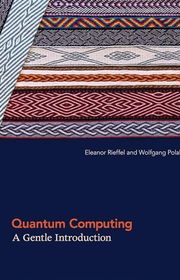
Quantum Computing: A Gentle Introduction
For readers who want a systematic first mathematical course with concepts built in sequence. Its measured development bridges computing and quantum formalism, though the word gentle does not mean the subject can be learned without exercises.
What it's about
Eleanor Rieffel and Wolfgang Polak develop quantum computing from basic mathematical and computational ideas. Explanations of quantum states, operations, circuits, and algorithms build toward information processing, giving readers a structured foundation for understanding how quantum computation differs from classical computation.

Quantum Computing since Democritus
For readers comfortable with abstract ideas who want computation connected with physics and philosophy. Aaronson makes conceptual limits the central attraction, though the conversational style does not remove the mathematical and complexity-theory demands.
What it's about
Scott Aaronson explores computation through mathematics, quantum physics, and philosophical questions about knowledge and reality. Moving from classical computational limits to quantum theory and complexity, he asks what problems machines can solve and what remains beyond them.
Also recommended by
1 person Patrick Collison recommended this book
Patrick Collison
Patrick Collison labeled this book "substantially above average."
Patrick Collison's recommendation of this book

For readers willing to build the mathematics alongside the computing concepts. Its extended development offers more scaffolding than a terse reference, though the substantial length requires patience and sustained practice with unfamiliar notation.
What it's about
Robert Sutor builds an explanation of quantum computing from classical computing and the mathematics it requires. Chapters introduce superposition, entanglement, interference, circuits, and algorithms, then survey the physical and engineering ideas behind constructing quantum computing hardware.

For programmers who learn best by working through operations and algorithms in code. Its concrete examples help turn unfamiliar ideas into experiments, though software tools and execution environments may need updating as quantum platforms change.
What it's about
Eric Johnston and his coauthors introduce quantum programming through worked examples and code. The guide emphasizes building practical intuition for quantum operations and algorithms, showing software developers how to translate unfamiliar computing principles into programs and applications.
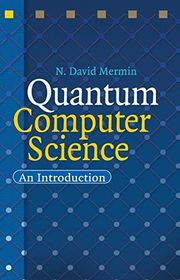
Quantum Computer Science: An Introduction
For computer-science readers who want a focused introduction without a full physics course first. Its economical development keeps attention on computation and circuits, though the concise mathematical presentation still requires careful work with vectors and operators.
What it's about
N. David Mermin introduces quantum computing through the mathematical machinery needed to describe qubits, gates, and circuits. The text develops quantum algorithms and related information concepts, emphasizing computational reasoning rather than a broad course in physical theory.

For technically minded readers who want foundations, code, and mathematical reference in one volume. Its breadth supports moving between theory and application, though the pace and changing software ecosystem make it demanding as a first introduction.
What it's about
Jack Hidary combines quantum computing foundations with worked code examples and a mathematical reference. Sections explain qubits and circuits, explore major algorithms and programming methods, and develop the tools needed to follow the theory behind practical quantum programs.

Quantum Computing for Computer Scientists
For computer-science students who want quantum ideas developed through familiar computational reasoning. Worked examples and exercises make the approach teachable, though comfort with mathematical abstraction matters more than programming experience alone.
What it's about
Noson Yanofsky and Mirco Mannucci introduce quantum computing using ideas familiar to computer science students. Mathematical explanations, worked examples, exercises, and programming drills develop the foundations needed to understand quantum systems, circuits, algorithms, and computational models.

For readers who prefer a historical and conceptual route into unfamiliar technology. Its connections between computing and quantum ideas provide context, though the narrative approach supplies less mathematical practice than the course texts here.
What it's about
John Gribbin traces the development of quantum computing from early computing and quantum theory to qubits. He explores the ideas behind these machines, including interpretations of quantum mechanics, and considers their potential practical applications.

Quantum Computing for Babies
For adults sharing an early science picture book with very young children. Its bold visual contrasts introduce basic vocabulary, though the deliberately simplified format offers no preparation for the mathematics or programming of quantum computing.
What it's about
Chris Ferrie and Whurley introduce quantum computing through simple language and bold illustrations for very young children. The book contrasts ordinary bits with qubits, offering an early encounter with ideas that distinguish quantum computers from familiar machines.
Sources
- 1
The Best Quantum Computing Books
fivebooks.com
- 2
Best Quantum Computing Books for Everyone
amarchenkova.com
- 3
Quantum Computing Books
goodreads.com
- 4
What books do you recommend reading to build a solid, in-depth understanding of how a quantum computer works?
reddit.com
- 5
Quantum Computing Resources
futurelearn.com
- 6
Quantum Books 2026, New And Essential Quantum Computing Books
quantumzeitgeist.com
- 7
Top Quantum Computing Books Worth Reading in 2026
thequantuminsider.com








Edited by
Software engineer whose passion for tracking book recommendations from podcasts inspired the creation of MRB.
Lead investor at 3one4 Capital whose startup expertise and love for books helped shape MRB and its growth.
Comments
Spotted a missing book, a wrong order or a mistake? Tell us and we'll fix this page.
We're a reading guide, not the author or publisher, so we can't send books or pass on messages.